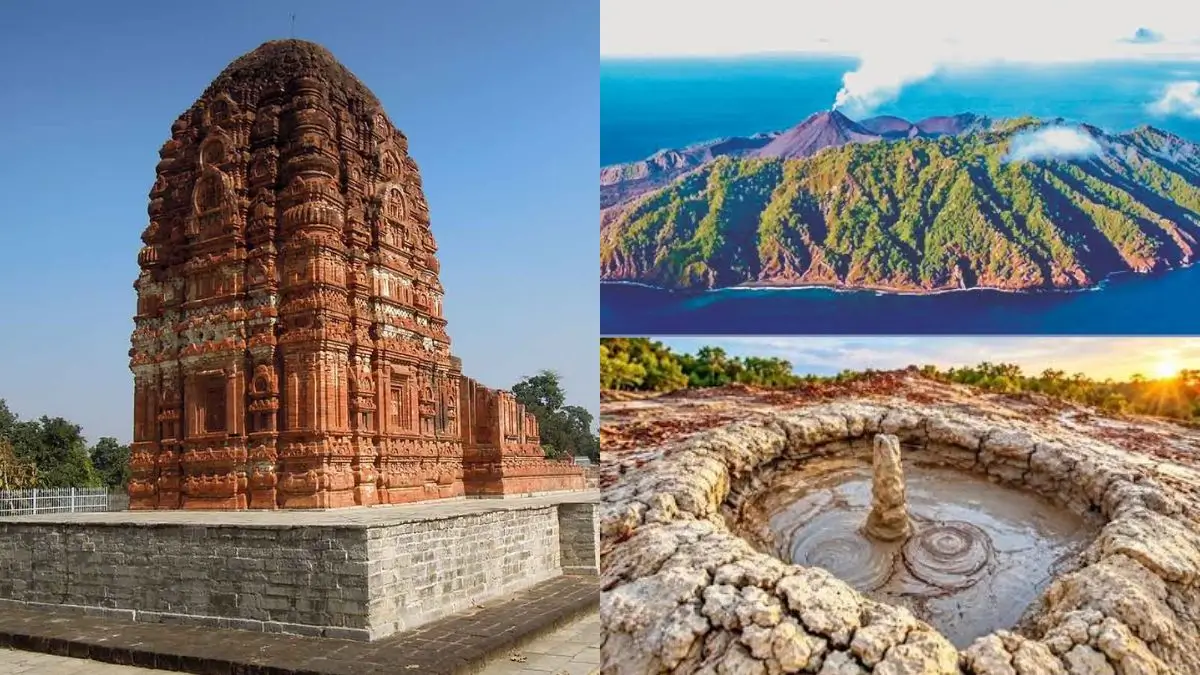
Three new sites have been added to India’s Tentative List by UNESCO’s World Heritage Centre, marking an essential step toward formal nomination for World Heritage status. As per the latest press release issued by the Permanent Delegation of India to the UNESCO, the newly included sites cover key geological and archaeological landscapes, namely the Karst-mud-volcano Complex of Baratang and Andaman Subduction Volcanoes in Andaman & Nicobar Islands and the Sirpur Cultural and Archaeological Landscape in Chhattisgarh.
Which Are The Three Properties That Have Been Listed In The Tentative List Of UNESCO?
The three properties have been proposed by the Permanent Delegation of India to UNESCO on September 28, 2026. As per UNESCO, the first two properties are natural properties while the third is cultural property.
| Property | State/Union Territory | Type | Significance |
| Karst-Mud-Volcano Complex of Baratang | Andaman and Nicobar Islands | Natural | Limestone Caves, Karst features & Mud Volcanoes |
| Andaman Subduction Volcanoes | Andaman and Nicobar Islands | Natural | Volcanic geological formations, Tectonic processes & Biodiversity |
| Sirpur Cultural and Archaeological Landscape | Chhattisgarh | Cultural | Archaeological site, Historic Trade Routes & Multi-faith heritage landscape |
1. Baratang Mud-Karst-Volcano Complex
The island of Baratang is one of the islands of Andaman and Nicobar group of islands in Bay of Bengal. It is nominated as a heritage site due to its limestone caves, karst formations, and mud volcanoes.
The limestone caves were created by means of the dissolution of soluble rocks by water. The landscape includes such elements as fissures, underground caves and speleothems – mineral deposits in the form of stalactites and stalagmites.
The mud volcanoes on Baratang, which are called “Jalki” locally, are not typical of volcanic formations as they expel mud, water and gas, not lava. The phenomenon is related to the presence of compressed underground sediments and seismic processes. According to the nomination document by UNESCO, the mud volcanoes have become active once more in 2025 after 20 years of inactivity.
2. Andaman Subduction Volcanoes
The proposed site for the Andaman Subduction Volcanoes property is Barren Island and Narcondam Island, which are two volcanic islands located in the Andaman Sea. They serve as a representation of volcanic activity in connection with the subduction of the Indian Plate under the Burma microplate.
Even though they both belong to the same volcanic arc, there are some differences between the two islands,
- Barren Island: Characterized by its active volcano, basaltic and basaltic-andesite lava, and a caldera due to the collapse of an older volcanic edifice.
- Narcondam Island: Known for its unique volcanic geology and its rich biodiversity. Narcondam Island is known to be an Important Bird Area and Key Biodiversity Area as well.
This property proposal is concerned about the land mass of both of these islands.
3. Sirpur Cultural and Archaeological Landscape
Sirpur is situated in Mahasamund District of Chhattisgarh, near the eastern banks of Mahanadi River and about 78 kilometres away from Raipur. This historic site has evidence of ancient trade and urbanisation activities along with inter-religious interactions.
Some of the historic monuments found here belong to various religions, such as Hindus and Buddhists, and show the links between commerce, religion and growth of settlements. Sirpur’s location is also an indicator that the culture of this historic place is related to the natural surroundings.
The nomination document submitted by UNESCO states that Sirpur lies in the Proterozoic Chhattisgarh Basin and also mentions the geology of stromatolites, which are laminated sediments created due to activities of microorganisms, like cyanobacteria. This property can be categorized as cultural since it holds archaeological importance.
What Is the World Heritage Tentative List of UNESCO?
Tentative List is a list of cultural or natural properties that a country considers eligible for nomination to the UNESCO World Heritage List. Listing on this list is a compulsory preliminary stage, although this does not imply that the property is already a World Heritage.
In general, the procedure looks like this,
- 1. Tentative List – Identification by the country of properties that have potential Outstanding Universal Value.
- 2. Nomination – submission of a nomination dossier by the country.
- 3. Evaluation – evaluation of the nomination.
- 4. Inscription – decision by the World Heritage Committee about inscription of the property into the World Heritage List.
The Tentative List may be updated by the country as new properties are identified. There are 81 properties listed for India according to UNESCO.






 PM-VBRY Scheme: EPFO Offers Up to ₹15,...
 Global Hunger Index 2026: India Ranks 10...
 Sudhakar Dalela Appointed as India’s N...