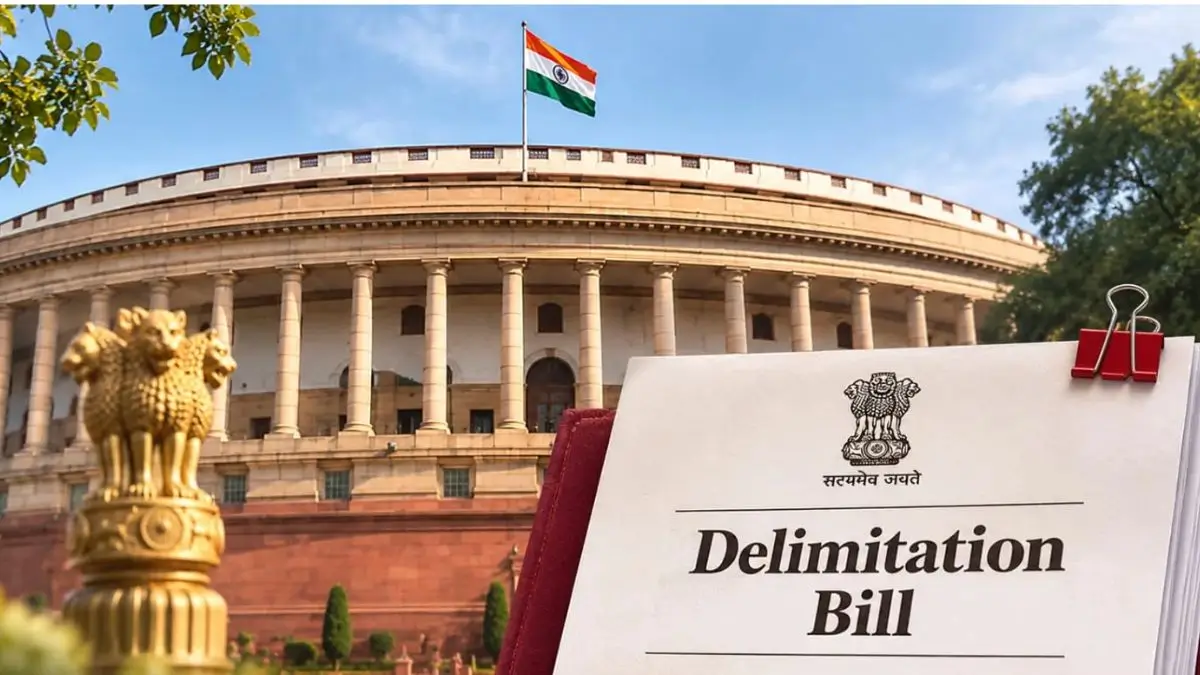
The Union Cabinet, chaired by Prime Minister Narendra Modi, approved a fresh delimitation-linked Women’s Reservation Constitution Amendment Bill on 27 November 2026. Union Government has notified the Constitution (One Hundred and Thirty-Second Amendment) Bill, 2026. The bill proposes to amend the India’s electoral system by increasing the total seats in the both Lok Sabha and State Assemblies by 50%.
The bill also aims to raise the upper limit of Lok Sabha membership to 850 and that of State Assemblies to 650 members. Further it aims to enable 33% reservation for women and continue the current pattern of inter-state allocation of seats till 2051. It will be presented in the Lok Sabha on 30th November, 2026.
Key Highlights of the Draft Delimitation Proposal 2026
| Particulars | Proposed Changes |
| Constitutional Amendment | Constitution (132nd Amendment) Bill, 2026 |
| Proposed Lok Sabha Maximum Strength | 850 |
| Seats from States | Up to 815 |
| Seats from Union Territories | Up to 35 |
| Maximum Strength of State Assemblies | 650 |
| Increase in Seats | 50% for each State and Union Territory |
| Women’s Reservation | 33% |
| Proposed Delimitation Freeze | Until 2051 |
| Scheduled Introduction | 30 November 2026 |
| Related Legislation | Delimitation (Second) Bill, 2026 |
What Is Delimitation?
Delimitation refers to the process of fixing or redrawing the boundaries of the territorial constituencies and determining the allocation of seats in the elected legislative bodies.
The main objective of the delimitation is to ensure fair representation by adjusting constituencies according to population changes and constitutional provisions.
In India, delimitation applies to the,
- Lok Sabha constituencies.
- State Legislative Assembly constituencies.
- Reserved constituencies for Scheduled Castes (SCs) and Scheduled Tribes (STs).
A Delimitation Commission is constituted to conduct the exercise. Its orders have the force of law and cannot be questioned in court, as provided under Article 329(a) of the Constitution.
Major Proposals Under the Constitution (132nd Amendment) Bill, 2026
1. 50% Increase in the Lok Sabha and State Assembly Seats
- The draft proposes increasing the number of seats allocated to the every State and Union Territory in the Lok Sabha by 50% over its existing strength.
- The same 50% increase is proposed for the total number of seats in the Legislative Assemblies of States and Union Territories.
- This uniform increase is intended to expand representation while maintaining the existing relative distribution of seats among States.
2. Lok Sabha Maximum Strength to Increase to 850
The Bill proposes amending Article 81 of the Constitution to increase the maximum permitted strength of the Lok Sabha.
| Category | Existing Constitutional Limit | Proposed Limit |
| Members representing States | 530 | 815 |
| Members representing Union Territories | 20 | 35 |
| Total Maximum Strength | 550 | 850 |
The proposed maximum strength of the Lok Sabha will therefore increase from 550 to 850 members.
3. State Assembly Strength to Increase to 650
- The draft also proposes to amending Article 170 to increase the maximum strength of the State Legislative Assembly from 500 to 650 members.
- This change would accommodate the proposed 50% expansion in Assembly seats.
4. Delimitation Freeze Until 2051
- The proposal seeks to maintain the allocation of Lok Sabha seats among States until the relevant figures of the first Census conducted after 2051 are published.
- It also proposes changes to the framework governing the allocation and readjustment of State Assembly seats.
- The purpose of this arrangement is to maintain the existing relative distribution of representation among States for the proposed period.
5. Delimitation Linked to Women’s Reservation
- The draft Bill connects the delimitation exercise with the implementation of 33% reservation for women in the Lok Sabha and State Legislative Assemblies.
- It proposes amending Article 334A, which was inserted through the Constitution (106th Amendment) Act, 2023, popularly known as the Nari Shakti Vandan Adhiniyam.
Under the draft,
- One-third of seats will be reserved for women in the Lok Sabha and covered State and Union Territory Legislative Assemblies.
- The reservation will take effect after the first delimitation exercise conducted following the commencement of the proposed amendment.
- The seats reserved for women will be allotted by rotation.
- The reservation is proposed to continue for 15 years from the commencement of the 106th Constitutional Amendment Act, 2023, unless Parliament extends it by law.
Which Constitutional Articles Are Proposed to Be Amended?
The Constitution (132nd Amendment) Bill, 2026 proposes the changes to several constitutional provisions related to electoral representation and delimitation.
| Constitutional Article | Subject |
| Article 54 | Election of the President |
| Article 55 | Manner of election of the President |
| Article 81 | Composition of the Lok Sabha |
| Article 82 | Readjustment after each Census |
| Article 170 | Composition of State Legislative Assemblies |
| Article 330 | Reservation of seats for SCs and STs in the Lok Sabha |
| Article 332 | Reservation of seats for SCs and STs in State Legislative Assemblies |
| Article 334A | Reservation of seats for women |
Background: Why Is a New Delimitation Bill Being Introduced?
The latest proposal follows the defeat of the Constitution (131st Amendment) Bill, 2026, in the Lok Sabha in April 2026.
The earlier proposal sought to increase the maximum strength of the Lok Sabha to 850 and facilitate delimitation. However, it did not contain a written provision guaranteeing a uniform 50% increase in seats for every State and Union Territory.
The Bill failed to secure the special majority required under Article 368 of the Constitution.
The government has now introduced a revised constitutional amendment proposal along with a fresh Delimitation (Second) Bill, 2026. The revised framework explicitly includes the 50% increase in seats, addressing concerns about the possible impact of delimitation on the representation of different States.
What Is the Delimitation Commission?
The Delimitation Commission is a high-powered statutory body responsible for conducting delimitation exercises in India.
Its key functions include,
- Determining the allocation of seats in the Lok Sabha and State Legislative Assemblies.
- Redrawing territorial constituency boundaries.
- Adjusting constituencies reserved for SCs and STs.
- Implementing the reservation of seats for women through the proposed framework.
The fresh Delimitation (Second) Bill proposes that the Central Government constitute the Commission after the commencement of the proposed legislation. It also provides for the allocation of seats reserved for women by rotation.







 India’s First Chief Justices of India ...
 Dr Virendra Kumar to Launch SAMAVESH and...
 PANI Project: Centre Proposes Undersea F...