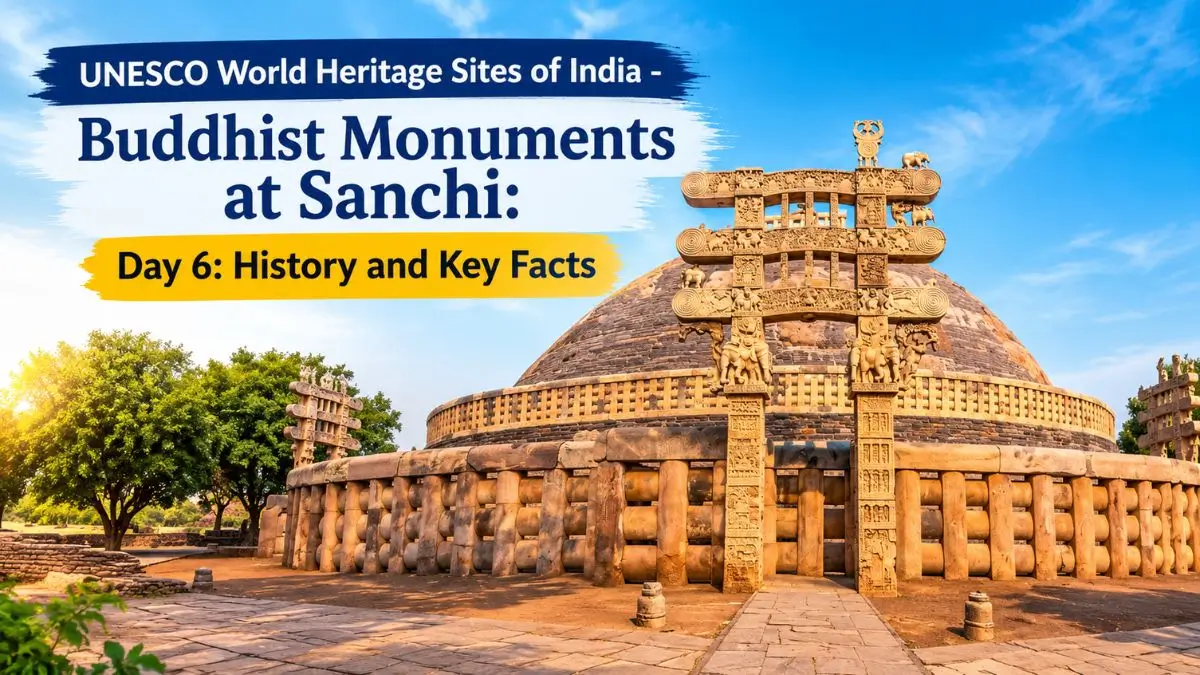
Buddhist Monuments at Sanchi, found in Madhya Pradesh, are one of the earliest examples of Buddhist architecture in India. This monument comprises stupas, monasteries, temples, pillars, and elaborately carved gateways. It depicts the evolution of Buddhist art and architecture from 3rd century BC to 12th century AD. The earliest monuments were built by Emperor Ashoka during the Maurya period. Understanding its historical and cultural importance, the Buddhist Monuments at Sanchi have been designated as a UNESCO World Heritage Site since 1989.
Key Information about Buddhist Monuments at Sanchi
- Name of Monument: Buddhist Monuments at Sanchi
- Location: Sanchi, Madhya Pradesh, India
- UNESCO listed: 1989
- UNESCO Criteria: Criteria (i), (ii), (iii), (iv) and (vi)
- Historical Period: 3rd Century BCE – 12th Century CE
- Ruler Empero:r Ashoka
- Key Monument: Great Stupa (Stupa 1)
- Religion: Buddhism
- Key Structures: Stupas, Viharas, Temples and Pillars
- Conservators of Venue: Archaeological Survey of India (ASI)
Where Are the Buddhist Monuments at Sanchi Located?
The monuments are located on a hillside within the town of Sanchi in the Raisen district of Madhya Pradesh. The site is around 40km from the state capital city of Bhopal and around 10km from the historic town of Vidisha.
The monuments are located on a forested plateau offering great views over the surrounding area. Sanchi is an incredibly important Buddhist destination in India due to its historical buildings, location and connection to Emperor Ashoka.
History of Buddhist Monuments at Sanchi
As far back as the 3rd Century BCE, Sanchi became an important religious site for Buddhists under the rule of Mauryan Emperor Ashoka. He converted to Buddhism and therefore promoted the spread of the religion. He created many Buddhist monuments throughout the Indian subcontinent.
Ashoka built the initial Stupa made out of bricks as well as a single stone pillar called the Ashoka Pillar. Sanchi developed further under various ruling dynasties.
| Dynasty | Contributions |
| Mauryan | Built initial Stupa and the Ashoka Pillar. |
| Shunga | Expanded Great Stupa and added stone structures. |
| Satavahana | Added intricate carvings onto 4 gateways. |
| Kushana | Developed further Buddhist religious structures. |
| Gupta | Built Shrines and Temples. Built 4 shrines around the Great Stupa. |
Sanchi became an extremely important Buddhist destination over the course of many centuries. The monuments give insight into how the art and religion evolved in Indian Buddhism.
The Great Stupa (Stupa 1)
The Great Stupa which is also known as Stupa 1, is the most famous monument at Sanchi. It was initially built by Emperor Ashoka during the 3rd Century BCE. It was expanded during the Shunga period and embellished with intricate gateways during the Satavahana period.
It is a classic example of early Indian Buddhist architecture. The main features of the architecture are,
- Anda – The dome-shaped structure representing the mound containing the sacred relics.
- Harmika – Square structure placed on top of the dome.
- Yashti – Pillar running through the centre of the harmika.
- Chhatra – Disc-shaped items on top of the pillar representing honour and spiritual power.
- Medhi – Raised circular platform around the dome.
- Pradakshina Patha – Pathway around the dome for followers to walk around.
- Vedika – Stone barrier around the stupa.
- Torana – Intricate gateways.
The Great Stupa has 4 gateways which are extremely famous for the intricate carvings depicting stories from the life of Buddha, Jataka stories, symbols and scenes from ancient Indian life.
Four Gateways of the Great Stupa
There are 4 gateways (toranas) to the Great Stupa.
The gateways have intricate carvings depicting stories from Buddhism, symbols, animals, plants, royal processions and everyday life. They are some of the best examples of early Indian stone carving.
They were added during the Satavahana period between the 1st Century BCE and 1st Century CE.
Aniconic Art at Sanchi
An important feature of the Buddhist Monuments at Sanchi is the development of Aniconic Art.
During the early stages of Buddhist art, Buddha was often depicted using symbols. Some important symbols shown within the sculptures of Sanchi are:
| Symbol | Meaning |
| Bodhi | Tree Enlightenment of Buddha |
| Empty Throne | Presence and spiritual power of Buddha. |
| Dharma Chakra | Teachings of Buddha and wheel of law. |
| Footprints of Buddha | Presence and teachings of Buddha. |
| Stupa | Relics and remembrance of Buddha. |
| Horse | Great Renunciation of Buddha. |
The sculptures also depict Jataka stories telling the past lives of Buddha and scenes from the lives of people in Ancient India.
Other Important Monuments
Alongside the Great Stupa, there are many other important structures.
Stupa 2 – Located on the west side of the hill there is another stupa. This one is famous for having intricately carved stone barriers and ornate medallions. The sculptures show animals, flowers and Buddhist symbols.
Stupa 3 – This stupa is very important as it contained the remains of 2 of Buddha’s main disciples, Sariputra and Maudgalyayana. Their relics have been an important part of Buddhist worship.
Ashoka Pillar – A single stone pillar built during Emperor Ashoka’s reign. The capital has influences of Achaemenid Persian art.
Buddhist Temples and Viharas – There are temples, monasteries and dwellings showing the development of Buddhist religious architecture.
Relics of Sariputra and Maudgalyayana
The Buddhist Monuments at Sanchi are also important as they are connected to 2 of the most important disciples of Gautama Buddha.
The remains of Sariputra and Maudgalyayana were in the reliquary of Stupa 3. These were historically highly respected by Buddhists.
This adds religious importance to the site.
UNESCO World Heritage Site – Why is Sanchi Important?
The Buddhist Monuments at Sanchi were added to the UNESCO World Heritage List in 1989. They were added using the following criteria:
| Criteria | Reason |
| (i) | Great Stupa and gateways are an outstanding example of art. |
| (ii) | Shows the interaction and evolution of art and culture during different Indian Dynasties. |
| (iii) | Offers outstanding evidence of Buddhism being an important religion in Ancient India. |
| (iv) | Stupas are an accomplished example of Buddhist religious architecture. |
| (vi) | Directly related to Buddhist beliefs, culture and worship of relics. |
The site is an outstanding example of early Buddhist architecture and shows important evidence of how Buddhist art developed in India.
Conservation of Sanchi
The Buddhist Monuments at Sanchi are conserved and managed by the Archaeological Survey of India (ASI). This is part of the Ministry of Culture and the Government of India.
The site is protected by the Ancient Monuments and Archaeological Sites and Remains Act, 1958, including rules and any amendments.
All structures, including stupas, pillars, temples, monasteries, gateways and the archaeological sites, are conserved. It is important to manage the surrounding area to protect the historical context of the site.








 Which Is the Tallest Statue in the World...
 Why Kashmir’s Chinar Trees Turn Red Ev...
 Do You Know? This Maharashtra Village Pr...