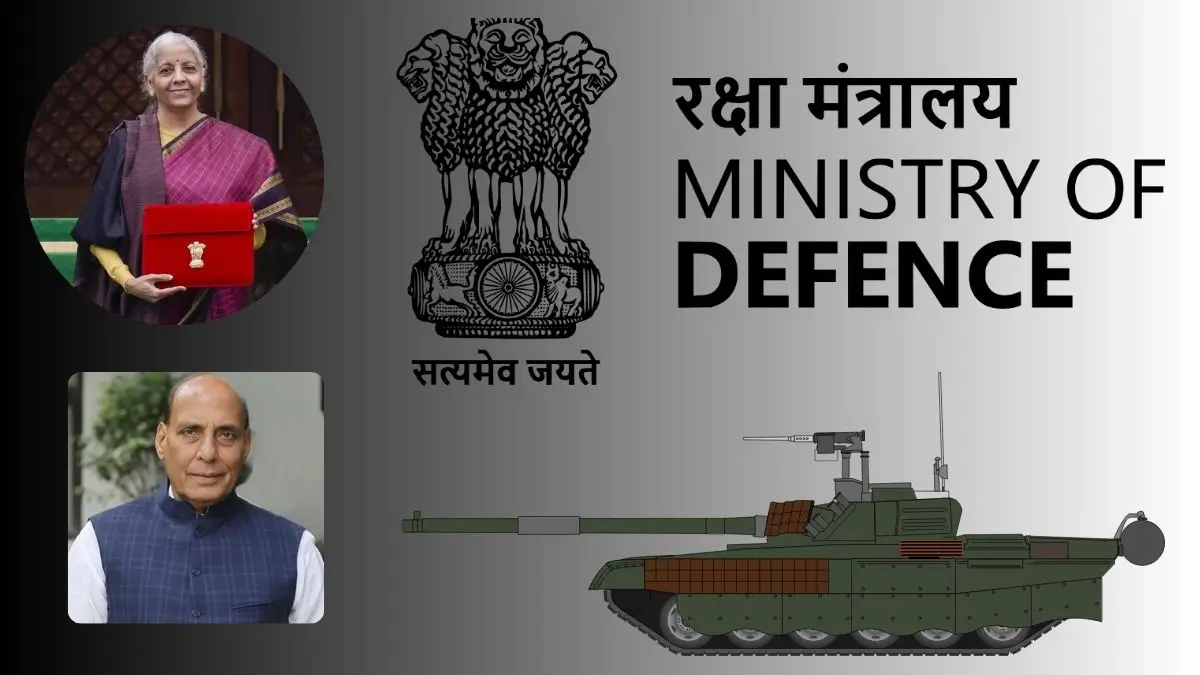
The Union Budget 2026 has delivered one of the strongest signals yet of India’s changing security priorities. Just a year after a major military confrontation with Pakistan, the government has raised defense spending by 15.3% to ₹7.84 lakh crore. Presented in Parliament, the Budget reflects lessons from recent conflict, growing geopolitical uncertainty, and the push for self-reliant defense manufacturing. With higher capital outlay, customs duty relief and procurement reforms, defense has emerged as a central pillar of India’s strategic and economic planning.
Defense Budget at a Glance
- For FY 2026-27, the Ministry of Defense has been allocated ₹7.84 lakh crore, up from ₹6.81 lakh crore last year.
- This marks a 15.3% increase, one of the highest annual jumps in recent years.
- Of this, ₹3.65 lakh crore is for defence services revenue, ₹2.19 lakh crore for capital outlay, and ₹1.71 lakh crore for pensions.
- Capital expenditure alone rose by 21.8%, signalling a clear focus on modernisation, new platforms and equipment acquisition.
Capital Outlay and Combat Readiness
- The sharp rise in capital outlay reflects urgency after recent operational deployments.
- Funds will support acquisition of artillery systems, drones, surveillance platforms, electronic warfare tools and advanced weapons systems.
- The experience of coordinated deployment of indigenous equipment during recent operations highlighted both strengths and gaps.
- Budget 2026 aims to close these gaps by prioritising Indian-designed and Indian-built systems, ensuring faster availability and reduced dependence on imports during crises.
Make in India and Aatmanirbharta in Defence
- The Budget reinforces the government’s defence industrial policy under the leadership of Narendra Modi and Defense Minister Rajnath Singh.
- Indigenous defence production reached ₹1.26 lakh crore in 2024, while exports crossed ₹21,000 crore.
- Over 65% of defence equipment is now manufactured domestically.
- Customs duty exemptions on aircraft components and MRO raw materials further support the defence aerospace ecosystem, linking military readiness with industrial growth.
Defense Manufacturing Ecosystem: Progress and Gaps
- India’s defense manufacturing ecosystem has expanded rapidly, supported by Defence Industrial Corridors in Uttar Pradesh and Tamil Nadu, attracting investments of over ₹9,100 crore.
- Nearly 788 industrial licences have been issued to more than 460 companies.
- While defence PSUs still account for 77% of production, private sector participation is gradually increasing.
Procurement Reforms and Policy Push
- Budget 2026 builds on reforms like the Defence Acquisition Procedure (DAP) 2020 and Defence Procurement Manual (DPM) 2025.
- These frameworks aim to simplify procurement, reduce delays and prioritise Indian-designed, developed and manufactured (IDDM) systems.
- Faster acquisition cycles improve combat readiness while giving industry predictable demand.
- This policy angle is important for questions linking defence reforms with economic policy.
Exports, Strategy and Regional Security
- India’s defence exports reached ₹23,622 crore in FY 2024-25, a dramatic rise from under ₹1,000 crore a decade ago.
- Export growth strengthens diplomacy, offsets costs, and improves economies of scale.
- Post-conflict realities have reinforced the importance of reliable domestic supply chains during emergencies.
- Budget 2026 reflects a strategic shift where defence spending is no longer just expenditure, but also industrial investment and geopolitical signalling.
Question
Q. What is India’s total defense allocation in Budget 2026-27?
A. ₹6.81 lakh crore
B. ₹7.25 lakh crore
C. ₹7.84 lakh crore
D. ₹8.10 lakh cror


 Indian Navy INS Aridaman: Features, Role...
 INS Taragiri Commissioned - What Makes T...
 India's Defense Exports Hit Record ₹38,4...