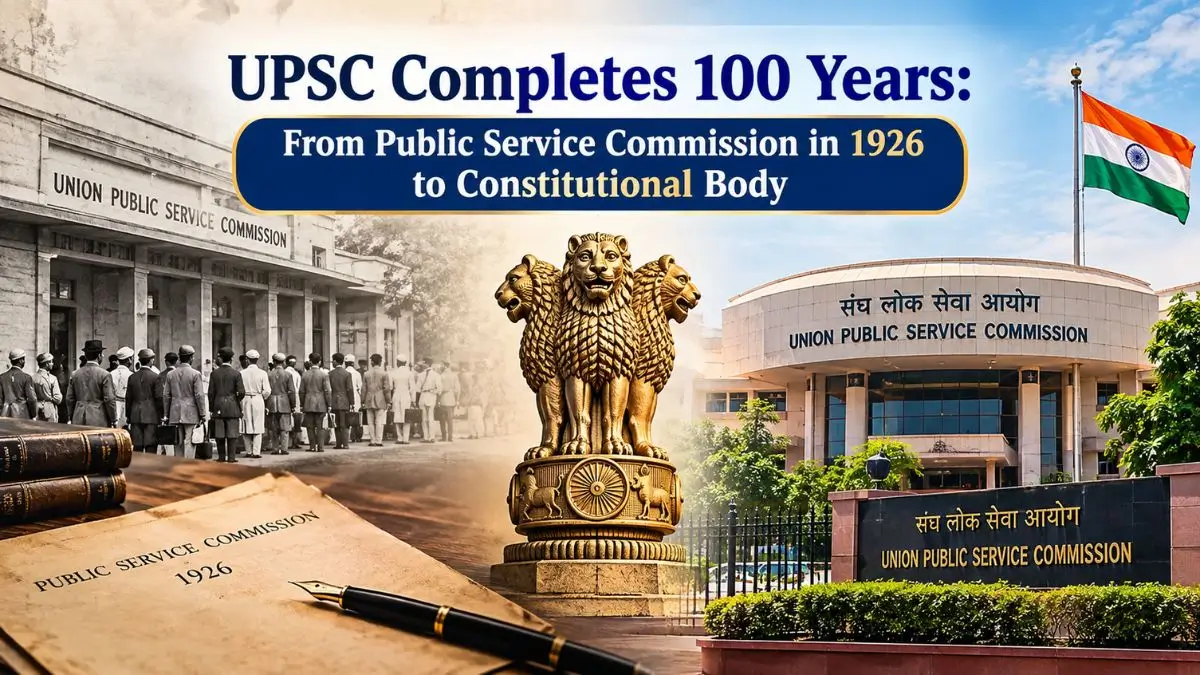
The Union Public Service Commission will complete its 100th year in India on 1 October 2026, which will be a century of the establishment of the first Indian Public Service Commission in 1926. The organization started off as an advisory commission through the Government of India Act, 1919 structure and developed into the Federal Public Service Commission and finally became the UPSC after the implementation of the Constitution in 1950. Currently, the organization is a constitutional body with powers from Articles 315 to 323.
From the 1926 Public Service Commission to UPSC
The beginning of the merit system for recruiting members of the civil service in India can be traced back to the ICS (Indian Civil Service) examination of 1855 that replaced nomination with open competitive selection process. The examinations used to take place in London, causing great difficulties for Indians to participate in them.
Under the provisions of the Government of India Act of 1919, a Public Service Commission was to be established. A report was prepared by the Lee Commission, headed by Lord Lee, to establish a Public Service Commission in 1924. As a result, the first Public Service Commission was established on 1 October 1926, consisting of the Chairman Sir Ross Barker and Four Members.
The Government of India Act of 1935 made provisions for a Federal Public Service Commission and Provincial Public Service Commissions. The Federal Public Service Commission started operating in 1937. After India gained independence, it became the Union Public Service Commission on 26 January 1950, obtaining constitutional status under the Constitution of India.
Constitutional Provisions Governing UPSC and Articles 315-323
The articles governing the Public Service Commissions are provided in Part XIV, Chapter II, Articles 315-323.
| Article | Provision |
| 315 | Public Service Commissions for the Union and States |
| 316 | Appointment and tenure of office of Chairman and Members |
| 317 | Removal and suspension of Members |
| 318 | Regulations with respect to conditions of service |
| 319 | Restrictions on holding other offices in case of members |
| 320 | Function of Public Service Commissions |
| 321 | Extension of function |
| 322 | Expenditure of Public Service Commissions |
| 323 | Reports of the Commissions |
Article 320 deals specifically with the functions of the commissions like conducting exams for appointments to Union services and advising on recruitment, promotions, disciplining and other service matters.
What Does UPSC Do?
UPSC acts as both a recruiting agency and advisory body. The examinations that it conducts relate to several significant Union services and posts. It is also engaged in direct recruitment through interviews and recruitment tests.
It has the following functions,
- Conducts examinations for recruitment to Union services.
- Direct recruitment through selection and interviews.
- Advice on appointments through promotion, deputation and absorption.
- Preparation and amendment of Recruitment Rules.
- Advice on disciplinary action involving civil services.
- Advice to the Government on matters referred to the Commission under Article 320.
The examinations conducted by UPSC include the Civil Services Examination (CSE), Indian Forest Service Examination, Engineering Services Examination, Combined Medical Services Examination, NDA & NA Examination, Combined Defence Services Examination and Central Armed Police Forces (Assistant Commandants) Examination.
Major Milestones in the 100-Year Journey
The evolution of UPSC has closely followed changes in India’s administrative and constitutional system.
| Year | Major milestone |
| 1926 | Formation of the first Public Service Commission |
| 1935 | The Government of India Act created the Federal and Provincial Public Service Commissions |
| 1937 | Public Service Commission became Federal Public Service Commission |
| 1947 | H.K. Kripalani became the first Indian Chairperson |
| 1950 | Federal Public Service Commission became the UPSC |
| 1951 | All India Services Act came into the effect |
| 1966 | Indian Forest Service formed as the third All India Service |
| 1979 | Introduction of three-tier Civil Service Examination |
| 1992 | Rose Millian Bathew Kharbuli became the first female Chairperson |
| 2000 | Introduction of Online Recruitment Application process |
| 2011 | Civil Services Aptitude Test (CSAT) introduced |
| 2015 | CSAT made a qualifying paper with 33% qualifying marks |
| 2021 | Women admitted to the NDA & NA Examination for the first time |
| 2025 | Universal Registration Number introduced on the revamped application portal |
| 2026 | UPSC marks its centenary year |
The three-stage Civil Services Examination structure—Preliminary Examination, Main Examination and Interview was introduced in 1979 following recommendations associated with the D.S. Kothari Committee.
Modernisation and Inclusivity of UPSC
The Commission has developed its infrastructure and incorporated the use of technology over time. The examination process of the Commission has evolved from the traditional paper-based system to the online application and computer-based recruitment tests and processes.
The recent initiatives of UPSC include the introduction of Universal Registration Number, randomisation of interview boards, candidate helpdesk, new examination centers, and online representations of the question paper. As per the centenary report published by Press Information Bureau (PIB), the Commission also increased the scale of AI-based facial authentication process of the Civil Services Preliminary Examination in 2026.
The Commission has also increased inclusivity for various categories. The data of the Commission indicates a significant rise in the representation of women, Scheduled Castes, Scheduled Tribes and Persons with Benchmark Disabilities among the recommended candidates.








 India Plans Mandatory Automatic Emergenc...
 India Notifies New Telecom Rules for Tes...
 MeitY Forms Special Team to Investigate ...