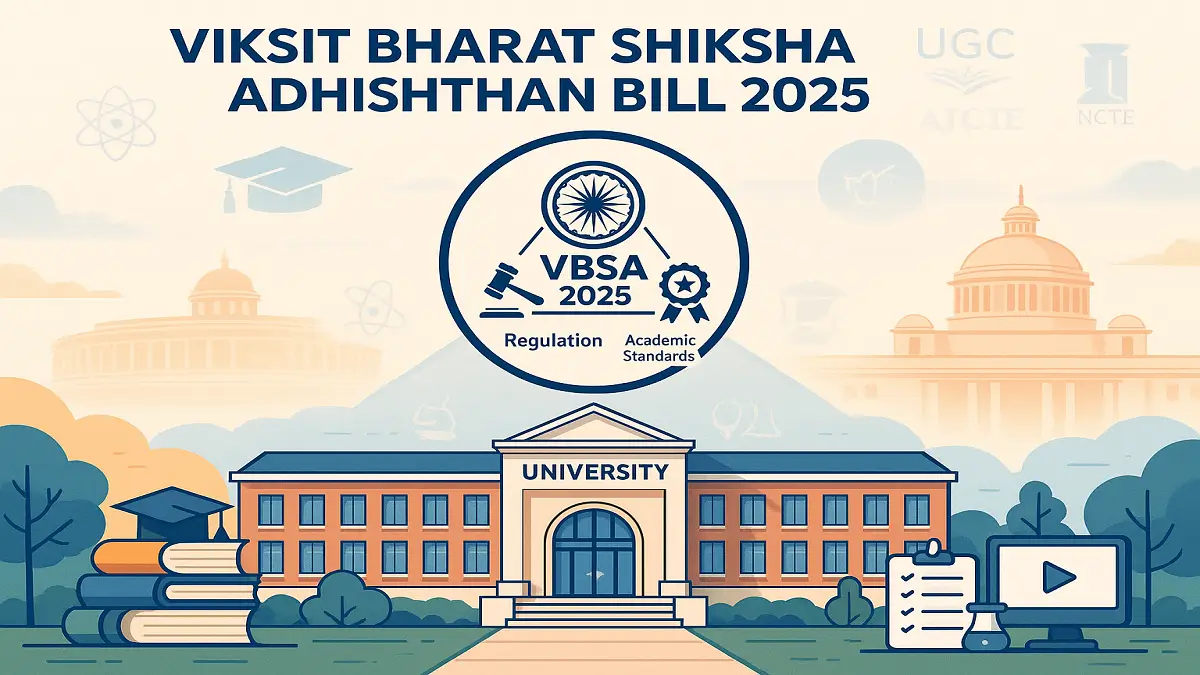
India’s higher education system is among the largest in the world, yet it has long faced challenges such as overlapping regulators, inconsistent standards, and bureaucratic delays. To address these issues and align governance with the National Education Policy (NEP) 2020, the Union Government has introduced the Viksit Bharat Shiksha Adhishthan (VBSA) Bill, 2025, which was listed in the Winter Session of Parliament.
The Bill represents one of the most significant reforms in higher education governance in recent years, aiming to simplify regulation, enhance academic quality, and improve global competitiveness.
Background: Problems with the Existing Regulatory System
Currently, India’s higher education sector is regulated by multiple bodies such as:
- University Grants Commission (UGC)
- All India Council for Technical Education (AICTE)
- National Council for Teacher Education (NCTE)
While each body serves a specific purpose, their overlapping mandates have often resulted in:
- Fragmented regulatory control
- Multiple approvals for the same institution
- Inconsistent academic standards
- Excessive compliance burden on universities
The VBSA Bill seeks to resolve these structural inefficiencies through a single, integrated regulatory framework.
Core Objectives of the VBSA Bill, 2025
The Bill clearly outlines its intent to enable and empower universities to achieve excellence in:
- Teaching and learning
- Research and innovation
- Academic governance
Key objectives include:
- Better coordination among regulatory functions
- Clear and uniform academic standards
- A unified governance mechanism for higher education
The Statement of Objects and Reasons strongly reflects the NEP 2020 principle of a “light but tight” regulatory framework—reducing bureaucratic interference while ensuring strong accountability.
Structure of the Viksit Bharat Shiksha Adhishthan (VBSA)
Apex Umbrella Commission
At the heart of the Bill is the Viksit Bharat Shiksha Adhishthan (VBSA), a 12-member apex commission that will function as the highest authority for higher education regulation in India.
The VBSA will include:
- Representatives from the Ministry of Education
- Members from State higher education institutions
- Eminent academic and policy experts
Three Specialised Councils Under VBSA
To ensure functional clarity, the VBSA will oversee three distinct councils, each with up to 14 members:
1. Viksit Bharat Viniyaman Parishad (Regulatory Council)
- Responsible for regulatory oversight
- Ensures compliance with governance norms
- Coordinates institutional regulation across universities and colleges
2. Viksit Bharat Gunvatta Parishad (Accreditation Council)
- Oversees accreditation processes
- Builds an independent and credible accreditation ecosystem
- Focuses on institutional and programme-level quality assurance
3. Viksit Bharat Manak Parishad (Standards Council)
- Sets academic and curricular standards
- Ensures harmonisation of quality benchmarks nationwide
- Promotes consistency across disciplines and institutions
Institutions Covered Under the VBSA Bill
The Bill applies to a wide range of institutions, including:
- All Central and State Universities
- Colleges and Higher Educational Institutions (HEIs)
- Institutions of National Importance
- Institutions of Eminence
- Technical and teacher education institutions
Exempted Professional Programmes
Certain professional courses are excluded from the Bill and will continue under their existing regulators:
- Medicine
- Dentistry
- Nursing
- Law
- Pharmacology
- Veterinary Sciences
The Council of Architecture will remain responsible for professional standards in architecture but will not exercise regulatory powers.
Major Reforms Introduced by the VBSA Bill
1. Replacement of Existing Regulatory Bodies
The Bill proposes to subsume UGC, AICTE, and NCTE, integrating their roles under a single, coherent framework. This aims to:
- Eliminate duplication
- Reduce compliance burden
- Improve coordination
2. Separation of Funding from Regulation
A major structural reform is the removal of grant-disbursal powers from the UGC. Under the new system:
- Funding mechanisms will be handled separately by frameworks devised by the Ministry of Education
- Regulatory bodies will focus purely on academic quality and standards
This directly aligns with NEP 2020’s recommendation to delink regulation from financial control.
3. Enabling Globalisation of Higher Education
The Regulatory Council will:
- Lay down norms for foreign universities operating in India
- Enable high-performing Indian universities to establish offshore campuses
- Prevent excessive commercialisation of education
This provision supports India’s ambition to become a global education hub.
4. Strengthening Accreditation
The Accreditation Council will develop an outcome-based accreditation framework, shifting focus from:
- Input-based compliance → learning outcomes and academic performance
This encourages institutions to prioritise quality education over procedural formalities.
Graded Penalties and Enforcement Mechanisms
To ensure accountability, the Bill provides strong enforcement powers:
- Fines from ₹10 lakh to ₹75 lakh for violations
- Closure of institutions for repeated non-compliance
- Suspension of authority to grant degrees or diplomas
- Institutions operating without accreditation may face penalties of ₹2 crore or more
These provisions aim to curb substandard and unethical practices in higher education.
Criticism and Federal Concerns
Like earlier reform attempts (e.g., the 2018 HECI Bill), the VBSA Bill has attracted criticism:
- Fear of excessive centralisation
- Concerns over Centre’s influence in appointments
- Removal of grant powers from an autonomous body
However, a key improvement is the mandatory inclusion of State representation in all three councils, partially addressing federal concerns.
Implications for India’s Higher Education System
If implemented effectively, the VBSA Bill could:
- Streamline regulatory processes
- Ensure uniform academic standards
- Improve global rankings and competitiveness
- Enhance transparency and accountability
- Reduce fragmentation in governance
At the same time, issues related to institutional autonomy, funding clarity, and Centre-State balance will require careful handling through stakeholder consultation.


 Gender Budgeting In India Jumps 11.55%: ...
 NGT Gives Nod to ₹81,000 Crore Great Nic...
 Highways That Help Honeybees? NHAI’s ‘Be...