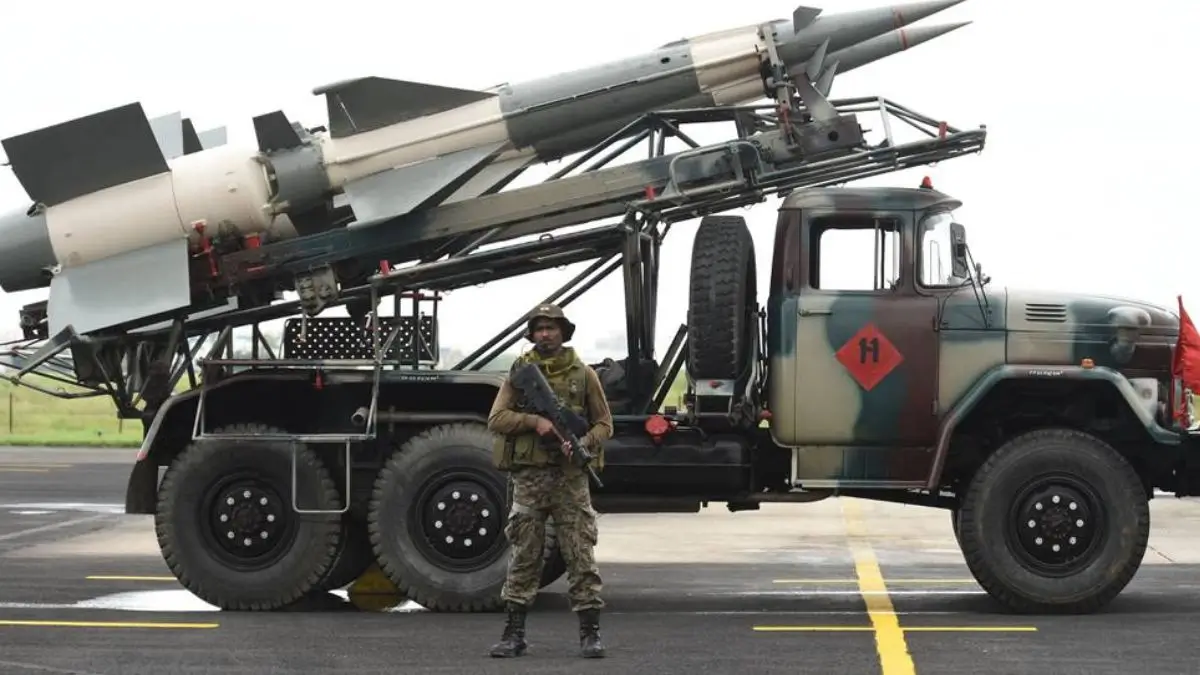
India has taken another strong step toward defense modernization. In January 2026, the Indian Air Force’s Pechora missile system, inducted in the 1970s, was successfully fully digitized through an indigenous upgrade. The modernisation has significantly enhanced its operational performance and extended its service life. This achievement highlights India’s growing capability to upgrade legacy defence systems domestically while strengthening the country’s layered air defence network against modern aerial threats.
What Is the Pechora Missile System?
- The Pechora is a surface-to-air missile (SAM) system inducted into the Indian Air Force during the 1970s.
- Originally of Russian origin, it has been a key element of India’s air defence architecture for nearly five decades.
- Known for its robustness and reliability, the system was designed to intercept hostile aircraft at low to medium altitudes.
- However, rapid technological advancements made many of its analogue components outdated, creating the need for a comprehensive modernisation to keep it operationally relevant.
Why Modernization Was Necessary
- Despite its proven track record, the Pechora system faced challenges such as slower response time, maintenance difficulties, and limited integration with modern digital command networks.
- With evolving threats including fighter aircraft, cruise missiles, and drones, the IAF required faster detection, better tracking, and improved accuracy.
- Instead of replacing the system entirely, a cost-effective upgrade was chosen to extend its service life while maintaining combat readiness during the transition to next-generation air defence platforms.
Role of Indigenous Industry in the Upgrade
- The modernisation programme was executed by Alpha Design Technologies, a Bengaluru-based private defence firm.
- The company signed a Rs 591.3 crore contract on 25 September 2020 to carry out the upgrade.
- This project marked a major milestone as it became one of the first instances where an Indian private company successfully modernised a vintage Russian-origin weapon system, reinforcing India’s defence industrial base.
Key Features of the Digitised Pechora System
- The upgrade involved complete digitisation of the Pechora system.
- Indigenous subsystems were developed and integrated, including thermal imaging fire control units, software-defined radios, missile launch detection systems, and handheld laser target designators.
- Digitisation has improved reaction time, tracking accuracy, reliability, and ease of maintenance.
- It also enables better integration with modern surveillance and command systems, making the upgraded Pechora more effective in today’s complex air threat environment.
Successful Trials at Pokhran Range
- The first fully upgraded Pechora system underwent successful firing trials at the Pokhran test range in Rajasthan between 6 November and 26 December 2025.
- These user trials validated the system’s performance under real field conditions.
- The successful missile launches confirmed operational readiness and demonstrated the reliability of indigenously developed components.
- The Pokhran range continues to play a vital role in testing and validating India’s advanced weapon systems.
Key Summary at a Glance
| Aspect | Details |
| Why in News? | Pechora missile system fully digitised |
| Force | Indian Air Force |
| Industry Partner | Alpha Design Technologies |
| Trial Location | Pokhran, Rajasthan |
| Strategic Role | Strengthening layered air defence |
Question
Q. The Pechora missile system belongs to which category?
A. Air-to-air missile
B. Anti-ship missile
C. Surface-to-air missile
D. Ballistic missile


 DRDO Tests Indigenous Air Droppable Cont...
 India’s Agni-4 vs Pakistan’s Shaheen-II:...
 Tata Advanced Systems Partners with Ramc...