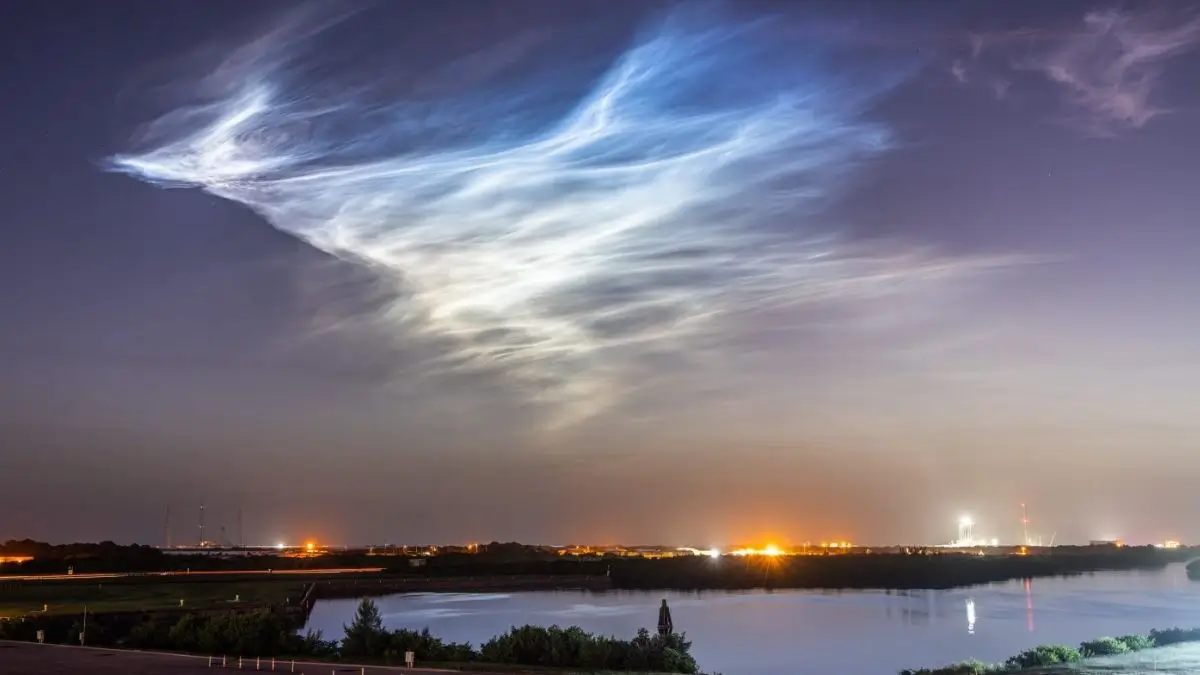
Clouds are the nature’s most fascinating creation as, from fluffy white formations which are drifting across the summer sky to towering thunderclouds signaling the approaching storm they are the constant part of our daily lives. But not all the clouds are common.
Some cloud formations are so rare that only the small number of people ever get the chance to witness them in the sky.
Among these extraordinary atmospheric wonders, there is one type cloud stands out as the rarest and most mysterious of all and it is the Noctilucent Cloud.
It is often described as the glowing electric-blue clouds near the edge of the space, noctilucent clouds captivate scientists, photographers and skywatchers alike.
What Is the Rarest Type of Cloud in the World?
The rarest cloud type in the world is the Noctilucent Cloud which is known as the Polar Mesospheric Cloud (PMC).
These clouds forms at an astonishing altitude of the around 80 kilometers (50 miles) above Earth’s surface in the mesosphere and making them as the highest clouds in the planet’s atmosphere.
Unlike the ordinary clouds that form in the lower atmosphere, noctilucent clouds exist near to the boundary between the Earth’s atmosphere and outer space.
Their rarity, unusual location and glowing appearance makes them as one of the most remarkable atmospheric phenomena ever observed in the atmosphere.
Why the Noctilucent Clouds Are So Special?
This clouds are visible during the twilight when the Sun has already set below the horizon for the people on to the ground.
Because of their extreme altitude, they set to continue to receive the sunlight even after the lower atmosphere has become dark.
This phenomenon causes them to glow with the striking blue white or silver white color against the natural night sky.
The clouds names comes form Latin word which means,
- Nocti = Night
- Lucent = Shining
By combining these, this term means the “night-shining clouds.”
Where Do Noctilucent Clouds Form?
Noctilucent clouds form in the mesosphere and it is one of the coldest layers of the Earth’s atmosphere.
They typically develop at the,
- Altitudes of 76-85 kilometers
- During the summer months
- Near polar and high-latitude regions
- Under extremely cold atmospheric conditions
Temperatures in the mesosphere can drop below the -120°C and it allows the tiny ice crystals to form around the microscopic dust particles.
What Do Noctilucent Clouds Look Like?
Noctilucent clouds are unlike the any other cloud formation.
They often appear as the,
- Glowing electric-blue veils
- Delicate silver streaks
- Rippled wave-like patterns
- Thin luminous filaments
Because they shine after the sunset, they creates an almost otherworldly appearance and it leading the many first-time observers to mistake them for auroras or unusual celestial events.
Other Rare Cloud Types Found Around the World
While the noctilucent clouds are considered as the rarest, there are several other uncommon cloud formations which are famous for their dramatic appearance.
1. Mammatus Clouds
Mammatus clouds resemble the giant pouches or hanging bubbles suspended beneath the larger storm clouds.
These formations are unusual because they develop via the sinking air rather than rising air, it is the process behind the most cloud formation.
They often appear after the severe thunderstorms and it can stretch across vast areas of the sky.
2. Nacreous Clouds
They are also known as Mother-of-Pearl Clouds, nacreous clouds display the stunning rainbow-like colors.
They form in the stratosphere over the polar regions during extremely cold weather.
Their iridescent appearance is also caused by the sunlight scattering through tiny ice crystals.
3. Kelvin-Helmholtz Clouds
Among the most visually striking cloud formations the Kelvin-Helmholtz clouds resembles the giant ocean waves breaking across the sky.
They occur when the fast-moving air flows over a slower-moving layer and it creating the strong wind shear.
4. Asperitas Clouds
Asperitas clouds creates the dramatic and turbulent appearance and it resembling rough ocean waves overhead.
Although they often look threatening but they usually do not produce the severe weather.
Their unique texture also led to their official recognition into the International Cloud Atlas in 2017.
5. Roll Clouds
Roll clouds appear as the long, tube-shaped cloud bands stretching across the horizon.
Unlike the storm clouds, they are typically detached from the thunderstorms and forms due to atmospheric gravity waves.
Some roll clouds can extend for the hundreds of kilometers.
Why Are Rare Clouds Important to Scientists?
Rare clouds provides the valuable insights into Earth’s atmosphere and climate systems.
Scientists study them to better understand the,
- Atmospheric circulation
- Temperature changes
- Moisture distribution
- Climate trends
- Weather forecasting
Noctilucent clouds are specially important because they form into the upper atmosphere where the subtle environmental changes can have the significant effects.
Researchers believe that increased sightings of noctilucent clouds may be linked to changes in atmospheric conditions and long-term climate patterns.
Can Noctilucent Clouds Be Seen from India?
Noctilucent clouds are the most commonly observed in to the high-latitude regions such as the,
- Northern Europe
- Canada
- Alaska
- Scandinavia
- Russia
They are rarely visible in India because the country lies much closer to the equator.








 Who Is Navi Pillay? Nobel Peace Prize 20...
 Vande Bharat vs Amrit Bharat Express: Ke...
 Asian Games to LA28: Which Sports Earned...