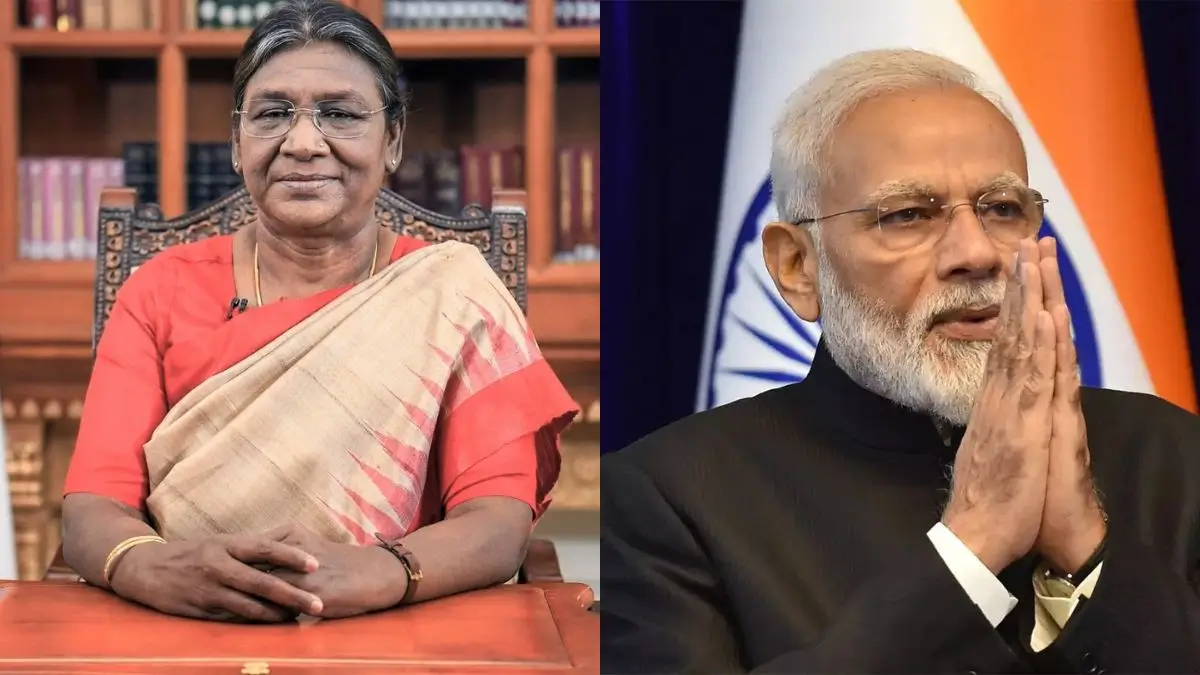
As India’s democratic system is built on the unique parliamentary framework where both the President and the Prime Minister plays the crucial but very different roles.
While the President is the constitutional head of the nation, on the other side Prime Minister is the head of the government and exercises the real executive authority.
Let’s explore their roles, powers, appointment process, constitutional provisions and key differences in detail way.
Who Is the President of India?
The President of India is the Head of the State and the constitutional guardian of the Republic of the country.
The office of the President is established under Article 52 of the Constitution of India.
According to Article 53, the executive power of the Union is vested in the President.
However, these powers are generally exercised on the advice of the Prime Minister and the Council of Ministers.
As of 2026, Droupadi Murmu is the 15th President of India. She assumed the office on 25th July, 2022 and she became the first tribal woman to hold the country’s highest constitutional office.
The President of India resides in New Delhi at Rashtrapati Bhavan.
Key Facts About the President of India
- Constitutional Position of President: Head of State
- Articles Related to President: Articles 52–62
- Term of the Office: 5 years
- Minimum Age for the Post: 35 years
- Election Method: Indirect election via an Electoral College from (MPs and MLAs)
- Official Residence: At the Rashtrapati Bhavan
- He/She is the Supreme Commander of the Armed Forces
- Also grant the pardons under the Article 72 on the advice of the Council of Ministers
Who Is the Prime Minister of the India?
The Prime Minister of India is the Head of the Government and the real executive authority in the country.
The office of the Prime Minister derives its constitutional basis from the Articles 74 and 75. Article 74 provides for the Council of Ministers and they are headed by the Prime Minister to aid and advise the President.
The Prime Minister leads the government, formulates policies, oversees administration and coordinates the functioning of the various ministries.
As of 2026, Narendra Modi serves as the Prime Minister of India. He assumed office for his third term on 9th June, 2024 after leading his party and coalition to victory in the 18th Lok Sabha elections.
Key Facts About the Prime Minister of India
- Constitutional Position: Head of Government
- Constitutional Articles: Articles 74, 75, and 78
- Appointment: By the President
- Qualification: Must be a Member of Parliament
- Term: No fixed term
- Heads the Council of Ministers
- Leads policy formulation and governance
- Represents India at the major international forums
Difference Between Prime Minister and President of India
| Basis | President of India | Prime Minister of India |
| Position | Head of State | Head of Government |
| Constitutional Articles | Articles 52 and 53 | Articles 74 and 75 |
| Nature of Power | Constitutional and ceremonial head | Real executive authority |
| Selection Process | Elected indirectly by the Electoral College | Appointed by President after securing the Lok Sabha majority |
| Term of Office | Fixed term of 5 years | Depends on majority support in the Lok Sabha |
| Eligibility | Minimum 35 years of age | Must be a Member of Parliament |
| Role in Governance | Acts on the advice of Council of Ministers | Directly runs the government |
| Law-Making Role | Gives assent to bills passed by Parliament | Formulates and introduces policies |
| Armed Forces | Supreme Commander | Directs defense policy through Cabinet |
| Removal Process | Impeachment by Parliament | Loss of majority in Lok Sabha |
| Official Residence | Rashtrapati Bhavan | Official Prime Minister’s Residence |
Powers of the President of India
Although the President is largely as the constitutional head but the office President carries significant responsibilities.
Executive Powers
All the executive actions of the Government of India are formally carried out in the name of the President.
Legislative Powers
The President summons and prorogues the Parliament, addresses Parliament and it gives the assent to bills before they become law.
Judicial Powers
Under the Article 72, the President can grant pardons, reprieves, respites and the commutations of sentences.
Military Powers
The President serves as the Supreme Commander of the Indian Armed Forces.
Emergency Powers
The President can proclaim the,
- National Emergency (Article 352)
- President’s Rule (Article 356)
- Financial Emergency (Article 360)
Appointment Powers
The President also appoints the,
- Prime Minister
- Governors
- Chief Justice of India
- Supreme Court and High Court Judges
- Constitutional authorities
Powers of the Prime Minister of India
The Prime Minister is the central figure in the India’s parliamentary system.
Head of the Council of the Ministers
The Prime Minister selects the ministers, allocates portfolios and coordinates the government functioning.
Policy Formulation
Major government policies, schemes and developmental initiatives are also formulated under the Prime Minister’s leadership.
Link Between President and Cabinet
Under the Article 78, the Prime Minister communicates the Cabinet decisions to the President.
Leader of the Government
The Prime Minister also leads the ruling party or coalition in the Parliament and he/she manages legislative business.
Chairperson of NITI Aayog
The Prime Minister heads the NITI Aayog, which plays the key role in the national development planning.
International Representation
The Prime Minister also represents the India in international summits, diplomatic engagements and global negotiations.
Why Does India Have Both a President and a Prime Minister?
India follows the parliamentary system of the government which is inspired by the United Kingdom.
Under this system,
- The President serves as the constitutional and symbolic head of the nation.
- The Prime Minister serves as the political and the executive head of the government.
This separation ensures the stability, democratic accountability and the smooth governance of the Nation.







 Who Is Navi Pillay? Nobel Peace Prize 20...
 Vande Bharat vs Amrit Bharat Express: Ke...
 Asian Games to LA28: Which Sports Earned...