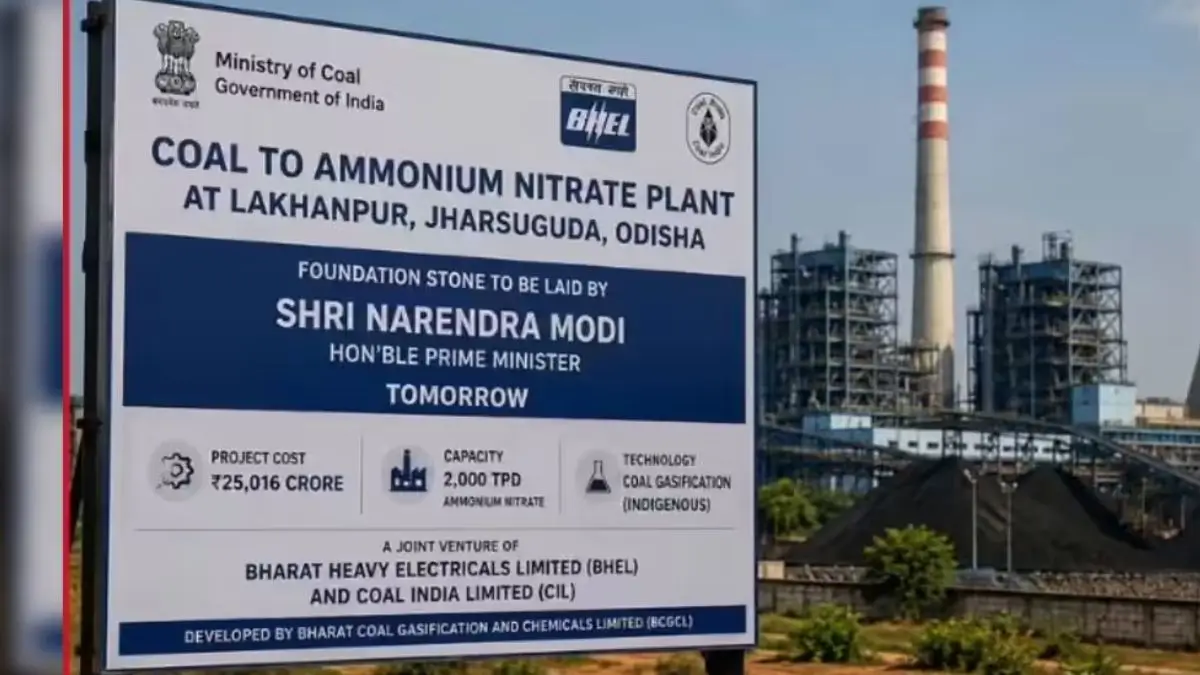
Honorable Prime Minister Narendra Modi set to lay the foundation stone of the India’s first commercial scale coal to ammonium nitrate project in state of Odisha on 20th of June, 2026. This project set to implemented with the financial outlay of ₹25,016 crore and it is located at Lakhanpur in Jharsuguda district and it will developed by the Coal Gasification and Chemicals Limited (BCGCL).
Landmark Project for the India’s Industrial Future
The Lakhanpur coal gasification project marks the first commercial-scale facility in the India that will convert the coal into ammonium nitrate using indigenous technology.
The project will be developed by the Bharat Coal Gasification and Chemicals Limited (BCGCL), and it is a joint venture between the,
- Bharat Heavy Electricals Limited
- Coal India Limited
The facility will have the capacity to produce the 2,000 tonnes of ammonium nitrate per day and it creates the domestic source of the important industrial chemical currently dependent on the imports and conventional feedstocks.
What Is Coal Gasification?
Coal gasification is the advanced industrial process that converts coal into the synthesis gas which is commonly known as the syngas.
Syngas primarily contains the,
- Hydrogen
- Carbon monoxide
- Other gaseous compounds
This gas can then be processed to manufacture the several value-added products which includes the,
- Methanol
- Urea
- Ammonium nitrate
- Synthetic natural gas
- Chemical feedstocks
Unlike the direct coal combustion, gasification enables the coal to be utilized for the producing industrial chemicals and fuels and there by increasing the its economic value.
Why Coal Gasification Is Important for the India
As India possesses one of the world’s largest coal reserves which making the coal gasification strategically important for the long-term industrial development.
India is the world’s second-largest producer of coal and world’s second-largest consumer of coal. It also home to the fifth-largest coal reserves worldwide and it estimated at over 400 billion tonnes.
Coal gasification also supports the India’s energy security goals by reducing dependence on imported the Natural gas, Ammonia, Methanol and Chemical intermediates.
Also to diversifying the feedstock sources also makes the country’s industrial supply chains more resilient.
One of the strong arguments for the coal gasification is its potential to lower the import bills. As India currently imports end-use and intermediate chemical products hat worth approximately to ₹2.7 lakh crore annually.
Coal Gasification Promotion Strategy of Government
By recognizing the strategic value of the coal gasification, the Government of India has launched the major support programs to encourage investment in the sector.
The government has approved the incentive schemes with a cumulative outlay of up to ₹46,000 crore for the surface coal and lignite gasification projects.
The coal gasification initiative is also expected to attract the investments worth of ₹2.5 lakh crore to ₹3 lakh crore across the multiple projects nationwide.
The program is also projected to create the approximately 50,000 direct and indirect jobs.
And total 25 coal gasification projects are set to located in the coal-bearing regions.
Key Features of the Lakhanpur Project
The Odisha project incorporates the several significant features.
- Project Cost: ₹25,016 crore
- Location of Project: Lakhanpur, Jharsuguda district, Odisha
- Total Land Requirement: Approximately 350 acres
- Production Capacity of Plant: 2,000 tonnes of ammonium nitrate per day
- Government Support: ₹1,350 crore support under the Ministry of Coal’s incentive scheme
The project has already secured the necessary approvals and is expected to commence implementation following the foundation stone ceremony.








 India’s Internet Subscribers Cross 1.1...
 PM GatiShakti Completes Five Years: Obje...
 President Droupadi Murmu Appoints Six Go...