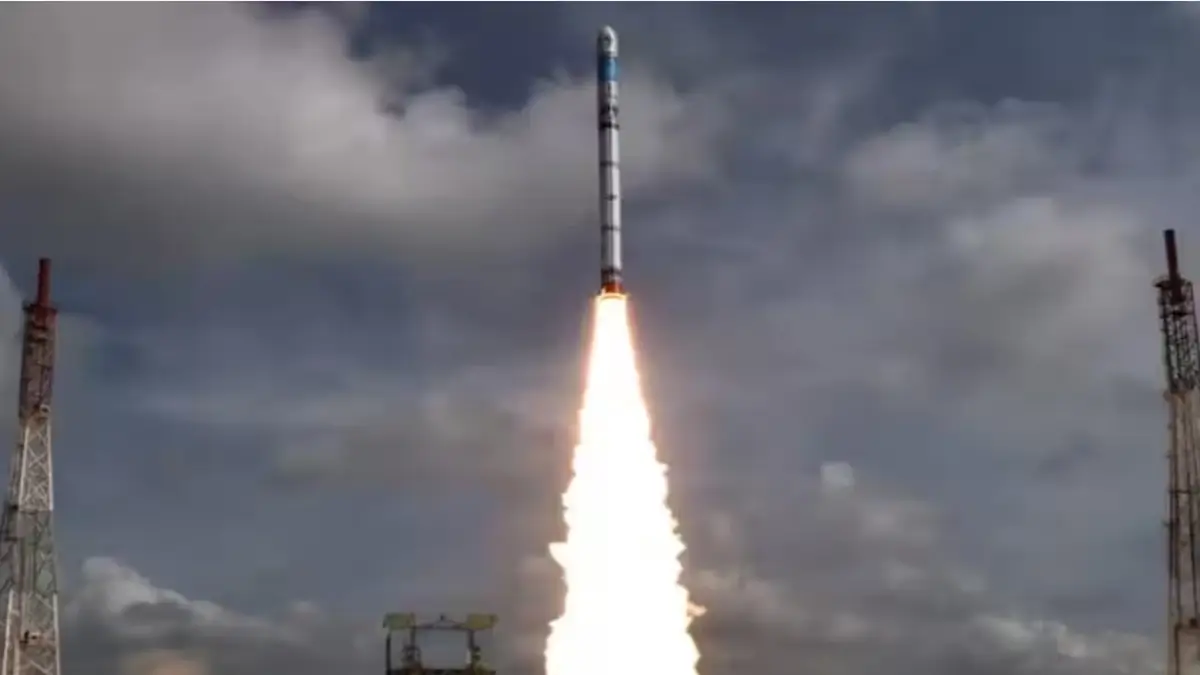
“A small vessel may sail far, but every journey has its cost.” This saying aptly reflects India’s position in the global space-launch industry, where smaller rockets have helped keep overall launch expenses manageable but have pushed the cost per kilogram of payload significantly higher than that of other major space powers.
According to a study published in Economics Letters, titled “Geopolitics and space access: cost asymmetries and strategic dependence,” India currently has the highest average cost of sending a kilogram of payload into orbit among major space powers.
The researchers analysed more than 6,740 rocket launches between 1960 and 2025 to compare launch costs, payload capacity and the changing global space landscape.
India’s Costliest Launches Per Kilogram
The study estimates that in 2025, the average cost of putting one kilogram of payload into orbit was:
| Country/Region | Cost per kg |
|---|---|
| India | $13,302 |
| Europe | $9,897 |
| Russia | $6,682 |
| China | $5,809 |
| Japan | $5,287 |
| USA | $3,225 |
| Global Average | $3,868 |
Thus, India’s estimated cost per kilogram was more than four times that of the US.
Why Is India’s Cost So High?
“When the load is small, the burden of the journey becomes heavy.”
The researchers attribute India’s high per-kilogram cost largely to the smaller size of rockets used.
A launch involves substantial fixed expenses. When a smaller rocket carries a limited payload, these costs are distributed across fewer kilograms. As a result, the cost per kilogram increases, even if the overall launch price remains relatively low.
US and Europe Have Improved Faster
The study found that only the US and Europe recorded statistically significant improvements in launch costs between 2010 and 2025, with the US showing a much faster improvement.
The growing use of reusable rockets, particularly SpaceX’s Falcon 9, has played a major role in reducing US launch costs.
India’s relatively limited launch activity may also mean that it has not yet achieved the same economies of scale and learning effects seen in countries with much higher launch frequencies.
SpaceX Changes the Global Launch Equation
“He who lowers the cost, opens the road.”
The US has dramatically increased its share of global payload in recent years.
Its share dropped from nearly 50% in 1995 to below 20% in 2012, but subsequently surged to more than 82% in 2024.
The rise was driven largely by increased US launch activity after 2016, supported by SpaceX’s reusable rockets and the Starlink satellite constellation.
The study estimates that SpaceX alone accounted for around 75% of global payload sent into orbit in 2025.
China Rapidly Expands Its Space Programme
China has also emerged as a major competitor in the global space sector.
It overtook Europe in cumulative payload sent into space in 2023. China’s share of global payload reached around 27% in 2021, declined afterward and recovered again in 2025.
Meanwhile, Europe and Russia have seen their shares decline to only a few percentage points.
Europe’s Growing Cost Gap with the US
“When technology moves forward, standing still becomes expensive.”
The US and Europe had broadly similar average launch costs during 2012–13. However, the gap has widened considerably.
Today, launching one kilogram of payload using European rockets is estimated to cost more than three times as much as using US rockets.
One major reason was Europe’s continued reliance on the Ariane 5 through much of the 2010s, while the US increasingly shifted toward reusable launch systems.
Europe introduced Ariane 6 in 2024, which could help narrow the gap. However, Ariane 6 remains a single-use rocket, and its expected launch rate is comparatively limited.
Russia Faces Its Own Challenges
Russia has phased out the lower-cost-per-kilogram Proton rocket, but its intended successor, Angara, has not successfully replaced it at scale.
As a result, Russia continues to depend on the more expensive Soyuz launch system.
The US and Russia had broadly similar cumulative payload levels until 2003. However, the Columbia disaster, followed by a two-year pause and the eventual scaling down of the US Space Shuttle programme, significantly changed the US launch trajectory.
The Shuttle programme was finally retired in 2011, without an immediate heavy-lift replacement.
High Launch Costs Can Create Strategic Dependence
“A nation that cannot control its road to space may have to depend on someone else’s road.”
More than 100 countries have at least one satellite in space, but many of them rely on foreign launch providers to put those satellites into orbit.
The study highlights an important strategic dilemma: countries may choose expensive domestic launch systems to maintain strategic autonomy, while cheaper foreign launch services can provide greater economic efficiency.
For non-US space powers, this creates a difficult choice between independence and affordability.
What India Needs to Focus On
The study highlights the importance of developing low-cost, domestically controlled reusable launch technology.
For India, reducing the cost per kilogram will require greater launch frequency, larger payload capacity, technological innovation and eventually wider adoption of reusable launch systems.








 Ebola Vaccine Trial Begins in DR Congo: ...
 ISRO to Have Four Functional Launch Pads...
 ISRO to Launch NVS-03 Navigation Satelli...