The Arctic Circle is one of the five major imaginary lines on Earth, located around 66.5° north latitude. It marks a special region of the world where the sun never sets during summer (known as the Midnight Sun) and never rises for 24 hours in winter (known as the Polar Night).
This region, covered in ice and snow for most of the year, is home to unique wildlife like polar bears, reindeer, walruses, and Arctic foxes. Beyond its beauty, the Arctic plays a vital role in regulating Earth’s climate — its ice reflects sunlight, helping keep the planet cool. However, rising global temperatures are melting the Arctic at an alarming rate, leading to climate change, rising sea levels, and disrupted ecosystems.
Countries in the Arctic Circle
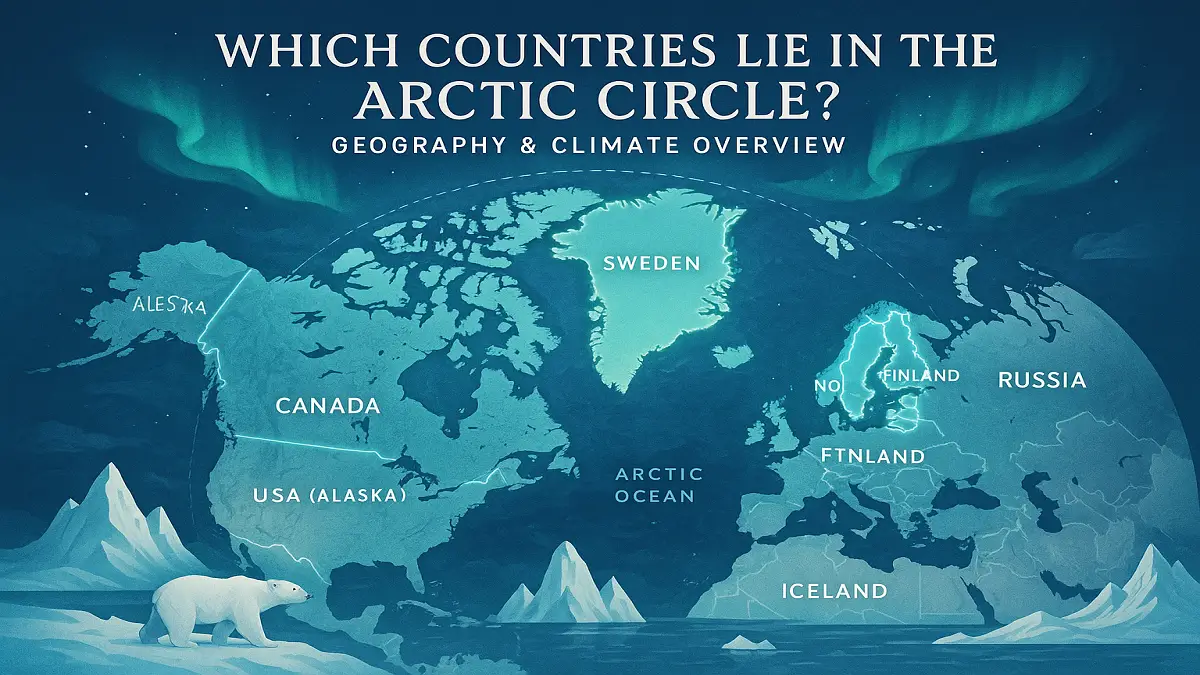
A total of eight countries have territories or islands that lie partially or entirely within the Arctic Circle. These countries are crucial for scientific research, environmental protection, indigenous cultures, and natural resource management.
| Sr. No. | Country | Key Arctic Region or Territory |
|---|---|---|
| 1 | Norway | Svalbard, Tromsø, Lofoten Islands |
| 2 | Sweden | Swedish Lapland |
| 3 | Finland | Finnish Lapland |
| 4 | Russia | Murmansk, Siberian Arctic |
| 5 | United States | Alaska (Northern region) |
| 6 | Canada | Yukon, Northwest Territories, Nunavut |
| 7 | Denmark | Greenland |
| 8 | Iceland | Grímsey Island (north of mainland Iceland) |
Detailed Overview of Each Arctic Country
1. Norway
Norway’s northern region, including Tromsø, Lofoten Islands, and the Svalbard Archipelago, lies well within the Arctic Circle. Known for its Northern Lights (Aurora Borealis) and Midnight Sun, it is a global hub for Arctic tourism and research. The region is also rich in marine resources and plays a leading role in international Arctic cooperation.
2. Sweden
Swedish Lapland, located in the far north, is part of the Arctic Circle. It’s culturally important as the homeland of the Sámi people, known for their reindeer herding traditions. The region is famous for attractions like the Icehotel and the Northern Lights, blending natural beauty with cultural heritage.
3. Finland
Finnish Lapland, home to the city of Rovaniemi, sits directly on the Arctic Circle and is known as the official home of Santa Claus. It experiences long, dark winters and bright, endless summer days. The region offers snowy adventures, reindeer safaris, and some of the best Northern Lights views in the world.
4. Russia
Russia possesses the largest landmass within the Arctic Circle, spanning vast areas of Siberia and the Murmansk region. This region contains huge oil, gas, and mineral reserves, making it economically vital. The Russian Arctic is also home to indigenous peoples and numerous scientific research bases studying global climate patterns.
5. United States (Alaska)
The Arctic part of the U.S. lies in northern Alaska, including Utqiaġvik (Barrow) — one of the world’s northernmost inhabited towns. Characterized by tundra landscapes, glaciers, and polar wildlife, this area is home to Indigenous Alaskan communities who have lived here for centuries, adapting to extreme Arctic conditions.
6. Canada
A vast portion of Northern Canada, including the Yukon, Northwest Territories, and Nunavut, lies within the Arctic Circle. This remote and icy region consists of thousands of islands, frozen seas, and tundra landscapes. It’s rich in natural resources and home to the Inuit people, known for their deep connection with Arctic life and traditions.
7. Denmark (Greenland)
Denmark is part of the Arctic Circle through its territory Greenland, the world’s largest island. Mostly covered in ice, Greenland is a key site for climate research and glaciology. Despite its harsh environment, it has small coastal settlements and is an important center for studying global warming’s impact on polar ice.
8. Iceland
Although most of Iceland lies just below the Arctic Circle, the small northern island of Grímsey crosses the line, making Iceland an Arctic nation. The country uniquely combines Arctic glaciers, volcanoes, and geothermal hot springs, offering a fascinating mix of fire and ice in its landscape and culture.
Importance of the Arctic Circle
The Arctic region holds enormous significance for the environment, economy, and global climate system:
- Acts as the Earth’s cooling system by reflecting solar radiation.
- Home to rare Arctic ecosystems and wildlife.
- Contains vast untapped natural resources like oil, gas, and minerals.
- Provides essential data for climate change research.
- Houses indigenous communities preserving ancient Arctic traditions.
However, as global warming accelerates, the Arctic faces severe challenges — melting glaciers, rising sea levels, and disappearing habitats threaten both human and ecological survival.


 What is National Investigation Agency? C...
 Which State is the Largest Petroleum Pro...
 Largest Crude Oil Supplier Countries to ...