
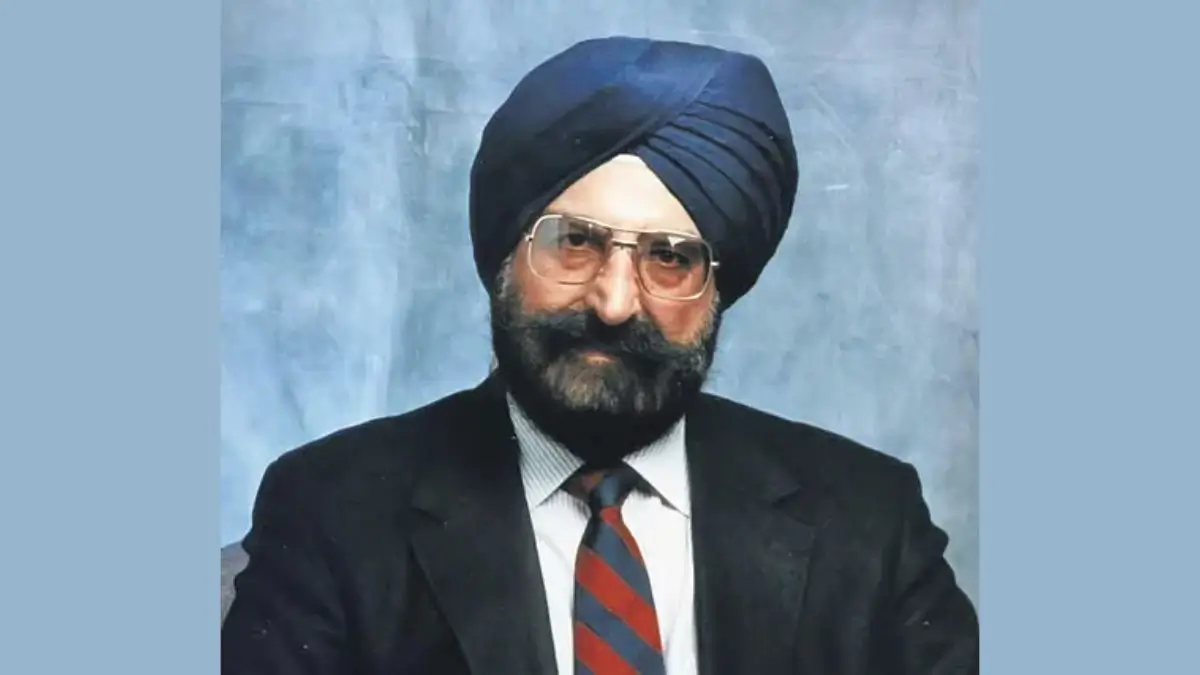
Dr Narinder Singh Kapany was an Indian-American physicist, inventor and entrepreneur well-known as the Father of Fibre Optics who pioneered the development of optical fibre. Dr Kapany proved that light and images can be sent through bundles of glass fibres.
Born on 31 st October 1926 in Moga, Punjab, Dr Kapany has been internationally recognised for his contribution to science. To celebrate his 100 th birthday, Prime Minister Narendra Modi paid tribute to him in the 139 th episode of Mann Ki Baat.
Who Was Narinder Singh Kapany?
Dr Narinder Singh Kapany was a physicist and entrepreneur who pioneered Fibre Optics. He became known as the Father of Fibre Optics after proving that images can be sent through bundles of optical fibre.
Dr Kapany proved that light could be sent through thin glass fibres and images could be sent using bundles of optical fibres. This helped form the foundations of optical communication technology.
He also coined the term Fibre Optics after publishing an article in Scientific American in 1960. Kapany made many contributions to science, including lasers, medical instruments, solar technology and defence.
Why Is Narinder Singh Kapany Known As The Father Of Fibre Optics?
Dr Narinder Singh Kapany is known as the Father of Fibre Optics because he pioneered experiments proving that light and images can be sent through flexible glass fibres.
During his time working at Imperial College London in the early 1950s, Kapany worked with Professor Harold Hopkins, an expert in optics. In 1953 they successfully proved that images could be sent with high quality through bundles of optical fibre. Their findings were published in the scientific journal ‘Nature’ in 1954.
Kapany also helped to create Fibre Optics as a recognised field of study. In November 1960 Kapany published an article titled ‘Fibre Optics’ in Scientific American.
His work helped create the foundations of using fibres in modern technology including telecommunications, medical imaging and high speed data.
What Is Fibre Optics?
Fibre Optics refers to using thin flexible fibres made from glass or plastic to send information using light.
Optical Fibres usually have three components,
| Component | Use |
| Core | Light is sent through the core |
| Cladding | Keeps light trapped within the core` |
| Protective Coating | Protects the fibre |
Fibre optic communications mostly rely on the use of total internal reflection. Light is passed into the fibre and is reflected many times within the core. This helps to send the light through the fibre with minimal loss.
Fibre Optics are used widely in,
- Telecommunications and internet – Sends high speed data over long distances.
- Medical technology – Used in endoscopes and other equipment to look inside parts of the body.
- Defence – Using fibre optic communications.
- Industrial – Used to look in hard to reach places. Uses specialist measuring systems.
- Scientific – Used in lasers, optical equipment and advanced imaging.
Early Life and Education
Narinder Singh Kapany was born on 31 st October 1926 in Moga, Punjab, India. He grew up in Dehradun and became fascinated with light and optics whilst at school.
After completing his undergraduate degree from Agra University in 1948, Kapany moved to the UK to complete his postgraduate studies in optics at Imperial College London.
He gained his doctorate in optics in 1955. His research with Professor Harold Hopkins played a large part in the early developments of Fibre Optics.
Institution and Qualification
- Agra University:Undergraduate degree (1948)
- Imperial College London: Doctorate research in optics
- University of London: PhD (1955)
Career And Businesses
Kapany moved to the US after completing his doctorate. He joined the University of Rochester in 1955. He went onto work at the Illinois Institute of Technology. He started to build his career as a scientist, academic and entrepreneur.
In 1960, Kapany founded Optics Technology Inc. in Palo Alto, California. This company specialised in creating optical technology and was successfully taken public in 1967.
Kapany went onto found other technology companies,
| Year | Company | Significance |
| 1960 | Optics Technology Inc. | First major business venture in optical technology. |
| 1973 | Kaptron Inc. | Developed and created more optical technology. |
| 2000 | K2 Optronics | Optical technology venture. |
Kapany also worked as an academic at University of California, Berkeley, University of California, Santa Cruz and Stanford University. His research spanned lasers, solar technology, medical instruments and pollution monitoring.
Kapany has gained over 100 patents across his career and has written many articles around optical technology.
Awards And Achievements
Dr Narinder Singh Kapany has won many awards throughout his career for his contributions to science, entrepreneurship and philanthropy.
| Year | Awards / Achievements |
| 1961 | Became a Fellow of the Optical Society of America (OSA). |
| 1998 | Excellence 2000 Award from the USA Pan-Asian American Chamber of Commerce. |
| 1999 | Founded an Endowed Chair in Opto-Electronics at UC Santa Cruz. |
| 2008 | Pravasi Bharatiya Samman. |
| 2008 | Fiat Lux Award from University of California. |
| 2019 | Asia Game Changer West Award. |
| 2021 | Padma Vibhushan (Posthumous). |
In 2021 the Government of India awarded Kapany the Padma Vibhushan (posthumous) for his work in Science and Engineering. This is the second highest civilian award in India.
Kapany was considered to be a contender for the Nobel Prize in Physics for 2009, which was awarded to Charles K. Kao for his contribution to fibre optic communications.
Sikh Heritage And Philanthropy
Alongside his work in science and entrepreneurship, Kapany was passionate about preserving Sikh artwork, culture and heritage.
In 1967 he formed the Sikh Foundation. This organisation was set up to promote Sikh history, artwork, culture and literature. Kapany supported exhibitions of Sikh artwork in international museums and helped create permanent collections.
He donated to education by creating endowments for academic posts,
- Kundan Kaur Kapany Chair of Sikh Studies at the University of California, Santa Barbara. Named after his mother.
- Narinder Singh Kapany Chair in Opto-Electronics at the University of California, Santa Cruz. Created in 1999.
100th Birthday And Acknowledgement From PM Narendra Modi
Narinder Singh Kapany’s 100 th birthday was on the 31 st October 2026. PM Narendra Modi paid tribute to him in the 139 th episode of Mann Ki Baat.
He remembered Kapany as the Father of Fibre Optics and encouraged young people to take inspiration from scientists like him.
His 100 th birthday was celebrated in his hometown of Moga, Punjab. There were science exhibitions and efforts to educate students about his life.
Death Of Narinder Singh Kapany
Narinder Singh Kapany passed away in December 2020, aged 94 in California, United States.
He leaves behind his two children, Rajinder Singh Kapany and Kiran Kaur Kapany, as well as his grandchildren. His wife Satinder Kaur had passed away.
His autobiography ‘The Man Who Bent Light’ shows his passion for optics throughout his life.








 Who Is Jensen Huang? NVIDIA CEO’s Biog...
 Tihar 2026: Dates, Five-Day Celebrations...
 Vikram Samvat vs Saka Samvat: Origin, Di...