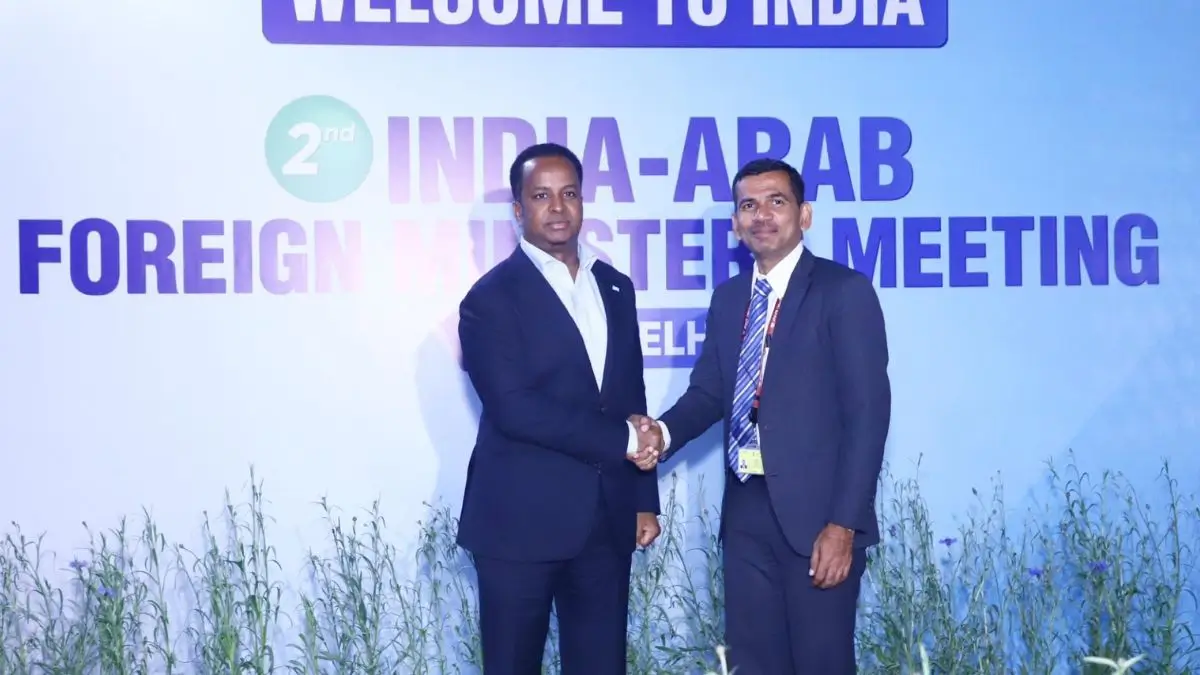
India is set to host a major diplomatic event that signals a renewed focus on the Arab world. On January 31, 2026, New Delhi will host the second India-Arab Foreign Ministers’ Meeting (FMM), a platform that returns after a decade-long pause. Co-chaired by India and the UAE, the meeting brings together Foreign Ministers from Arab League member states at a time of shifting global and regional dynamics. The gathering highlights India’s growing engagement with West Asia and its ambition to build deeper political, economic, and cultural partnerships with Arab nations.
About India-Arab Foreign Ministers’ Meeting
- The India-Arab Foreign Ministers’ Meeting is a high-level dialogue mechanism between India and the League of Arab States.
- It provides a collective platform for political dialogue, strategic coordination, and cooperation across multiple sectors.
- The meeting includes Foreign Ministers of Arab League member countries along with the Secretary General of the Arab League.
- The revival of this format reflects India’s intent to institutionalize its engagement with the Arab world beyond bilateral relations and strengthen multilateral cooperation.
Why the UAE Is Co-Chairing the Meeting
- The United Arab Emirates is co-chairing the meeting alongside India, highlighting the deep strategic partnership between the two countries.
- The UAE has emerged as one of India’s most important partners in the Middle East, with strong ties in trade, energy, investment, diaspora engagement, and defense.
- Co-chairing the meeting places the UAE in a leadership role within the Arab grouping and reflects trust in its ability to bridge India-Arab cooperation.
- This also aligns with India’s broader West Asia policy of working with key regional anchors.
Significance of the 10-Year Gap
- The second India–Arab FMM is being held after 10 years, following the first meeting in Bahrain in 2016.
- At that inaugural meeting, India and Arab nations identified five priority areas economy, energy, education, media, and culture.
- However, regional instability, global crises, and shifting diplomatic priorities slowed the process.
- The revival of the meeting indicates renewed political will on both sides. It also reflects changing geopolitical realities where India’s economic rise and the Arab world’s diversification efforts now create stronger grounds for partnership.
Key Agenda Areas of the Meeting
- The second meeting is expected to build on the five priority verticals identified earlier. Economic cooperation will focus on trade expansion, investment, and supply chain resilience.
- Energy discussions are likely to include oil, gas, renewables, and green hydrogen. Education and culture aim to promote people-to-people ties, student exchanges, and cultural understanding.
- Media cooperation is expected to enhance information exchange and counter misinformation. Together, these areas underline a shift from symbolic diplomacy to practical and outcome-oriented engagement.
Participation from Across the Arab World
- The meeting will see participation from a wide range of Arab countries.
- Ministers from Somalia, Palestine, Comoros, and Sudan, along with the Secretary General of the Arab League, are in New Delhi for the discussions.
- This broad representation highlights the pan-Arab nature of the platform.
- It also reflects India’s balanced approach towards the region, engaging with Gulf countries, North Africa, and the Horn of Africa under a single diplomatic framework.
Question
Q. The second India-Arab Foreign Ministers’ Meeting is being co-chaired by India and which country?
A) Saudi Arabia
B) Qatar
C) United Arab Emirates
D) Egypt

 India Overtakes China as Top Exporter of...
 IEA to Release Record 400 Million Barrel...
 Gulf of Hormuz vs Strait of Malacca: Whi...