
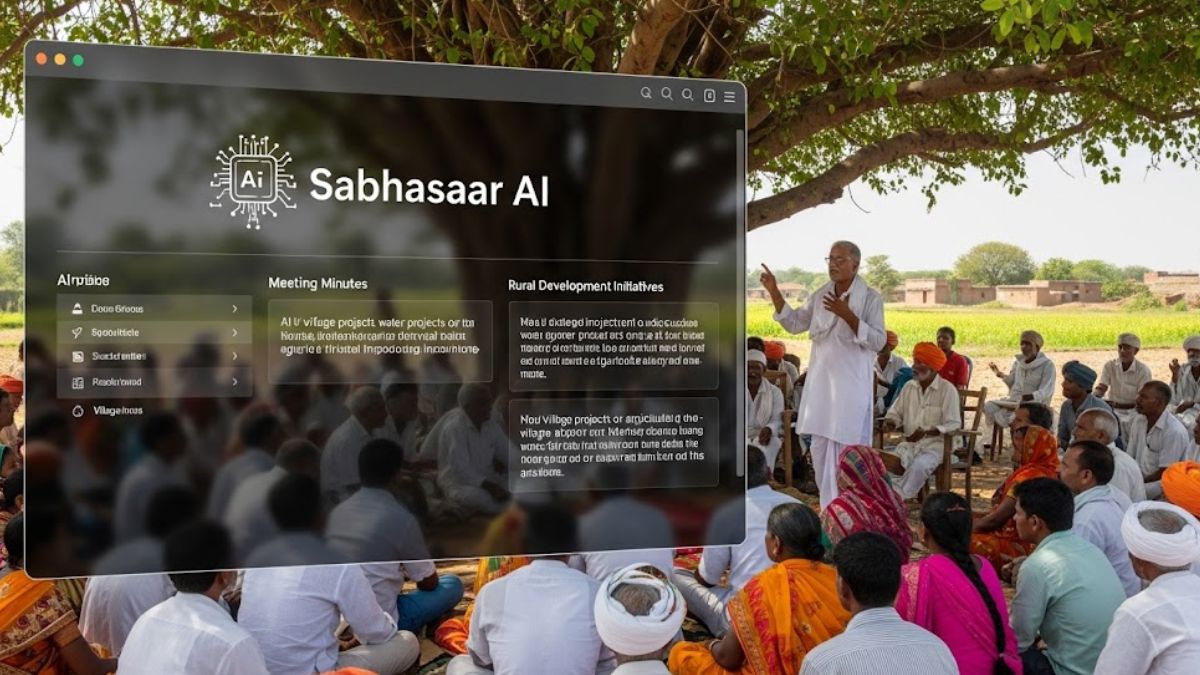
On Independence Day 2025, the government unveiled ‘SabhaSaar’, an AI-powered tool designed to enhance the functioning of Gram Sabhas, the foundation of India’s Panchayati Raj system. Launched initially in Tripura and gradually expanding nationwide, SabhaSaar aims to digitize, standardize, and democratize village-level governance.
For UPSC aspirants, this is not just a news update—it is a critical topic in polity, governance, and technology in administration, linking directly to 73rd Constitutional Amendment, e-governance initiatives, and inclusive democracy.
What is SabhaSaar?
SabhaSaar is an AI-powered documentation tool developed to assist Gram Sabha meetings by converting their video and audio proceedings into structured minutes.
Core Features
- AI-generated minutes: Converts videos and audio recordings of Gram Sabha meetings into structured summaries.
- Language support: Built on the Bhashini platform, it supports transcription and translation in all major Indian languages (Hindi, Bengali, Tamil, Telugu, Marathi, Gujarati) along with English.
- Uniformity: Ensures standardized meeting records across India, avoiding discrepancies in documentation.
- Ease of access: Panchayat officials can upload recordings using e-GramSwaraj login credentials, ensuring integration with existing systems.
- Transparency: Provides villagers with instant access to summaries, improving accountability and citizen engagement.
The Digital Ecosystem Around Gram Sabhas
SabhaSaar is not a standalone initiative—it complements other digital governance platforms:
Panchayat NIRNAY Portal
- A real-time monitoring system for Gram Sabha meetings.
- Allows scheduling, public notifications, and agenda circulation in advance.
- Over 10,000 Gram Sabha meetings conducted in FY 2024–25 using this platform.
e-GramSwaraj Portal
- Tracks Panchayat-level plans, budgets, and accounts.
- Integrated with SabhaSaar for documentation and transparency.
Bhashini Platform
- AI-powered language translation initiative aimed at bridging linguistic and digital divides.
- Forms the backbone of SabhaSaar’s multilingual transcription capability.
Relevance of Gram Sabha in Indian Polity
- The Gram Sabha is the bedrock of India’s Panchayati Raj system, institutionalized under the 73rd Constitutional Amendment Act, 1993.
- Mandatory meetings: At least four per year—on January 26, May 1, August 15, and October 2.
- Composition: All registered voters in a village form the Gram Sabha.
Functions
- Approving development plans
- Monitoring welfare schemes
- Ensuring accountability of Panchayats
As of 2025, India has 2,55,397 village panchayats, 6,742 intermediate panchayats, 665 district panchayats, and 16,189 traditional local bodies, all directly or indirectly linked to Gram Sabha activities.


 ECINet KYC Feature Explained: How Voters...
 BIRAC-BioNEST Incubation Centre Inaugura...
 E20 Petrol India 2026: Nationwide Rollou...











