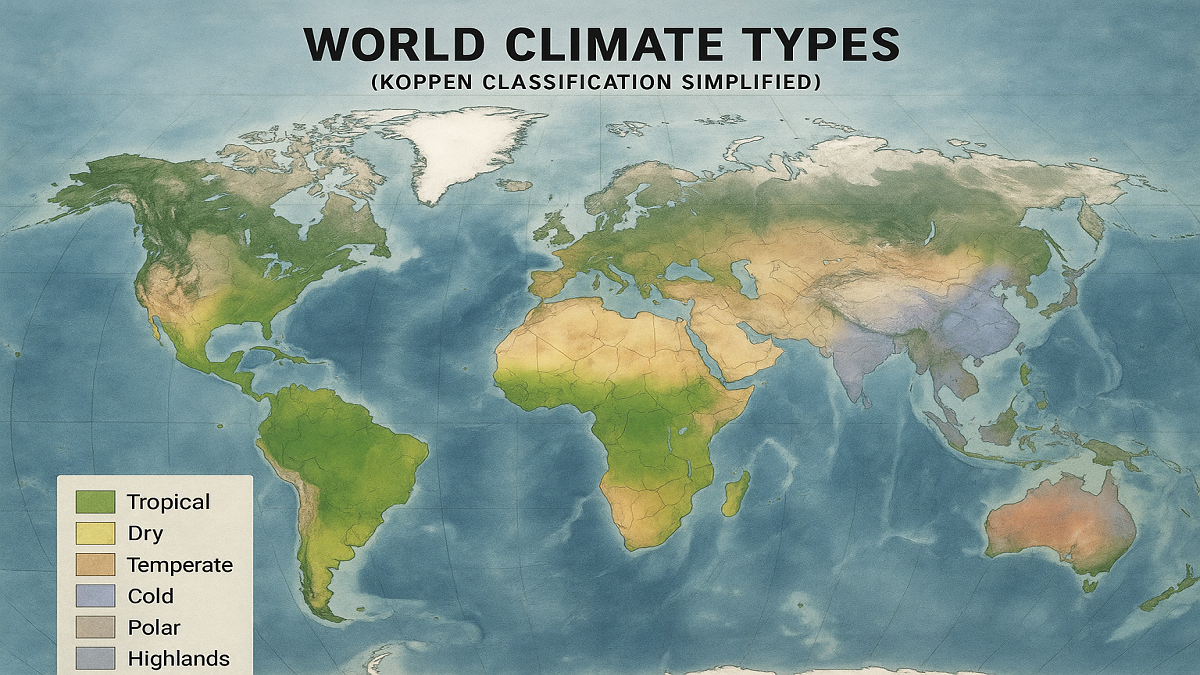
The Köppen Climate Classification, developed by Wladimir Köppen, is the most widely used system to classify world climates. It is based on temperature, rainfall, and vegetation patterns. To make it easy to understand, Köppen divided climates into five major groups, each represented by a capital letter. These are further subdivided, but for exam purposes, the main types are enough.
Major Climate Types (Köppen Simplified)
1. Tropical Climate (Type A)
- Found near the Equator (0°–15° latitude).
- Hot and humid throughout the year.
- Rainfall is high, supporting rainforests and monsoon vegetation.
- Examples: Amazon Basin (South America), Congo Basin (Africa), Indonesia, India’s coastal regions.
2. Dry Climate (Type B)
- Found in deserts and semi-arid regions.
- Very little rainfall; evaporation exceeds precipitation.
- Can be hot deserts (Sahara, Thar, Arabian) or cold deserts (Central Asia, Gobi).
- Vegetation is sparse – cactus, thorny bushes, grasses.
3. Temperate Climate (Type C)
- Found in mid-latitudes (30°–45°).
- Moderate temperatures – neither extremely hot nor cold.
- Rainfall is well distributed, with seasonal variation.
- Examples: Mediterranean region, southeastern USA, parts of China.
- Vegetation: mixed forests, shrubs, and crops like wheat, grapes, and olives.
4. Continental Climate (Type D)
- Found in interior parts of continents (45°–65° latitudes).
- Characterized by severe winters and warm summers.
- Rainfall mostly in summer, winters are snowy.
- Examples: Canada, Russia, northern USA, Central Asia.
- Vegetation: coniferous forests (taiga), grasslands.
5. Polar Climate (Type E)
- Found near the Poles (above 65° latitude).
- Very cold throughout the year; long winters and very short summers.
- Rainfall is extremely low, mostly in the form of snow.
- Examples: Antarctica, Greenland, Arctic region.
- Vegetation: mosses, lichens (tundra vegetation).
Quick Memory Tip
- A → Always hot (Tropical)
- B → Barely rains (Dry)
- C → Comfortable (Temperate)
- D → Drastic winters (Continental)
- E → Extreme cold (Polar)


 Which Continent is known as the White Co...
 Which Hobby is known as the King of Hobb...
 Who is known as the Father of Mobile Pho...