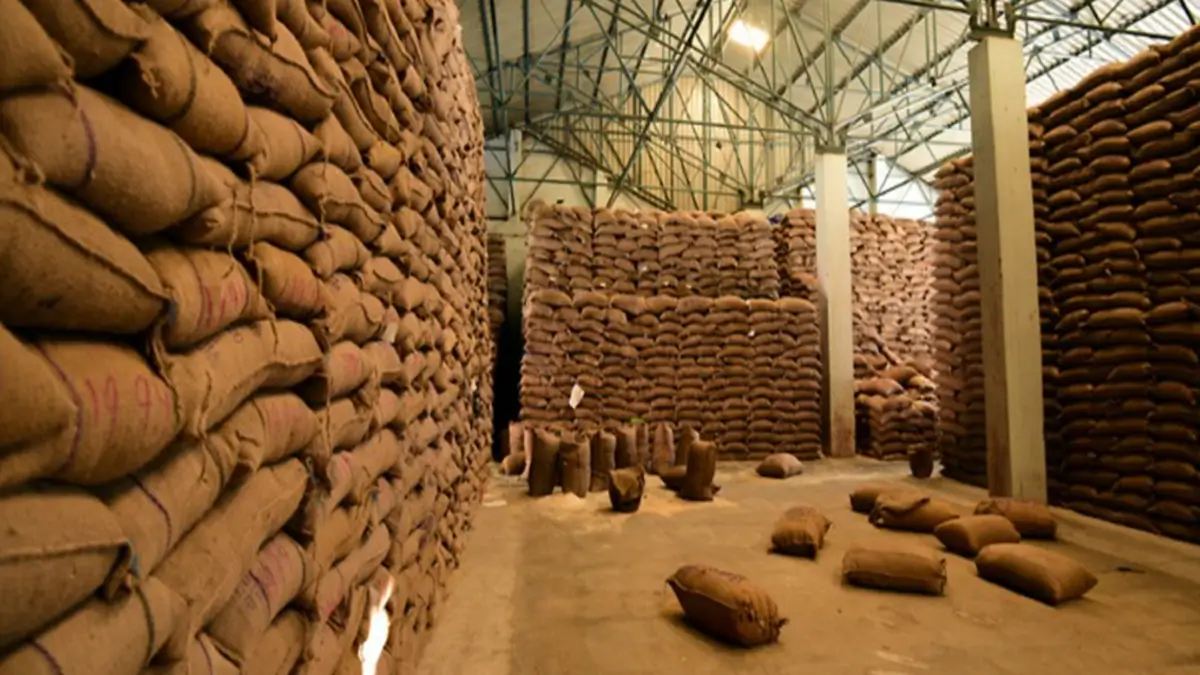
The Government of India is implementing the World’s Largest Grain Storage Plan in the Cooperative Sector (WLGSP) to strengthen decentralized storage infrastructure at the grassroots level. The initiative aims to enhance food security, reduce post-harvest losses, and improve farmers’ income.
The information was provided by Union Minister for Home and Cooperation Amit Shah in a written reply in the Rajya Sabha.
Pilot Project in Madhya Pradesh
World’s Largest Grain Storage Plan in Cooperative Sector (WLGSP)
The Government of India is implementing the World’s Largest Grain Storage Plan in the Cooperative Sector (WLGSP) to strengthen decentralized storage infrastructure at the grassroots level. The initiative aims to enhance food security, reduce post-harvest losses, and improve farmers’ income.
The information was provided by Union Minister for Home and Cooperation Amit Shah in a written reply in the Rajya Sabha.
Pilot Project in Madhya Pradesh
Balaghat district of Madhya Pradesh was selected as the pilot district under the scheme.
- A 500 MT godown was constructed at Bahudeshiya Prathamik Krishi Saakh Sahakari Society Maryadit Parswada in Balaghat.
- The project was inaugurated by Prime Minister Narendra Modi on 24 February 2024.
- The godown has been hired by the Madhya Pradesh Warehousing and Logistics Corporation (MPWLC).
Convergence of Government Schemes
The plan is being implemented at the PACS (Primary Agricultural Credit Societies) level by integrating various existing schemes, including:
- Agriculture Infrastructure Fund (AIF)
- Agricultural Marketing Infrastructure (AMI) Scheme
- Sub Mission on Agricultural Mechanization (SMAM)
- Pradhan Mantri Formalization of Micro Food Processing Enterprises (PMFME)
Key Amendments:
- Loan repayment period under AIF extended from 2+5 years to 2+8 years for PACS.
- Margin money requirement reduced from 20% to 10%.
-
Construction cost revised to:
- ₹7000/MT (plain areas)
- ₹8000/MT (Northeastern states)
- Subsidy for PACS increased from 25% to 33.33%.
- Additional subsidy (one-third of admissible subsidy) for ancillary infrastructure such as internal roads and weighbridges.
Benefits for Farmers
The decentralized storage system allows farmers to:
- Store produce locally
- Access pledge financing
- Avoid distress sales
- Sell crops at better market prices
It is especially beneficial for small and marginal farmers, who often face challenges due to lack of storage facilities.
Expected Impact
- Reduction in post-harvest losses
- Lower transportation costs
- Improved price realization
- Strengthened supply chain efficiency
- Enhanced national food security
By promoting scientific storage at the village level, the WLGSP aims to transform India’s agricultural storage ecosystem and empower cooperative institutions.
Exam-Oriented MCQs
Q1. Which district was selected as the pilot district under the World’s Largest Grain Storage Plan in the Cooperative Sector (WLGSP)?
(a) Indore
(b) Bhopal
(c) Balaghat
(d) Jabalpur
(e) Gwalior
Q2. The pilot 500 MT godown under WLGSP was inaugurated by which Prime Minister?
(a) Manmohan Singh
(b) Narendra Modi
(c) Atal Bihari Vajpayee
(d) H. D. Deve Gowda
(e) I. K. Gujral
Q3. Under the Agriculture Infrastructure Fund (AIF), the loan repayment period for PACS has been extended to:
(a) 2+5 years
(b) 2+6 years
(c) 2+7 years
(d) 2+8 years
(e) 3+8 years
Q4. The subsidy for PACS under the Agricultural Marketing Infrastructure (AMI) Scheme has been increased to:
(a) 25%
(b) 30%
(c) 33.33%
(d) 40%
(e) 50%
Q5. The primary objective of decentralized storage at the PACS level is to:
(a) Promote export of grains
(b) Increase fertilizer consumption
(c) Reduce post-harvest losses and prevent distress sales
(d) Replace mandis entirely
(e) Privatize agricultural storage
Q6. The World’s Largest Grain Storage Plan is being implemented through convergence of which of the following schemes?
(a) Agriculture Infrastructure Fund
(b) AMI Scheme
(c) PMFME Scheme
(d) SMAM
(e) All of the above


 PM Modi Addressed Parliament on Middle E...
 What Is Sarhul Festival? Meaning, Ritual...
 What Is the National DMF Summit 2026 and...