
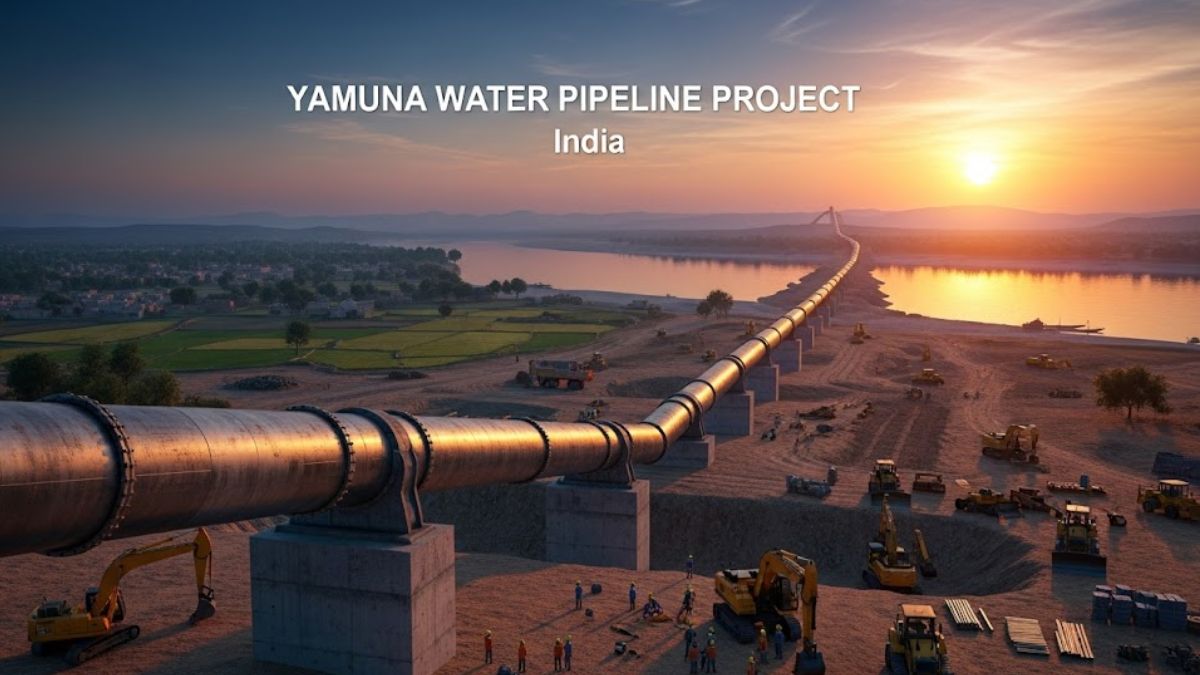
In a major step towards addressing water scarcity in arid regions of Rajasthan, the states of Haryana and Rajasthan have entered into a Memorandum of Understanding (MoU) for a landmark project—the Yamuna Water Pipeline Project. The project aims to transfer Yamuna River water from Hathnikund in Haryana to several water-stressed districts of Rajasthan using an underground pipeline network. This initiative signals a new model of inter-state water cooperation for sustainable drinking water supply in India.
Key Features of the Yamuna Water Pipeline Project
MoU for Joint DPR Development
As per the MoU signed, both Haryana and Rajasthan will jointly prepare a Detailed Project Report (DPR) for the project. The collaboration includes formation of a Task Force by both states to oversee the planning and implementation stages.
Rajasthan has already appointed a consultant to work on the DPR, accelerating the preparatory phase of the project.
Project Scope and Phase-1 Details
Water Transfer Plan
Phase-1 of the project is designed to transfer up to 577 million cubic meters (MCM) of water annually from the Hathnikund Barrage to the districts of Churu, Sikar, Jhunjhunu, and other nearby areas in Rajasthan. This transfer will take place during the monsoon months of July to October, ensuring sustainable use of surplus river water during peak flow seasons.
Use of Underground Pipelines
The water will be conveyed through an underground pipeline system, minimizing loss due to evaporation and seepage—common in open canal systems. This approach ensures efficient, secure, and hygienic water transport over long distances.
Conditions for Water Transfer
Post-Fulfillment of Haryana’s Needs
Water transfer will commence only after Haryana’s full water requirements are met, particularly through the Western Yamuna Canal, which has a total flow capacity of 24,000 cusecs. This includes the Delhi share drawn at Hathnikund.
Only after the Western Yamuna Canal is operating at its full capacity, and Haryana’s needs are fulfilled, will the surplus water be diverted for the Rajasthan districts under the pipeline project.
Significance of the Project
Addressing Water Stress in Rajasthan
The districts targeted—Churu, Sikar, and Jhunjhunu—are part of Rajasthan’s semi-arid and arid regions, which frequently face droughts and groundwater depletion. Reliable access to surface water from the Yamuna would significantly improve drinking water supply, reduce groundwater dependence, and improve living conditions in these areas.
A Model for Inter-State Collaboration
This project sets a precedent for cooperative water management between states, balancing regional water rights, infrastructure development, and sustainable resource use. It represents a strategic response to the challenges posed by climate change and water insecurity in India.


 India Launches AI-Driven Initiative to M...
 What the NPC-MoEFCC Agreement Means for ...
 IIT Bombay & Honeywell Launch Sustai...











