
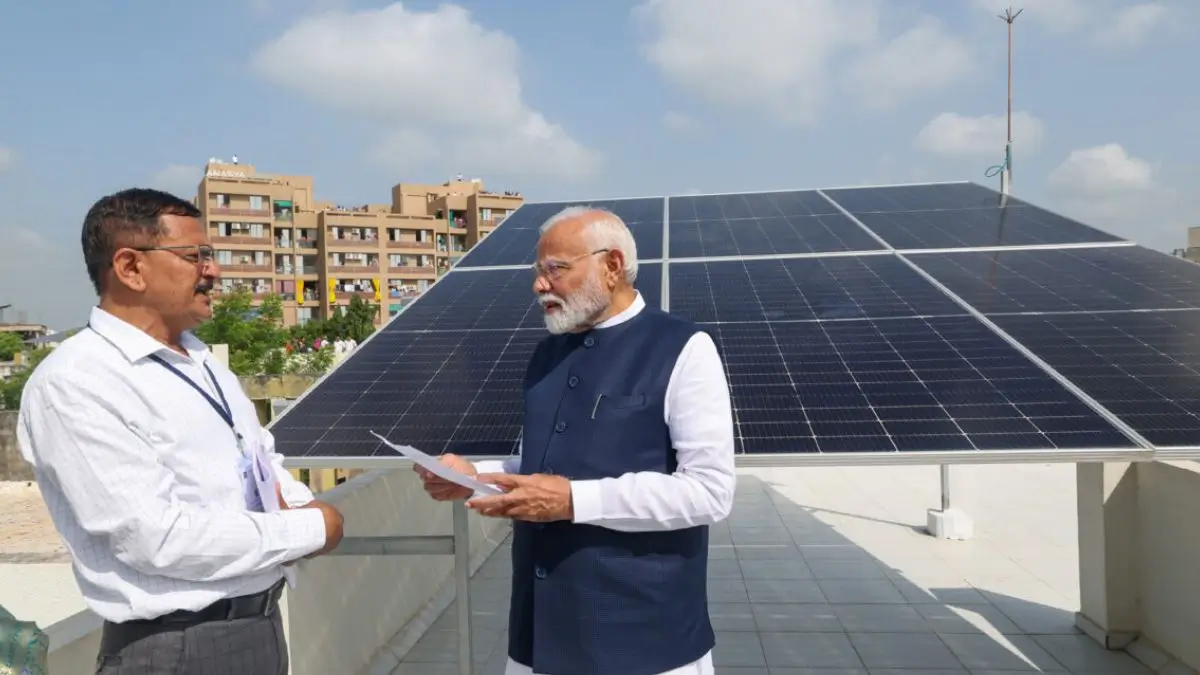
The PM Surya Ghar: Muft Bijli Yojana has completed two years since its launch, marking a significant phase in India’s rooftop solar journey. Launched with an ambitious outlay of ₹75,021 crore, the scheme aims to cover at least one crore households by promoting residential rooftop solar installations. Under the scheme, beneficiaries receive up to 300 units of free electricity per month and subsidies of up to ₹78,000 for a 3 kW solar system. On its second anniversary, the scheme shows impressive growth but also faces execution challenges.
What Is PM Surya Ghar: Muft Bijli Yojana?
The PM Surya Ghar: Muft Bijli Yojana is a flagship initiative promoting rooftop solar energy for households.
Key benefits include,
- Subsidy up to ₹78,000 for 3 kW systems
- Up to 300 units of free electricity monthly
- Reduced electricity bills
- Contribution to clean energy transition
The scheme aligns with India’s renewable energy goals and aims to decentralize power generation at the household level.
Rapid Growth in Rooftop Solar Installations
- One of the most striking outcomes of PM Surya Ghar is the surge in installations.
- According to industry leaders, residential solar installations have grown from around 8,000 units per month in 2021 to nearly 2 lakh units per month in early 2026.
- Companies like Solar Square have reported installing around 40,000 systems, indicating strong consumer interest.
- The sharp rise reflects growing awareness, falling solar panel costs, and improved policy support.
Financial Incentives Driving Adoption
The financial design of PM Surya Ghar has played a crucial role in boosting adoption. By offering significant upfront subsidies and guaranteeing free electricity up to 300 units, the scheme makes rooftop solar affordable for middle-class and lower-income households.
For a typical 3 kW system,
- Consumers receive up to ₹78,000 subsidy
- Savings on monthly electricity bills
- Return on investment within a few years
This combination of subsidy and long-term savings has accelerated market penetration.
Execution Bottlenecks: What Are the Challenges?
Despite healthy growth, several bottlenecks remain,
- Delays in subsidy disbursement
- DISCOM-level approval slowdowns
- Grid connectivity constraints
- Technical inspection backlogs
These operational challenges sometimes slow installation timelines and discourage potential adopters. Streamlining coordination between installers, DISCOMs, and government agencies remains critical.
Broader Impact on India’s Energy Transition
- India aims to expand renewable energy capacity significantly in the coming years.
- Rooftop solar plays a crucial role in reducing transmission losses, empowering households, and lowering carbon emissions.
- The PM Surya Ghar scheme supports India’s broader commitments under global climate agreements and strengthens energy security by reducing dependence on conventional power sources.
Question
Q. Under PM Surya Ghar, households can receive subsidy up to,
A) ₹50,000
B) ₹60,000
C) ₹78,000
D) ₹1,00,000


 Ministry of Textiles Extends RoSCTL Sche...
 Delhi Government Launches the Lakhpati B...
 What Is Amrit Bharat Station Scheme? Gov...











