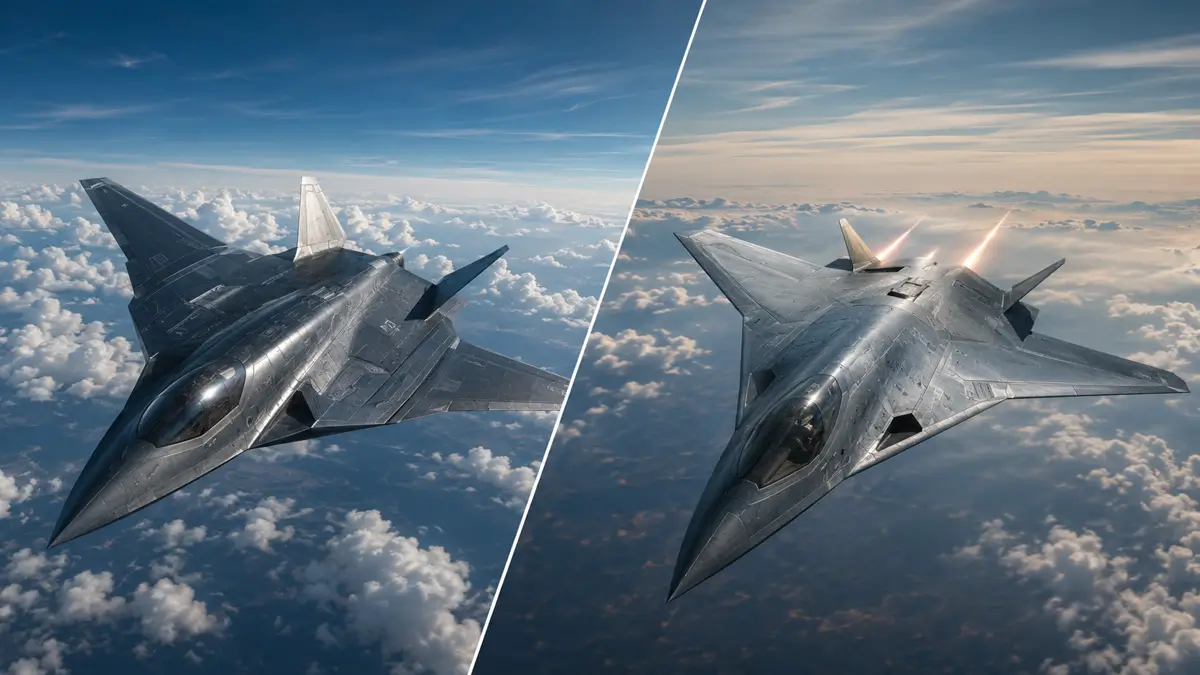
Modern air combat is entering a revolutionary phase. While several countries are still developing 6th-generation fighter jets, defence experts have already started discussing the concept of 7th-generation fighter aircraft. These futuristic war machines are expected to redefine aerial warfare using artificial intelligence, autonomous systems, hypersonic technology, and advanced stealth capabilities.
What Are 6th-Generation Fighter Jets?
6th-generation fighter jets are the next major evolution after 5th-generation aircraft like the F-35 Lightning II and Sukhoi Su-57.
Countries such as the United States, China, the United Kingdom, and Japan are currently working on these advanced aircraft programs.
Key Features of 6th-Generation Fighters
- Advanced stealth technology
- AI-assisted combat systems
- Drone wingman integration
- Directed-energy weapons (laser systems)
- Enhanced electronic warfare capabilities
- Hypersonic weapon compatibility
- Real-time battlefield data sharing
Major 6th-Generation Projects
- F-47 – United States
- Tempest – United Kingdom, Italy, Japan
- NGAD – United States
- FCAS – France, Germany, Spain
What Could 7th-Generation Fighter Jets Look Like?
7th-generation fighters are still mostly theoretical, but military experts believe they may become reality after 2040. These aircraft may not even require human pilots inside the cockpit.
Expected Features of 7th-Generation Fighters
1. Fully Autonomous AI Combat
Future jets may operate independently using highly advanced artificial intelligence capable of making combat decisions in real time.
2. Optional or No Human Pilot
Pilots may control the aircraft remotely from ground stations, reducing risks to human life.
3. Quantum Radar & Invisible Stealth
7th-generation aircraft could use quantum technologies to detect stealth enemies while remaining nearly invisible themselves.
4. Hypersonic Speed
These jets may travel beyond Mach 6, making interception extremely difficult.
5. Space-Air Combat Capability
Experts predict future fighters could operate in both Earth’s atmosphere and near-space environments.
6. Swarm Drone Command Systems
One fighter jet may control dozens of AI-powered combat drones simultaneously.
7. Energy Weapons
High-powered laser weapons and microwave systems may replace traditional missiles in some missions.
Key Difference: 6th vs 7th Generation Fighter Jets
United States
The US is currently leading with programs like NGAD and advanced AI combat systems.
China
China is rapidly developing stealth aircraft and autonomous drone warfare technology.
Russia
Russia continues to invest in hypersonic missile integration and advanced air combat systems.
United Kingdom & Japan
The Tempest program is among the world’s most ambitious future fighter projects.
India
India is developing the AMCA stealth fighter and expanding indigenous drone warfare capabilities.
Why These Fighter Jets Matter
Future wars may be dominated by:
- Artificial intelligence
- Autonomous drones
- Cyber warfare
- Hypersonic weapons
- Space-based military systems
The race for 6th and 7th-generation fighter jets is not just about air superiority — it is about technological dominance in future warfare.








 SIMBEX-2026: 33rd India-Singapore Mariti...
 IBSAMAR 2026: 9th India-Brazil-South Afr...
 India-Australia Joint Military Exercise ...