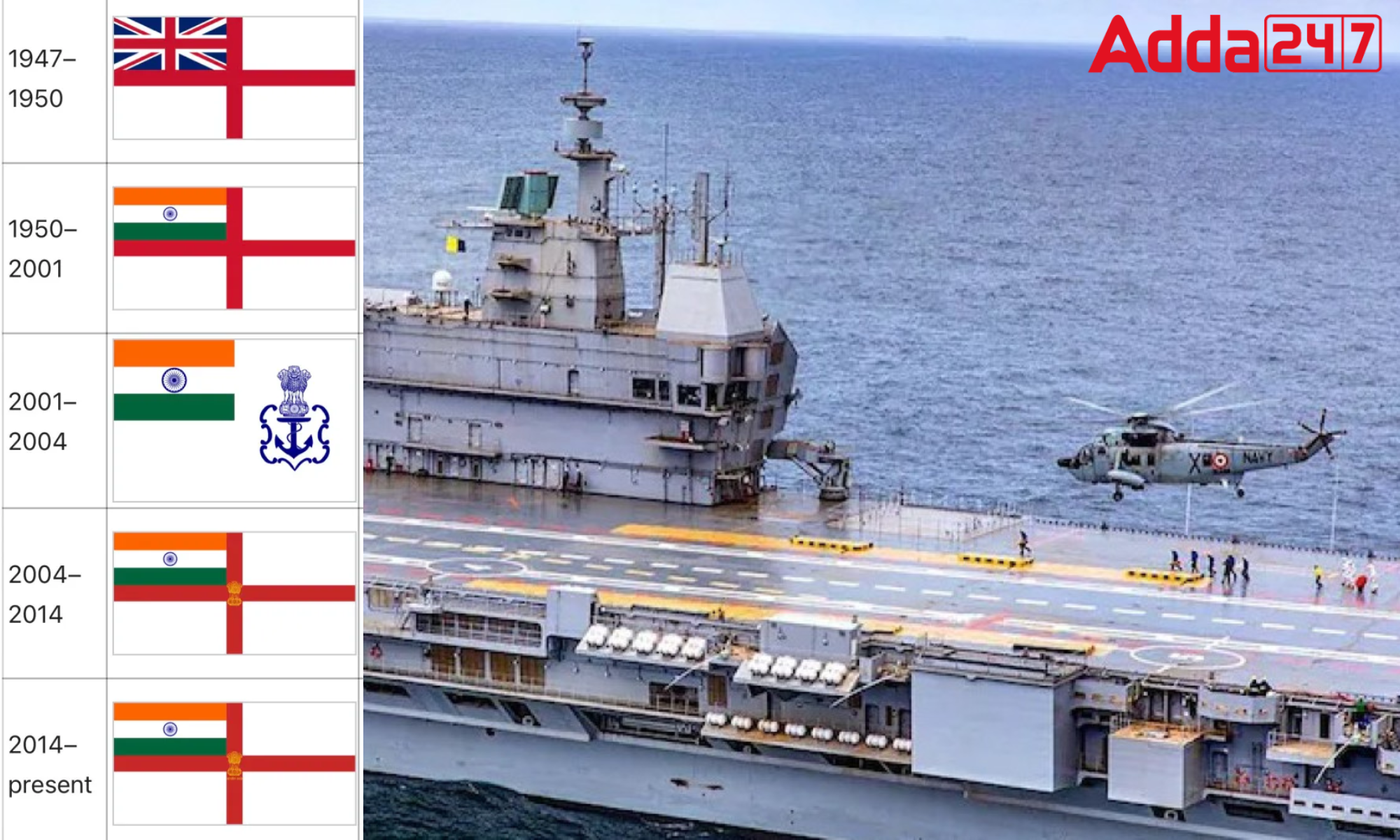
Prime Minister Narendra Modi will reveal a new ensign of the Indian Navy (New Naval ensign), at the aircraft carrier INS Vikrant Commissioning celebration on September 2. He will formally inaugurate the nation’s first aircraft carrier, INS Vikrant. The Indian Navy will receive a New Naval ensign on September 2 without the Saint George’s cross that has been on its flag since the British placed it during the pre-independence era. The cross sign was removed from the flag between 2001 and 2004 while Atal Bihari Vajpayee was in office, but it was reinstated once the UPA led by Manmohan Singh took back power.
Bank Maha Pack includes Live Batches, Test Series, Video Lectures & eBooks
New Naval ensign: Key Points
- “PM Modi will also present the New Naval ensign (Nishaan), doing away with the colonial history and fitting for the rich Indian maritime legacy”, according to a statement released by the Prime Minister’s Office (PMO).
- The Indian Navy will receive a New Naval ensign on September 2 without the Saint George’s cross that has been on its flag since the British placed it during the pre-independence era.
- The cross sign was taken off the flag between 2001 and 2004 under the Atal Bihari Vajpayee administration, but it was put back on after the Sonia Gandhi-led UPA regained power.
- The government noted several objections made by then-Navy authorities over the insignia (New Naval ensign).
New Naval ensign: Historic Importance
- The Cholas and later the Marathas were among the historic Indian navies, according to the Navy officials, who stated that there was also a suggestion to include a sign from their era.
- President Droupadi Murmu, who serves as the Supreme Commander of the armed forces, would grant her final permission after Prime Minister Narendra Modi. On September 1 and 2, the prime minister will travel to Kerala and Karnataka.
- The hallowed birthplace of Adi Shankaracharya, Sri Adi Shankara Janma Bhoomi Kshetram, will be visited by PM Modi on September 1. He will inaugurate the nation’s first aircraft carrier, INS Vikrant, on September 2 at Kochi’s Cochin Shipyard Limited.
- The Prime Minister will then inaugurate and lay the cornerstone for projects worth roughly 3,800 crores at Mangaluru, Karnataka, at 1:30 PM.
About INS Vikrant
- The INS Vikrant was built by Cochin Shipyard Limited, a Public Sector Shipyard under the Ministry of Ports, Shipping & Waterways, and was designed by the Indian Navy’s internal Warship Design Bureau (WDB).
- The largest ship ever constructed in India’s maritime history is the INS Vikrant. It was constructed with cutting-edge automation features.
- The Indigenous Aircraft Carrier bears the name of her esteemed predecessor, India’s first aircraft carrier, which had an important role to play in the war of 1971.
- There are several pieces of indigenous machinery and equipment, produced by big industrial companies nationwide as well as more than 100 MSMEs.
Find More News Related to Defence










 Current Affairs Capsule PDF (27 June 202...
 IAF Equips 40 Sukhoi Su-30MKI Fighter Je...
 India Sets Record with 7 Schools Shortli...