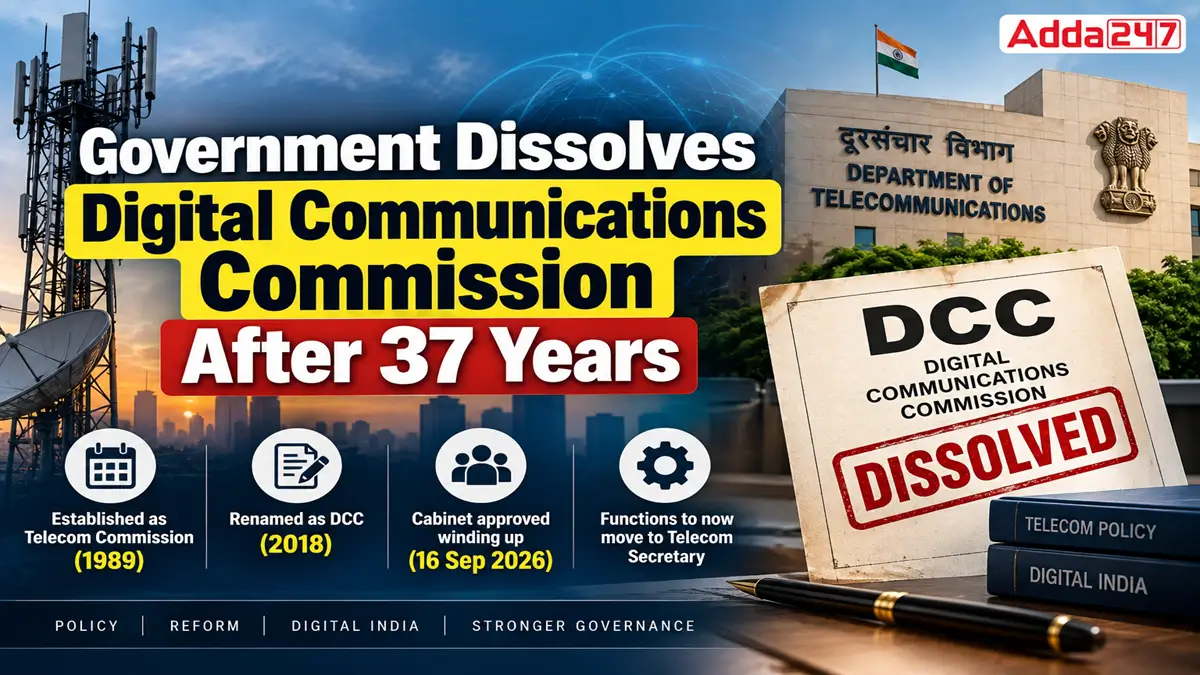
The Government of India has dissolved the Digital Communications Commission (DCC), the apex inter-departmental decision-making body under the Department of Telecommunications (DoT). The move brings an end to an institution that had functioned for nearly 37 years, first as the Telecom Commission and later as the DCC.
The Union Cabinet approved the winding up of the Commission on September 16, 2026, while the dissolution took effect following the publication of a government resolution dated September 19, 2026.
Digital Communications Commission Dissolved
The DCC played a major role in India’s telecommunications administration and handled important policy and administrative matters concerning the telecom and digital communications sectors.
Following its dissolution, responsibilities previously handled through the Commission will move more directly through the Telecom Secretary, with approvals from the Communications Minister and Union Cabinet wherever required.
Key Facts
| Particular | Details |
|---|---|
| Body | Digital Communications Commission |
| Abbreviation | DCC |
| Parent department | Department of Telecommunications |
| Originally established as | Telecom Commission |
| Established | April 1989 |
| Renamed as DCC | October 2018 |
| Cabinet approval for dissolution | September 16, 2026 |
| Government resolution | September 19, 2026 |
| Period of existence | Nearly 37 years |
| Last meeting | September 3, 2026 |
From Telecom Commission to Digital Communications Commission
The institution was originally established in April 1989 as the Telecom Commission.
For decades, it served as an important institutional mechanism for policy formulation and administrative decision-making in India’s telecommunications sector.
In October 2018, the Telecom Commission was re-designated as the Digital Communications Commission following the adoption of the National Digital Communications Policy, 2018.
The change reflected the transformation of India’s telecom sector from conventional telecommunications towards a broader digital communications ecosystem.
Why Was the DCC Dissolved?
One of the factors behind the decision was an overlap between the Commission’s membership and departmental advisers within the DoT.
The government viewed this arrangement as involving duplication in the decision-making structure. Vacancies in important DCC posts also formed part of the administrative context surrounding the decision.
The Commission had vacant member posts at the time of its dissolution, while its finance member was scheduled to retire in February 2027.
In addition, the Finance Ministry already exercised budget approval authority for relevant matters, further reducing the need for a separate layer of decision-making.
What Did the Digital Communications Commission Do?
The DCC functioned as an apex body for dealing with policy and administrative issues related to India’s telecommunications and digital communications sectors.
Its structure included senior DoT officials and departmental advisers and also provided for financial oversight.
Over the years, the Commission was involved in important decisions concerning telecom policy, spectrum and other administrative and financial matters in the sector.
DCC’s Last Meeting Held on September 3
The final meeting of the Digital Communications Commission was held on September 3, 2026.
One of its significant final areas of decision-making concerned satellite communication spectrum.
The Commission finalised decisions that included a five-year administrative spectrum assignment, which could be extended for another two years.
It also finalised a Spectrum Usage Charge (SUC) of 5% of Adjusted Gross Revenue (AGR).
What Happens After the Dissolution?
The dissolution does not mean that the policy and administrative responsibilities handled by the Commission will disappear.
Instead, these matters will now be processed more directly through the Telecom Secretary.
Where necessary, proposals will subsequently be placed before the Communications Minister or the Union Cabinet for approval.
The change is therefore aimed at creating a more direct administrative decision-making structure within the telecommunications department.
About National Digital Communications Policy 2018
The National Digital Communications Policy (NDCP), 2018 was introduced to address the changing nature of India’s communications sector amid rapid growth in broadband, digital connectivity and emerging technologies.
Following the policy’s adoption, the Telecom Commission was renamed the Digital Communications Commission in October 2018.
The re-designation reflected the government’s broader focus on digital communications rather than traditional telecommunications alone.
Why is This Important?
The dissolution is significant because the DCC had been part of India’s telecom policymaking architecture since 1989.
Its winding up marks a major institutional change in how policy and administrative decisions within the Department of Telecommunications will be processed.
With its functions moving more directly to the Telecom Secretary and higher authorities where necessary, the government is reducing an institutional layer that it considered duplicative.
Key Points for Exams
- Digital Communications Commission (DCC) has been dissolved after nearly 37 years.
- It functioned under the Department of Telecommunications (DoT).
- It was established as the Telecom Commission in April 1989.
- Telecom Commission was renamed the Digital Communications Commission in October 2018.
- The renaming followed the National Digital Communications Policy, 2018.
- Union Cabinet approved its winding up on September 16, 2026.
- Government resolution was dated September 19, 2026.
- The DCC’s last meeting took place on September 3, 2026.
- Its last spectrum decisions included a five-year administrative assignment, extendable by two years.
- Spectrum Usage Charge was fixed at 5% of AGR.
- After dissolution, relevant matters will move more directly through the Telecom Secretary.








 7th National Formulary of India 2026 Lau...
 ONGC Strikes Gas in Mahanadi Offshore Un...
 India Co-Sponsors Inaugural P4M Summit a...