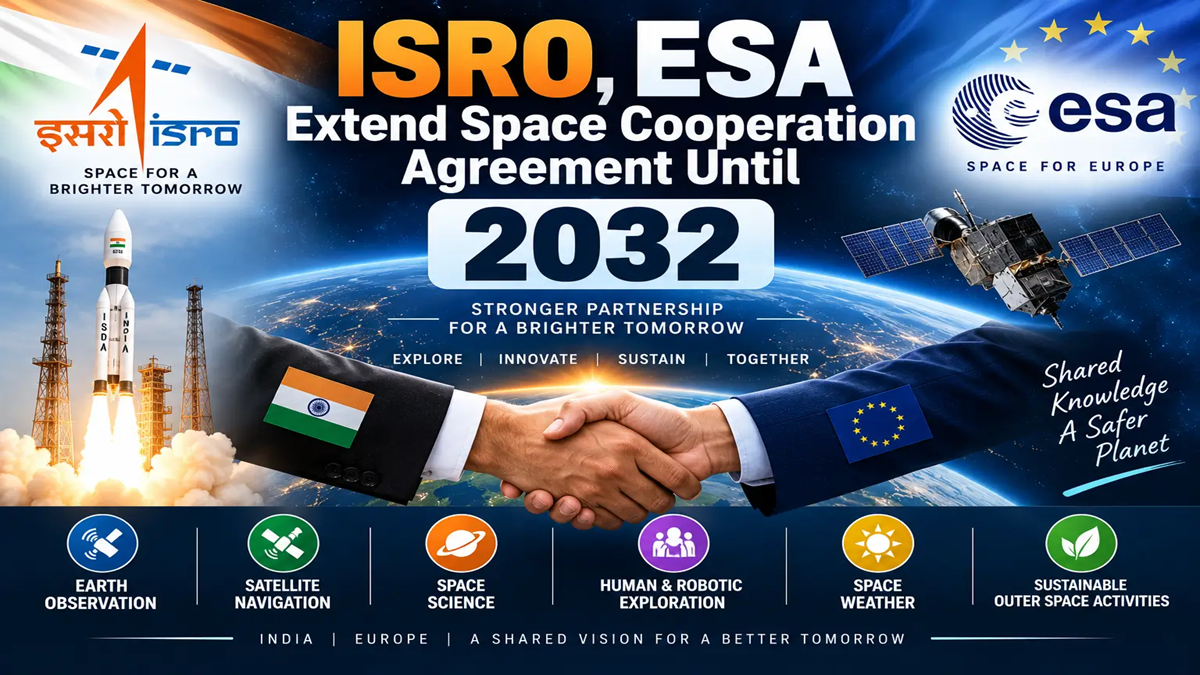
The Indian Space Research Organisation (ISRO) and the European Space Agency (ESA) have extended their long-standing Cooperative Agreement until January 8, 2032, strengthening India-Europe collaboration in space exploration and research. The extension was formalised through an exchange of letters in Paris on September 10, 2026, during the International Space Summit.
The renewed framework covers important areas including human and robotic exploration, space weather and sustainable outer space activities, while continuing cooperation in Earth observation, navigation, space science and mission support.
ISRO-ESA Cooperation Extended Until 2032
The Cooperative Agreement provides the broad institutional framework under which ISRO and ESA collaborate on space-related activities.
The original agreement came into force in January 2002, meaning the two agencies have worked within this formal cooperation framework for more than two decades.
The latest extension keeps the agreement valid until January 8, 2032.
Who Signed the Extension?
The extension documents were signed by ISRO Chairman Dr. V. Narayanan and ESA Director General Josef Aschbacher.
The agreement provides continuity to cooperation between the two major space agencies and creates a framework for further collaboration in emerging areas of space exploration.
Major Areas of ISRO-ESA Cooperation
ISRO and ESA have collaborated for more than two decades across several areas of space science and technology.
Their cooperation includes Earth observation, satellite navigation, space science and mission operations support.
Under the renewed framework, greater emphasis is also being placed on:
- Human space exploration
- Robotic space exploration
- Space weather
- Sustainable use of outer space
These areas have become increasingly important as the number and complexity of international space missions continue to expand.
Cooperation in Earth Observation
In March 2026, ISRO and ESA signed another agreement covering joint calibration and validation activities and scientific studies for Earth observation missions.
Calibration and validation are important for ensuring that observations made by satellite instruments are accurate, consistent and scientifically reliable.
Earth observation satellites have applications in areas including weather monitoring, agriculture, mapping, disaster management and environmental studies.
Cooperation in Human Space Exploration
ISRO and ESA have also been expanding their partnership in human spaceflight.
In 2025, the two agencies signed a Joint Statement of Intent on human exploration, establishing another avenue for collaboration in space exploration activities.
Human space exploration involves missions carrying astronauts, while robotic exploration involves uncrewed spacecraft, probes and other robotic systems used for scientific and exploration purposes.
Focus on Space Weather
Space weather is another important component of the renewed cooperation.
It refers to conditions in the space environment that are influenced largely by activity on the Sun. Solar events can affect satellites and other technological systems.
Space-weather phenomena can potentially disrupt satellite operations, communication systems, navigation signals and power grids, making monitoring and research increasingly important.
Sustainable Outer Space Activities
The renewed cooperation also includes sustainable outer space activities.
Space sustainability focuses on ensuring that outer space can continue to be used safely and responsibly over the long term. It includes issues associated with safe spacecraft operations and responsible management of the increasingly crowded space environment.
International cooperation is particularly important in this area because satellites and space missions from many countries operate in shared orbital environments.
About ISRO
The Indian Space Research Organisation (ISRO) was established in 1969 and operates under the Department of Space, Government of India.
ISRO is India’s national space agency and undertakes activities spanning satellite development, launch vehicles, Earth observation, navigation, communications, space science and exploration.
About European Space Agency
The European Space Agency (ESA) was established in 1975.
It is an intergovernmental organisation that undertakes space research, exploration, Earth observation and other space programmes through cooperation among its member states.
Why is the Agreement Important?
Extending the agreement until 2032 provides a long-term framework for ISRO and ESA to deepen cooperation across established and emerging areas of space activity.
The partnership combines experience in satellite missions and space science with growing cooperation in human exploration, robotic missions, Earth observation and space sustainability.
The agreement also reflects the increasingly collaborative nature of major space programmes, where agencies share scientific knowledge, infrastructure and operational expertise.
Key Points for Exams
- ISRO and ESA have extended their Cooperative Agreement.
- The agreement is now valid until January 8, 2032.
- Extension formalised on September 10, 2026.
- The exchange of letters took place in Paris during the International Space Summit.
- The original Cooperative Agreement came into force in January 2002.
- ISRO Chairman: Dr. V. Narayanan.
- ESA Director General: Josef Aschbacher.
- Key cooperation areas include human and robotic exploration, space weather and sustainable outer space activities.
- ISRO and ESA signed an Earth observation cooperation agreement in March 2026.
- A Joint Statement of Intent on human exploration was signed in 2025.
- ISRO was established in 1969.
- ESA was established in 1975.








 World Bank Ranks India Among Top 10 Emer...
 Elon Musk to Rename SpaceXAI as SpaceXSI
 Kerala Develops AI-Based Dengue Early Wa...