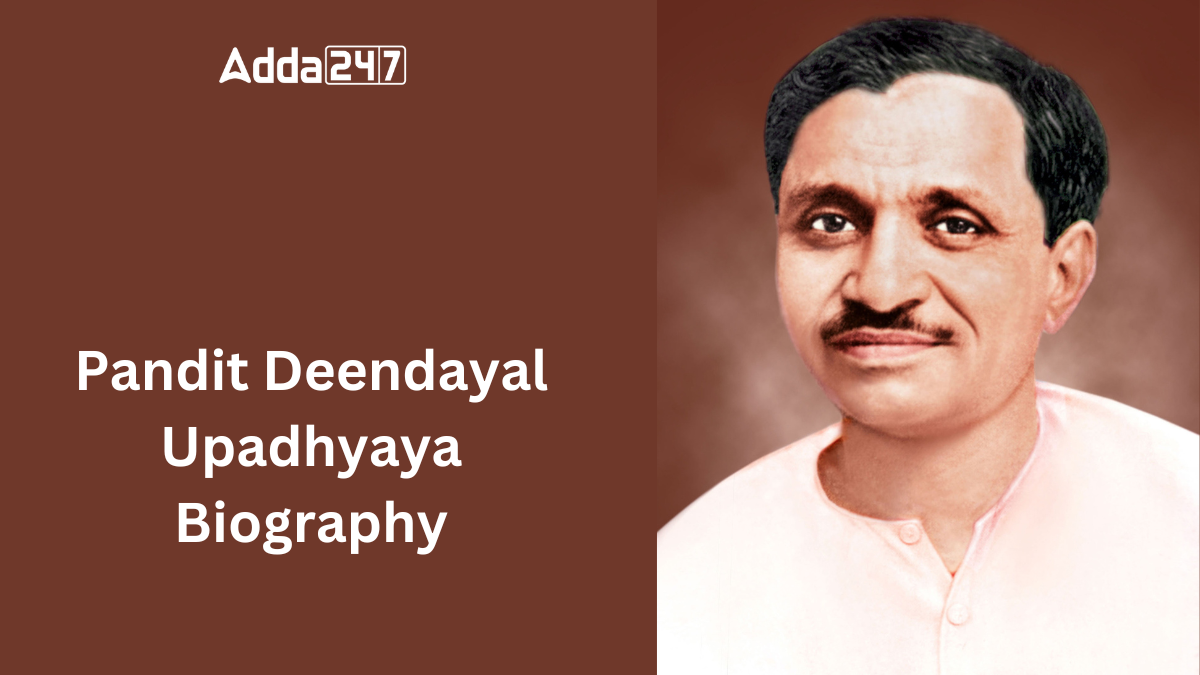
Deendayal Upadhyaya, born on September 25, 1916, in Mathura District, India, was a prominent politician and ideologue known for his integral humanism. As a key leader of the Bharatiya Jana Sangh (BJS), which later evolved into the Bharatiya Janata Party (BJP), Upadhyaya made significant contributions to Indian politics and society. His philosophy, rooted in Hindutva and Gandhian socialism, has influenced many political movements in India.
Key Details of Pandit Deendayal Upadhyaya
- Date of birth: 25th September 1916
- Place of birth: Mathura, United Provinces, British India
- Political Party: Bharatiya Janata Party
- Known for: Integral Humanism
- Death: 11th February 1968
- Place of death: Mughalsarai, British India
Early Life of Pandit Deendayal Upadhyaya
Upadhyaya was born into a Brahmin family in Nagla Chandraban. Tragically, he lost both parents by the age of eight and was raised by his maternal uncle. His education took him to several schools, culminating in a BA degree from Sanatan Dharma College, Kanpur. Despite starting a master’s degree in English literature at St. John’s College, Agra, he could not complete it due to family and financial issues. Known as Panditji for his traditional attire during civil services examinations, he began to establish himself in public life early on.
Political Career of Pandit Deendayal Upadhyaya
Deendayal Upadhyaya’s political journey began with the Rashtriya Swayamsevak Sangh (RSS), where he became a full-time worker in 1942. He later founded the monthly publication Rashtra Dharma in the 1940s, aiming to promote Hindutva ideology.
In 1951, when Syama Prasad Mookerjee established the Bharatiya Jana Sangh, Upadhyaya was appointed General Secretary of its Uttar Pradesh branch. He played a crucial role in shaping the party’s ideology, particularly through his work on the doctrine of integral humanism, which emphasized cultural nationalism and social progress.
Despite facing challenges, including a failed electoral bid for the Lok Sabha in 1963, Upadhyaya helped the BJS become the third-largest party in the Lok Sabha after the 1967 general elections. He was elected president of the BJS in December 1967, shortly before his untimely death.
Contribution to Integral Humanism
Integral humanism, the political philosophy drafted by Upadhyaya, was officially adopted by the Jan Sangh in 1965. It emphasized a holistic approach to human development, blending individual rights with collective responsibility, and sought to create a balance between modernity and tradition.
Pandit Deendayal Upadhyaya – Death
On February 10, 1968, Upadhyaya’s life was tragically cut short. After boarding a train from Lucknow to Patna, he was found dead near Mughalsarai station. Initial investigations suggested he had been pushed from the train by robbers. Despite a detailed inquiry by the Central Bureau of Investigation, the murder remains officially unresolved, with many speculating about political motivations behind his death.
Legacy of Pandit Deendayal Upadhyaya
Deendayal Upadhyaya’s influence continues to resonate in Indian politics. Since 2016, the BJP government has honored his legacy by naming various institutions and public spaces after him. Notable commemorations include roads, a bridge in Surat, and the Pandit Deendayal Upadhyaya Memorial Centre in Varanasi, inaugurated by Prime Minister Narendra Modi.









 UNESCO World Heritage Sites of India - D...
 Jamnagar Refinery: Why India's Oil Hub M...
 UNESCO World Heritage Sites of India - D...