
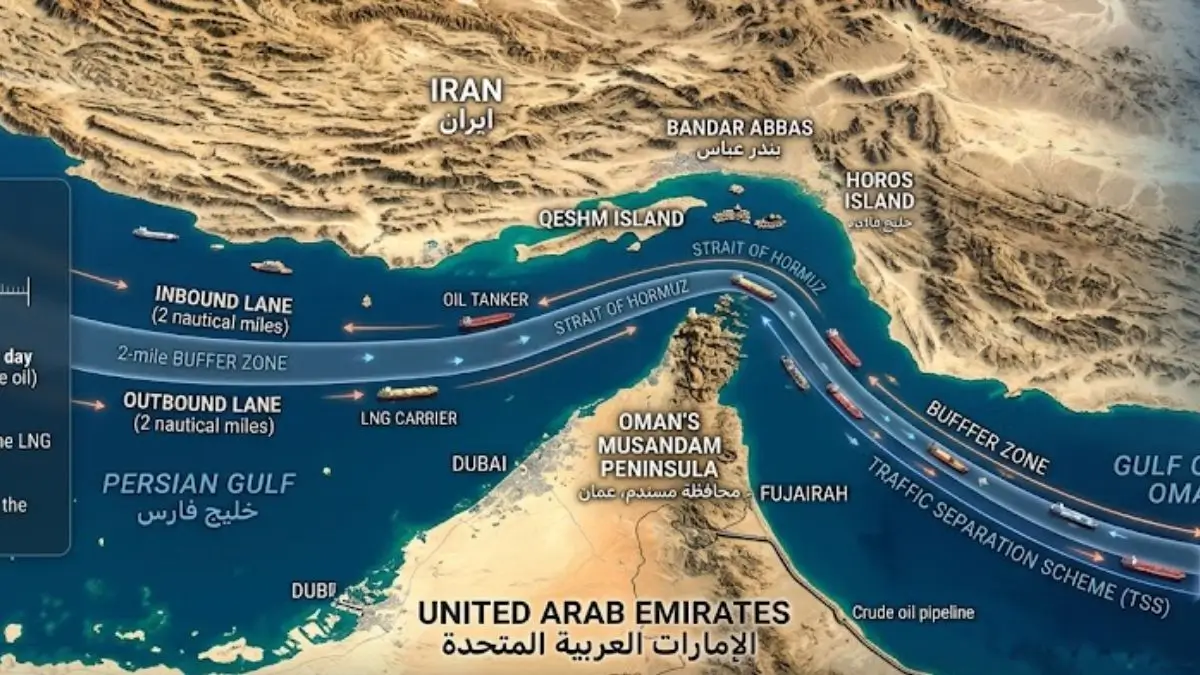
As the escalation in West Asia still continue around 22 countries have join hands to protect the shipping through the Strait of Hormuz in March 2026. This decision comes amid rising tensions with Iran and other country. The Hormuz sea route carries nearly 20 million barrels of oil daily and making it vital for global energy supply. The move comes after Iran imposed restrictions on the navigation through strait raising fears of disruptions.
Strait of Hormuz Crisis 2026
The crisis began when the Iran announced the restrictions on ships which are passing through the Strait of Hormuz after 2nd of March 2026.
Also Iran has warned that vessels who does not have coordination could be targeted. This raised serious concerns globally and disruptions of the supply everywhere.
The move was reportedly comes in response to ongoing US-Israel military actions which escalated tensions in the Gulf region.
As a result of this global shipping routes faced uncertainty and also leading to immediate diplomatic and security responses.
Download February Month Current Affairs PDF
22-Nation Coalition: Countries Involved and Their Role
The strong coalition of 22 countries comes together which are major global powers and they have stepped forward to secure maritime routes and ensure uninterrupted trade.
Key Countries in the Coalition are like,
- UAE and Bahrain (Leading roles)
- United Kingdom, France, Germany, Italy
- Japan, Canada, South Korea, Australia
- Nordic and European nations like Sweden, Norway, Finland
The coalition has condemned the attacks on civilian vessels and also stated the importance of freedom of navigation under international law.
Why Strait of Hormuz is Critical for Global Economy
The Strait of Hormuz is one of the most important and crucial chokepoints in the world for oil transportation.
Any disruption in strait route directly affects global markets.
Importance of the Strait is,
- It handles around 20% of global oil supply
- Also connects Middle East oil producers to global markets
- Essential for energy security of many countries
Even small disruptions can lead to fuel price increases and economic instability worldwide.
Impact on Global Energy Markets and Trade
The current tensions have already started affecting global markets and fear for the oils shortage.
Shipping costs have increased and insurance premiums for vessels have gone up significantly.
To manage the situation the International Energy Agency (IEA) has stepped in to coordinate the release of strategic oil reserves and aiming to stabilize supply and prices.
Question
Q. The Strait of Hormuz connects which two water bodies?
A. Red Sea and Arabian Sea
B. Persian Gulf and Gulf of Oman
C. Mediterranean Sea and Red Sea
D. Arabian Sea and Bay of Bengal








 Greece Approves Social Media Ban for Chi...
 France Confirms First Human Case of Sham...
 Nigeria Reports Imported Case of Ebola B...










