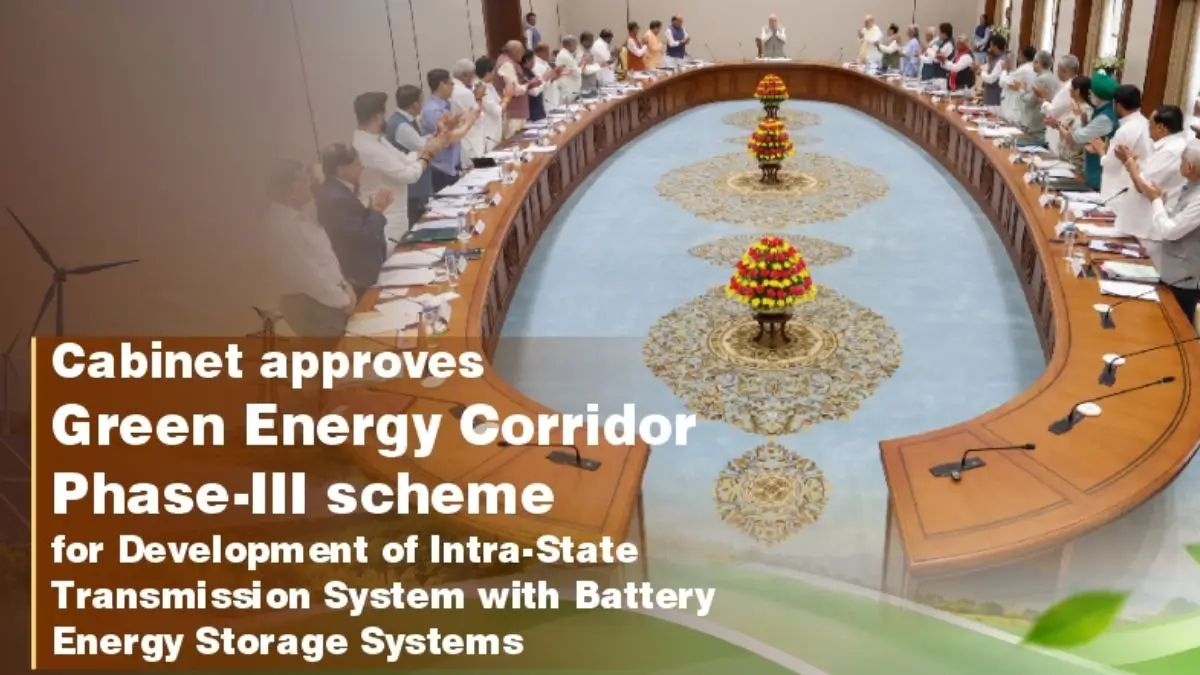
The Union Cabinet has sanctioned the Green Energy Corridor Phase-III (GEC-III) project for improving India’s Intra-State Transmission System (InSTS) to enable transmission of up to 135 GW of renewable energy. The total outlay of the project is ₹1,86,405 crore, which will include deployment of 50 GWh of Battery Energy Storage Systems (BESS). The projects are expected to be completed by FY 2032-33, for which the government will provide ₹54,082 crore funding.
What Is GEC-III or Green Energy Corridor Phase-III?
GEC-III refers to the third phase of the Green Energy Corridor program for intra-state transmission of electricity. Its purpose is to provide stronger transmission facilities in each State or Union Territory to facilitate integration and transport of electricity generated from renewable sources of energy to places where it is required.
The project involves not only transmission but also battery storage. Battery storage is meant to solve the problem of variation in renewable power generation and make the grid flexible enough during times of high demand or when there is no solar generation.
Green Energy Corridor has been implemented by the Ministry of New and Renewable Energy (MNRE) to build dedicated transmission facilities for integration of renewable energy into the country’s power grid. Implementation of phase I started in 2015.
Important Financial Information About GEC-III
The approved plan has a total project cost of ₹1,86,405 crore which will be allocated to intra-state transmission systems and battery storage facilities.
- Total Project Cost: ₹1,86,405 crore
- Intra-State Transmission System (InSTS): ₹1,36,378 crore
- Battery Energy Storage System (BESS): ₹50,000 crore
- Capacity of BESS: 50 GWh
- Central Financial Support (CFS): ₹54,082 crore
- Renewable Energy Transmission: Capacity Up to 135 GW
- Completion Target: FY 2032-33
- Supporting non-fossil fuel power capacity: 900 GW by 2035
₹54,082 crore Central Financial Support (CFS) has been provided for reducing intra-state transmission costs as well as the cost of renewable energy for consumers.
50 GWh Battery Energy Storage System
The other unique characteristic of GEC-III involves the use of 50 GWh of Battery Energy Storage Systems (BESS). The storage system can be located at the renewable energy developer or generator site or elsewhere within the electricity network.
Use of BESS is meant to overcome a number of issues that arise from renewable energy power plants, especially intermittency. The storage capacity is expected to deal with,
- Intermittency of renewable energy power
- Grid transmission congestion
- Peak-hour curtailing
- Demand during non-solar periods
- Grid flexibility
The battery system is therefore supposed to facilitate storage of the electricity that is produced during times of high production of renewable energy and distribution during low production periods.
GEC-III Implementation
The strategy adopts distinct modes of implementation for both greenfield transmission infrastructure construction and brownfield transmission network upgrade projects.
The former will be done using the Tariff Based Competitive Bidding (TBCB) under the InSTS part. In this approach, the transmission service providers will vie for project development and operations.
On the other hand, brownfield network enhancement will be undertaken using the Cost Plus Basis (CPB) method.
The State Transmission Utilities (STUs) will act as the implementing agencies while the TBCB transmission service providers will undertake their operations using the BOOM strategy.
GEC-I & GEC-II: Direct Relationship
The Green Energy Corridor project was designed after a POWERGRID study in 2012 that pointed out inadequate transmission infrastructure near potential sites for large-scale solar and wind power. Transmission plans were prepared by the states, and the programme began implementation in 2015 after obtaining the requisite approvals.
Prior to GEC-III, the intra-state corridor project had two phases:
Phase Wise Specific details
- GEC-I: Transmission Infrastructure for evacuation of renewable energy
- GEC-II: Transmission System for integration of around 20 GW of Renewable Energy Generation
- GEC-III: Evacuation of up to 135 GW of renewable energy + 50 GWh BESS
The states implementing GEC-II include Gujarat, Himachal Pradesh, Karnataka, Kerala, Rajasthan, Tamil Nadu and Uttar Pradesh. This will involve about 10,750 ckm of transmission lines and 27,500 MVA substations for integration of around 20 GW of Renewable Energy Generation Capacity.







 UPSC Completes 100 Years: From Public Se...
 Gujarat Restructures Porbandar Forest Di...
 PM-RKVY: ₹1,200 Crore Sanctioned to 10...