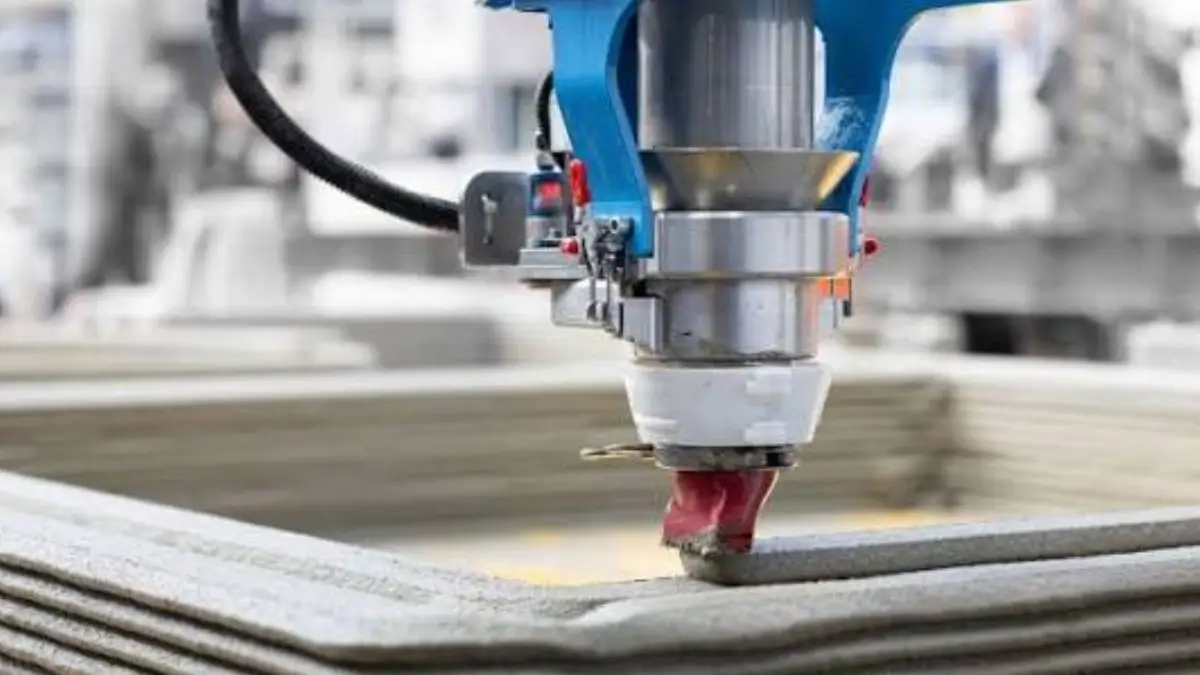
In Andhra Pradesh, India has initiated its first pilot project for building houses for rural communities through 3D Concrete Printing (3DCP) technology under the PMAY-G 2.0 scheme. There are 177 houses covered under this pilot project that have been undertaken in Guntur district with an estimated cost of ₹14 crore.
3D Printed Rural Housing Pilot: Key Points
- State Who Initiated: Andhra Pradesh
- District: Guntur
- Location: Burripalem and Obulnayudupalem
- Total houses: 177
- Technology: 3D Concrete Printing (3DCP)
- Scheme: PMAY-G 2.0
- Estimated Cost: About ₹14 crore
- Target Completion: Around six months
- Technical Institution: CSIR-CBRI, Roorkee
- Status: India’s first national-level rural housing 3DCP pilot
Out of the total 177 houses, 100 houses are to be built at Burripalem, whereas 77 houses are to be built at Obulnayudupalem/Pothuru in Guntur district.
The project has an estimated cost of about ₹13.93 crore excluding taxes. Out of this total cost, Union Ministry of Rural Development is contributing ₹9.44 crore, whereas the Andhra Pradesh Government is contributing ₹4.49 crore.
What is 3D Concrete Printing (3DCP)?
3D Concrete Printing (3DCP) is a form of additive manufacturing carried out on a construction scale where a computerized printer prints layers of specially formulated concrete to form structural elements.
Unlike the traditional technique of constructing buildings where bricks and blocks are laid manually and use of formwork, the 3DCP technology employs the use of a digital model and automated material deposition technique.
The main steps in the process include the following,
- Creation of a digital model: Buildings are digitally modeled using tools such as BIM (Building Information Modelling).
- Toolpath planning: The digital model is translated into specific computer controlled movements.
- Extrusion of materials: A robotic nozzle prints specially formulated concrete according to the toolpaths.
- Layer by layer construction: Depositing successive layers to form walls among other printable elements.
- Setting and curing: The material should set fast enough to support the deposited layers and obtain necessary qualities.
In order for 3DCP to be feasible, the concrete formulation must have desirable extruding and setting qualities.
How Could 3D Printing Impact Rural Housing?
There is scope for the reduction in construction time and labour for repetitive activities through the use of 3D printing technology.
Quick Building
- Through automated material deposition, building the walls can be much faster than traditional manual masonry. Whether such an advantage will translate into rural housing through the pilot project in Andhra Pradesh is yet to be seen.
Minimisation of Wasted Material
- Since material deposition happens through pre-set digital paths, there is a possibility of greater precision in construction and reduced wastage of material in traditional construction and formwork.
Reduced Reliance on Manual Masonry
- Through automation, reliance on some laborious construction processes could be reduced but not human labor itself.
Consistency in Design Through Digitized Design
- Through digitized design, a higher level of consistency could be achieved in dimension and patterns of construction in multiple houses.
Design Freedom
- 3D printing is capable of constructing curved walls among others which could require conventional formwork and manual labor.
What are the Difficulties in 3D Concrete Printing?
3DCP does not substitute for every aspect of traditional building.
There are certain aspects that need to be handled via traditional or hybrid building methods, which include,
- Foundation
- Structural reinforcement
- Roofing
- Electrical works
- Plumbing
- Doors and windows
- Finishing works
Moreover, this technology needs special concrete mixes, suitable machinery, skilled labor, quality control system and adequate energy and raw material supplies.
Furthermore, for rural application, transportation, site preparation, building requirements and rural climate can also affect the viability of 3D printing.
Thus, the Andhra Pradesh initiative is important not just because houses are being printed, but because it offers the chance to test the technology in actual rural housing scenario.
CSIR-CBRI’s Role
CSIR-Central Building Research Institute (CBRI), Roorkee, will be providing technical assistance to the pilot.
CBRI is an institute under Council of Scientific & Industrial Research (CSIR) and specializes in subjects related to building material technologies, construction techniques, civil and structural engineering.
Its participation bridges the pilot with the public sector Research and Development network in India.








 From Kuno to Durgavati, Cheetahs Find Th...
 Uttar Pradesh Renames Bhadohi as Sant Ra...
 Gujarat Uniform Civil Code Bill 2026 Get...