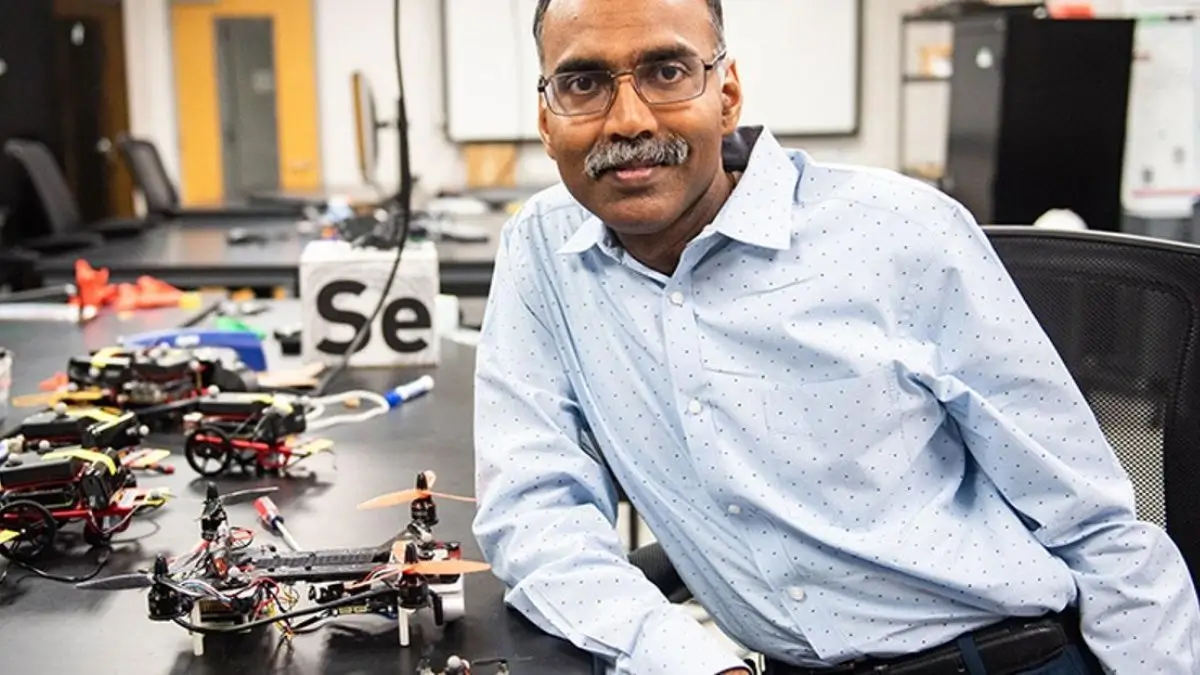
Maruthi R. Akella, an aerospace scientist and control systems engineer from the University of Texas at Austin has won the Indian Institute of Science (IISc) Distinguished Alumnus Award 2026. As an alumnus of IISc Bengaluru, Maruthi’s research group contributed to the in-situ guidance algorithm for Intuitive Machines’ IM-1 lunar lander ‘Odysseus’, which achieved the first US landing on the Moon since 1972, as well as the first soft landing on the Moon by a privately owned spacecraft. This demonstrates the contribution of Indian academia and researchers to global space exploration.
Who is Maruthi R. Akella?
Maruthi R. Akella is an aerospace scientist and control systems engineer who holds the Cockrell Family Chair in Engineering at the University of Texas at Austin in the USA.
He has been on the teaching faculty at the university since 1999. Maruthi is the head of the Controls Group for Distributed and Uncertain Systems (C-DUS), founder director of the Center for Autonomous Air Mobility and affiliated to the university’s Centre for Space Research.
His research focuses on mathematical and control algorithms for complex aerospace and robotic systems, including those in uncertain conditions. His research group also contributed to the in-situ guidance algorithm for Intuitive
Machines’ IM-1 lunar mission.
Education of Maruthi Akella
Maruthi first studied mechanical engineering before specialising in aerospace engineering.
| Qualifications | Institution | Year |
| BTech (Honours) Mechanical Engineering | National Institute of Technology Calicut | 1992 |
| ME (with distinction) Aerospace Engineering | Indian Institute of Science, Bengaluru | 1994 |
| PhD Aerospace Engineering | Texas A&M University, USA | 1998 |
Following his ME qualification from IISc, he became a research associate at Indian Space Research Organisation (ISRO) in their Space Technology Cell in Bengaluru.
In 1994, he moved to the USA to undertake his PhD research at Texas A&M University.
How did Akella’s algorithms enable the IM-1 lander?
One of Maruthi’s notable contributions to space exploration includes his research group contributing to Intuitive Machines’ IM-1 lunar mission.
The Nova-C lunar lander, known as Odysseus, delivered scientific equipment and technology demonstration to the Moon as part of NASA’s Commercial Lunar Payload Services (CLPS).
As stated by UT Austin, Maruthi’s research group contributed to the in-situ guidance algorithm. This allowed the spacecraft to determine how it should move.
What is Guidance, Navigation and Control?
Guidance, Navigation and Control systems allow a spacecraft to do the following,
- Guidance – Determine what path the spacecraft should take.
- Navigation – Estimate where the spacecraft is, how fast it is going and its orientation.
- Control – Control how the spacecraft moves.
During a lunar landing, these systems become very important as they allow the spacecraft to manage how it moves.
Algorithms can be used within the spacecraft to help them make any adjustments required based on data provided from the sensors. This reduces reliance on constant commands from Earth.
Maruthi’s research into nonlinear control, spacecraft attitude estimation and adaptive systems helps develop these autonomous systems.
What was the IM-1 lunar mission?
The IM-1 mission took place in February 2024. The Nova-C lunar lander ‘Odysseus’ was launched on February 15th 2024 using a SpaceX Falcon 9 Rocket.
It successfully landed near Malapert A in the south polar region of the Moon on February 22nd 2024.
This mission achieved two major accomplishments,
- It was the first successful landing on the Moon by the USA since Apollo 17 in 1972.
- It was the first successful soft landing on the Moon by a privately owned spacecraft.
The mission was performed as part of the NASA’s Commercial Lunar Payload Services (CLPS). This allows the private companies to be contracted by NASA to deliver scientific tools and technology demonstrations to the Moon.
This is part of NASA’s wider goals to encourage commercial exploration of the Moon.
Minor Planet 5376 renamed Maruthiakella
Maruthi also received recognition from the global astronomical community.
In October 2024, minor planet 5376 was named Maruthiakella by the International Astronomical Union (IAU). This was due to his contributions to astrodynamics and space systems control.
This Minor planet resides in the main asteroid belt between Mars and Jupiter. It was officially named in the IAU’s Working Group for Small Body Nomenclature Bulletin.
IISc Distinguished Alumnus/Alumna Awards 2026
IISc have announced 5 recipients of the Distinguished Alumnus/Alumna Awards and 3 recipients of the Young Alumnus/Alumna Medals for 2026.
Maruthi is one of the 5 recipients for the Distinguished Alumnus/Alumna Awards.
The other 4 recipients are,
- B.S Manjunath
- Dipankar Das Sarma
- Jagannath Nayak
- Rajat Moona
The 3 recipients for the Young Alumnus/Alumna Medals are,
- Abhishek Sinha
- Geethu Joseph
- Himanshu Joshi.
The awards will be presented on the 19 th December 2026 at the JN Tata Auditorium on the IISc campus in Bengaluru.






 President Droupadi Murmu Presents Nation...
 Infosys Prize 2026 Winners: Check All Si...
 Indian Students Win Five Medals at 5th I...