
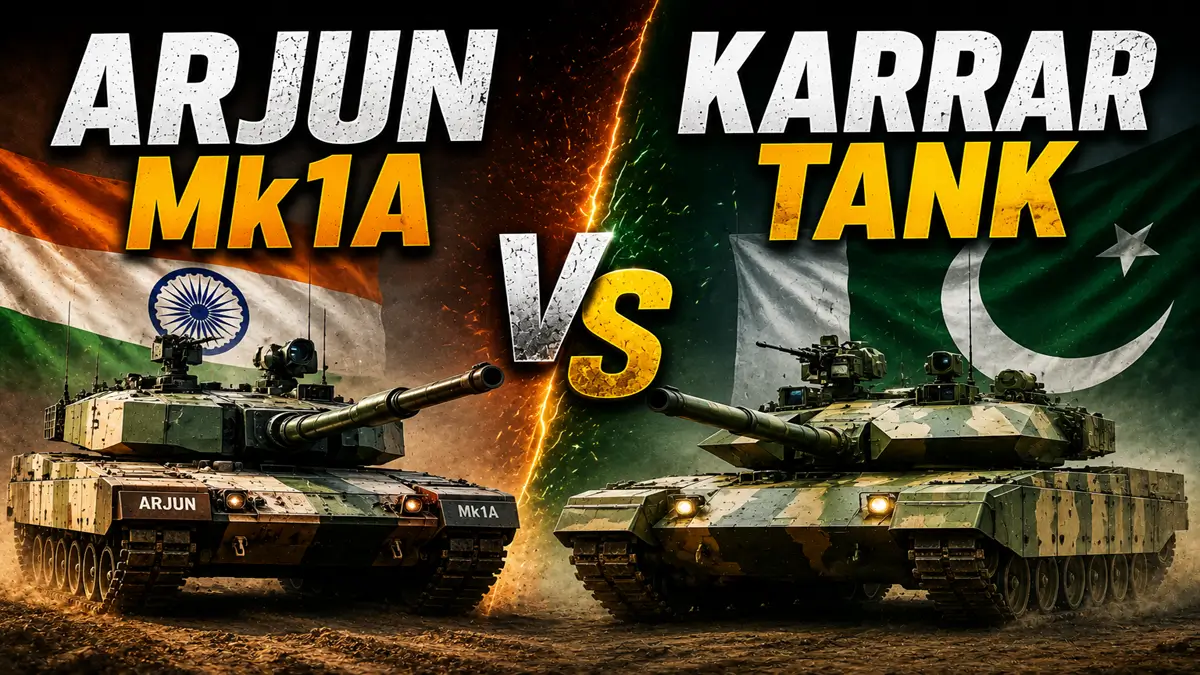
Modern main battle tanks (MBTs) remain one of the most important components of land warfare. Designed to combine firepower, protection, mobility, and battlefield awareness, tanks continue to play a major role in national defense strategies.
Among the notable indigenous tank programs in Asia are India’s Arjun Mk1A and Iran’s Karrar. While both platforms were developed to strengthen domestic military capability, they follow different design philosophies and battlefield priorities.
This article compares the two tanks based on publicly available specifications.
What is a Main Battle Tank (MBT)?
A Main Battle Tank (MBT) is a heavily armored combat vehicle designed for front-line military operations.
Modern MBTs focus on:
- Firepower
- Protection
- Mobility
- Battlefield survivability
- Integrated targeting systems
Arjun Mk1A (India)
The Arjun Mk1A is India’s upgraded indigenous main battle tank developed to improve firepower, survivability, and operational effectiveness.
It entered service in 2021 and incorporates multiple improvements over earlier variants.
Key Specifications
- Country: India
- Service Start: 2021
- Current Status: Active
- Main Gun: 120 mm Rifled Gun
- Armor: Kanchan Armor + Explosive Reactive Armor (ERA)
- Engine: 1,400 HP
- Weight: 68 tonnes
- Maximum Speed: 58 km/h
- Crew: 4
Major Features
- Around 72 upgrades over previous versions
- Remote Weapon Station (RWS)
- Indigenous armor protection systems
- Improved battlefield awareness and survivability
Karrar (Iran)
The Karrar is Iran’s domestically developed main battle tank introduced to strengthen indigenous armored capabilities.
The platform incorporates modern fire-control and protection features.
Key Specifications
- Country: Iran
- Service Start: 2017
- Current Status: Active
- Main Gun: 125 mm Smoothbore Gun
- Armor: Composite Armor + Claimed ERA protection
- Engine: 1,000 HP
- Weight: 51 tonnes
- Maximum Speed: 70 km/h
- Crew: 3
Major Features
- Claimed advanced fire-control system
- Laser warning capability
- Explosive Reactive Armor integration
- Indigenous production approach
Arjun Mk1A vs Karrar: Key Comparison
Firepower
- Arjun Mk1A: 120 mm Rifled Gun
- Karrar: 125 mm Smoothbore Gun
Both platforms emphasize armored engagement capability using different gun configurations.
Protection
- Arjun Mk1A: Kanchan Armor + ERA
- Karrar: Composite Armor + Claimed ERA
Protection philosophy differs based on domestic design approaches.
Mobility
- Arjun Mk1A: 58 km/h
- Karrar: 70 km/h
Karrar is lighter and has a higher reported top speed.
Engine Power
- Arjun Mk1A: 1,400 HP
- Karrar: 1,000 HP
Arjun operates with greater engine output.
Weight
- Arjun Mk1A: 68 tonnes
- Karrar: 51 tonnes
Arjun emphasizes heavier protection while Karrar prioritizes lower weight.
Crew Requirement
- Arjun Mk1A: 4 crew members
- Karrar: 3 crew members
Karrar uses a reduced crew configuration.
Why Are Indigenous Tank Programs Important?
Countries invest in domestic armored platforms to:
- Strengthen defense self-reliance
- Reduce dependence on imports
- Build military-industrial capability
- Improve operational flexibility
- Encourage indigenous defense technology
Quick Facts
- Higher Engine Power: Arjun Mk1A
- Faster Reported Speed: Karrar
- Heavier Tank: Arjun Mk1A
- Smaller Crew Requirement: Karrar
- Earlier Service Entry: Karrar (2017)








 DRDO Successfully Tests Quantum Key Dist...
 Indian Navy to Commission Indigenous Mul...
 Indian Army Launches Bharat Rice for Tro...










