
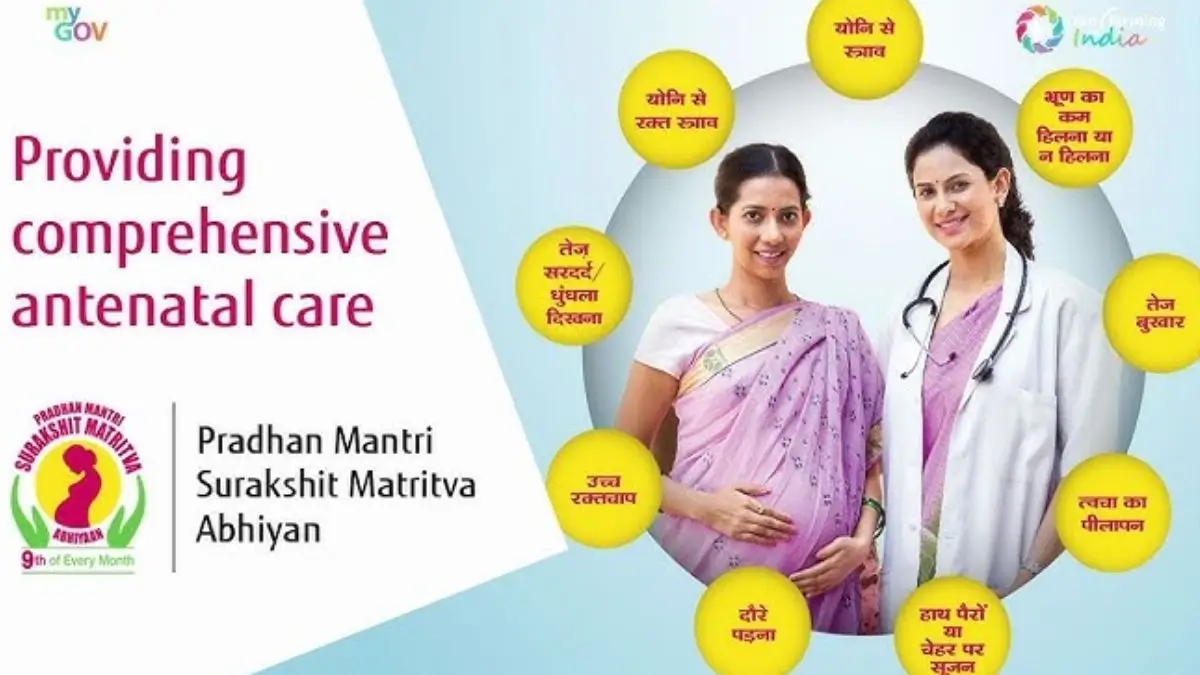
The Pradhan Mantri Surakshit Matritva Abhiyaan (PMSMA) has completed 10 years of providing the quality antenatal healthcare services to pregnant women across India. It was launched on 9th June, 2016 and this flagship maternal health initiative has been emerged as the country’s one of the impactful public health program. Over the last 10 years, around more than 7.5 crore pregnant women has received the specialized antenatal care under PMSMA, help to reduce pregnancy-related risks and improve the maternal health outcomes.
What is Pradhan Mantri Surakshit Matritva Abhiyaan (PMSMA)?
Pradhan Mantri Surakshit Matritva Abhiyaan is the nationwide initiative that provides the free and comprehensive antenatal care services to pregnant women, particularly those in their second and third trimesters.
Under the program the special antenatal care sessions are conducted on the 9th day of every month at designated government healthcare facilities across India.
The primary objective of the scheme is to identify the high-risk pregnancies at an early stage, provide timely medical intervention and also ensure safer pregnancies and childbirth outcomes for every woman regardless of her geographical location or the economic background.
Key Services Provided Under PMSMA
The program offers the comprehensive package of the maternal healthcare services designed to improve pregnancy outcomes.
Services include the clinical examinations, blood and urine investigations, ultrasonography, essential medicines, nutritional counselling, birth preparedness guidance and pregnancy-related health education.
There are Pregnant women are examined by the specialists such as Obstetricians, Gynaecologists or doctors trained in the Comprehensive Emergency Obstetric and Newborn Care (CEmONC) and Basic Emergency Obstetric and Newborn Care (BEmONC).
The program also facilitates the referral services for women requiring advanced medical care and ensures that high-risk pregnancies are linked to the First Referral Units (FRUs) for safe delivery management.
Focus on High-Risk Pregnancy Identification
One of the PMSMA’s most important features is the systematic identification and management of the High-Risk Pregnancies (HRPs).
The program screens pregnant women for the 25 high-risk conditions which including the severe anaemia, gestational diabetes, pregnancy-induced hypertension, HIV, syphilis, hypothyroidism, tuberculosis, multiple pregnancies, teenage pregnancies, previous Caesarean deliveries and other medical complications.
Early identification allows the healthcare providers to monitor these pregnancies closely and provide timely treatment and reducing the risk of maternal and neonatal complications.
Who Can Avail PMSMA Services?
The program is available to all the pregnant women who are residing in India who are in their second or third trimester of pregnancy.
Women between 13 and 27 weeks of pregnancy and those beyond 28 weeks until delivery can access the PMSMA services at designated government health facilities on the 9th of every month.
Special attention is also given to women identified as high-risk cases while those who have missed the routine antenatal check-ups are actively encouraged to participate and receive healthcare support.
Extended PMSMA: Strengthening Follow-Up Care
To ensure the high-risk pregnancies receive the continuous medical attention, the Government has launched the Extended PMSMA Strategy in January 2022.
Under this initiative, women identified as high-risk receive additional antenatal check-ups, regular monitoring and continuous follow-up until a safe delivery.
Every high-risk pregnancy is tracked individually and the financial incentives are provided to both beneficiaries and Accredited Social Health Activists (ASHAs) for up to three additional visits.
SMS-based alerts are also sent to the pregnant women and ASHA workers to ensure timely follow-up and medical support.
Impact of PMSMA Over the Last Decade
Over the last ten years, PMSMA has significantly expanded the its reach and strengthened the maternal healthcare services across India.
More than 7.50 crore pregnant women have received the antenatal care services under the program in addition to routine antenatal care.
This initiative has contributed to improved early detection of pregnancy complications, increased access to the specialist care and better pregnancy outcomes across urban and rural regions.
Improvement In Maternal Mortality Ratio (MMR)
After this scheme implementation there has been significant improvement is Maternal Mortality Ratio.
Maternal Mortality Ratio (Per 1 Lakh Live Bierths)
- From 2014-16: 130
- From In 2022-24: 87
- Total Reduction: 43 Points
The decline demonstrates the effectiveness of the targeted maternal healthcare interventions and improved healthcare accessibility.
Relation With Other Maternal Health Program
There are several complementary schemes which support maternal health at different stages of pregnancy and childbirth.
Major Maternal Health Schemes in India
| Scheme | Objective |
| Janani Suraksha Yojana (JSY) | Promotes The Institutional Deliveries |
| Janani Shishu Suraksha Karyakram (JSSK) | It provides Free Healthcare Services for Mothers and Newborns |
| POSHAN Abhiyaan | Improves Maternal and Child Nutrition |
| Surakshit Matritva Aashwasan (SUMAN) | Ensures The Quality Maternal Healthcare |
| Pradhan Mantri Matru Vandana Yojana (PMMVY) | Provides Maternity Benefits |
| LaQshya Initiative | Enhances The Quality of Labour Room Services |
Celebrating the 10 Years of PMSMA
To commemorate the completion of the ten years, the Government is organizing multiple special activities across the country.
Quality antenatal care services are being provided through the 1.8 lakh Ayushman Arogya Mandirs.
Community awareness program are also being conducted via Village Health Sanitation and Nutrition Days (VHSNDs), Jan Arogya Samitis and Self-Help Groups.
Special PMSMA sessions are also being organized at the district hospitals, sub-district hospitals, First Referral Units and other designated healthcare facilities.








 Prime Minister Dhan-Dhaanya Krishi Yojan...
 Bhagini Nivedita Scheme 2027: West Benga...
 Delhi Doubles ASHA Incentives, Launches ...










