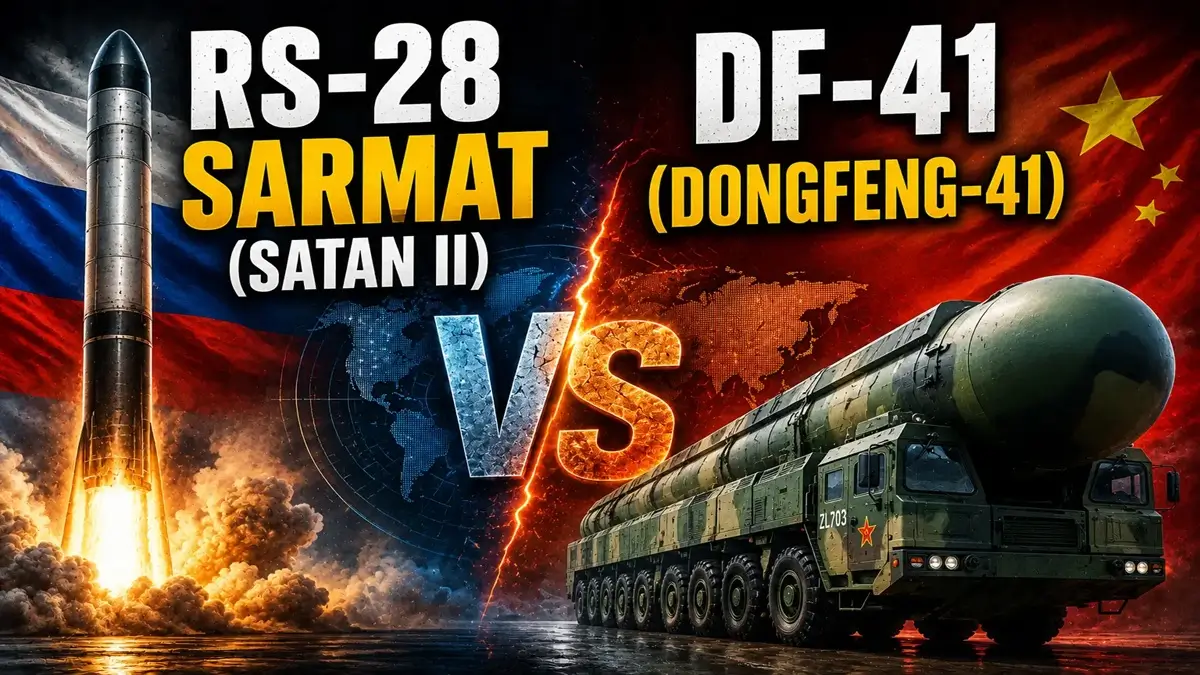
Modern strategic missile systems remain among the most important elements of national defense and nuclear deterrence. Countries with advanced missile capabilities continue investing in long-range systems to maintain strategic balance and strengthen national security.
Among the world’s most discussed intercontinental ballistic missiles (ICBMs) are Russia’s RS-28 Sarmat (Satan II) and China’s DF-41 (Dongfeng-41). Both are designed to carry multiple warheads across intercontinental distances and represent advanced strategic missile technology.
This article compares the two systems based on publicly reported specifications.
What Are Intercontinental Ballistic Missiles (ICBMs)?
Intercontinental Ballistic Missiles (ICBMs) are long-range missile systems capable of delivering payloads across thousands of kilometers.
Key characteristics include:
- Long operational range
- Multi-stage propulsion systems
- Strategic deterrence capability
- High-speed atmospheric and exo-atmospheric flight
- Ability to carry multiple independently targetable reentry vehicles (MIRVs)
RS-28 Sarmat (Satan II) – Russia
The RS-28 Sarmat, commonly referred to as Satan II, is Russia’s next-generation heavy intercontinental ballistic missile.
It entered service in 2023 and was developed to replace older strategic missile systems.
Key Specifications
- Country: Russia
- Service Start: 2023
- Current Status: Active
- Range: 18,000 km
- Maximum Speed: Mach 20
- Propulsion: Liquid-fueled, Three-stage
- Length: 35.3 metres
- Diameter: 3 metres
- Launch Weight: 208,100 kg
- Payload Capacity: 10,000 kg
- Warhead Configuration: 10–16 MIRV warheads
- Guidance System: Inertial + GLONASS
- Secondary Navigation: Astro-inertial system
Special Feature
One of the notable reported capabilities associated with the system is compatibility with advanced maneuvering reentry technologies and long-range strategic deployment concepts.
DF-41 (Dongfeng-41) – China
The DF-41 (Dongfeng-41) is China’s advanced intercontinental ballistic missile platform and forms an important component of its strategic deterrence structure.
The missile officially entered service in 2017.
Key Specifications
- Country: China
- Service Start: 2017
- Current Status: Active
- Range: 13,500 km
- Maximum Speed: Mach 25
- Propulsion: Solid-fueled, Three-stage
- Length: 21 metres
- Diameter: 2 metres
- Launch Weight: 80,000 kg
- Payload Capacity: 2,500 kg
- Warhead Configuration: 10–12 MIRV warheads
- Guidance System: Inertial + BeiDou
- Secondary Navigation: Satellite navigation
Special Feature
The DF-41 is associated with mobile deployment concepts, enabling flexibility through multiple transportation platforms.
RS-28 Sarmat vs DF-41: Key Comparison
Range
- RS-28 Sarmat: 18,000 km
- DF-41: 13,500 km
Russia’s system is reported with greater maximum operational range.
Speed
- RS-28 Sarmat: Mach 20
- DF-41: Mach 25
China’s DF-41 is associated with higher reported maximum speed.
Propulsion
- RS-28 Sarmat: Liquid-fueled, three-stage
- DF-41: Solid-fueled, three-stage
Solid-fuel systems are generally associated with faster readiness, while liquid-fuel systems may support heavier payload configurations.
Payload
- RS-28 Sarmat: 10,000 kg
- DF-41: 2,500 kg
The Russian system is associated with larger reported payload capacity.
Mobility
- RS-28 Sarmat: Fixed strategic deployment concepts
- DF-41: Road and rail mobile deployment capability
Mobility can increase operational flexibility.
Guidance Technology
- RS-28 Sarmat: Inertial + GLONASS + Astro-inertial navigation
- DF-41: Inertial + BeiDou + Satellite navigation
Both rely on integrated guidance technologies.
Why Do Countries Develop Strategic Missile Systems?
Strategic missile systems are developed to support:
- National deterrence capability
- Long-range strategic reach
- Military modernization
- Defense preparedness
- Strategic balance and security planning
Quick Facts
- Longer Reported Range: RS-28 Sarmat
- Higher Reported Speed: DF-41
- Larger Payload Capacity: RS-28 Sarmat
- Earlier Service Entry: DF-41 (2017)
- Mobile Deployment Feature: DF-41








 DRDO Successfully Tests Quantum Key Dist...
 Indian Navy to Commission Indigenous Mul...
 Indian Army Launches Bharat Rice for Tro...