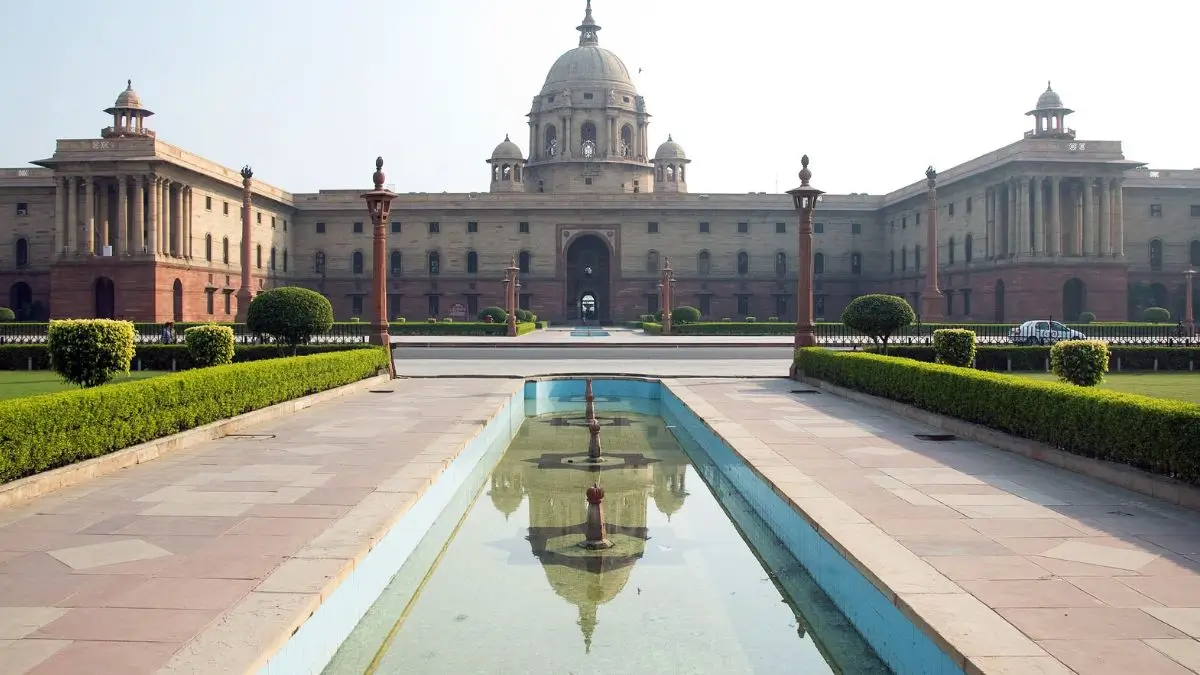
Prime Minister Narendra Modi announced that the statue of British architect Edwin Lutyens at Rashtrapati Bhavan will be replaced with a statue of C. Rajagopalachari. The announcement was made during the ‘Mann Ki Baat’ address. PM Modi said the move is part of a broader effort to shed colonial symbols and give rightful space to India’s national icons at the highest constitutional residence.
Why Lutyens Statue Is Being Replaced at Rashtrapati Bhavan
PM Modi stated that even after Independence, statues of British administrators continued to remain at Rashtrapati Bhavan, while many Indian leaders were not commemorated.
Key Reasons Behind the Move,
- Push to remove colonial-era symbols
- Honour Indian freedom fighters and statesmen
- Promote ‘freedom from slavery mentality under’ Panch-Pran vision
The statue of C Rajagopalachari will be unveiled in the central courtyard as part of Rajaji Utsav.
Who Was Edward Lutyens?
Edwin Lutyens was a prominent British architect chosen in 1912 to design the new capital of British India.
Major Landmarks Designed by Lutyens,
- Rashtrapati Bhavan
- North Block and South Block
- India Gate
- Hyderabad House
- Connaught Place
The central Delhi zone is popularly known as Lutyens’ Delhi, reflecting his architectural legacy.
Who Was C Rajagopalachari?
C. Rajagopalachari, popularly known as Rajaji, was a lawyer, freedom fighter and statesman.
Key Highlights,
- India’s only and last Governor-General (1948–1950)
- Close associate of Mahatma Gandhi
- Edited ‘Young India’ during Gandhi’s imprisonment
- Served as Home Minister in Jawaharlal Nehru’s Cabinet
- Founder of the Swatantra Party (1957)
He is remembered for his independent thinking, discipline and commitment to public service.
Rajaji Utsav and Exhibition Details
PM Modi announced that Rajaji Utsav will be celebrated on February 23, during which the statue will be unveiled.
Event Highlights,
- Statue unveiling at Rashtrapati Bhavan
- Exhibition on Rajagopalachari from February 24 to March 1
- Tribute to his contribution to Indian democracy
- The celebration aligns with the government’s emphasis on recognising national leaders in public spaces.
Colonial Symbols and New Narrative
The decision to replace the Lutyens statue at Rashtrapati Bhavan reflects a broader cultural and symbolic shift.
The government has highlighted the importance of,
- Reclaiming historical spaces
- Celebrating Indian leadership
- Strengthening national identity
The move is positioned as part of India’s post-colonial transformation narrative.
Question
Q. Whose statue will replace Edwin Lutyens at Rashtrapati Bhavan?
A) Jawaharlal Nehru
B) Sardar Patel
C) C. Rajagopalachari
D) B. R. Ambedkar


 ECINet KYC Feature Explained: How Voters...
 BIRAC-BioNEST Incubation Centre Inaugura...
 E20 Petrol India 2026: Nationwide Rollou...