
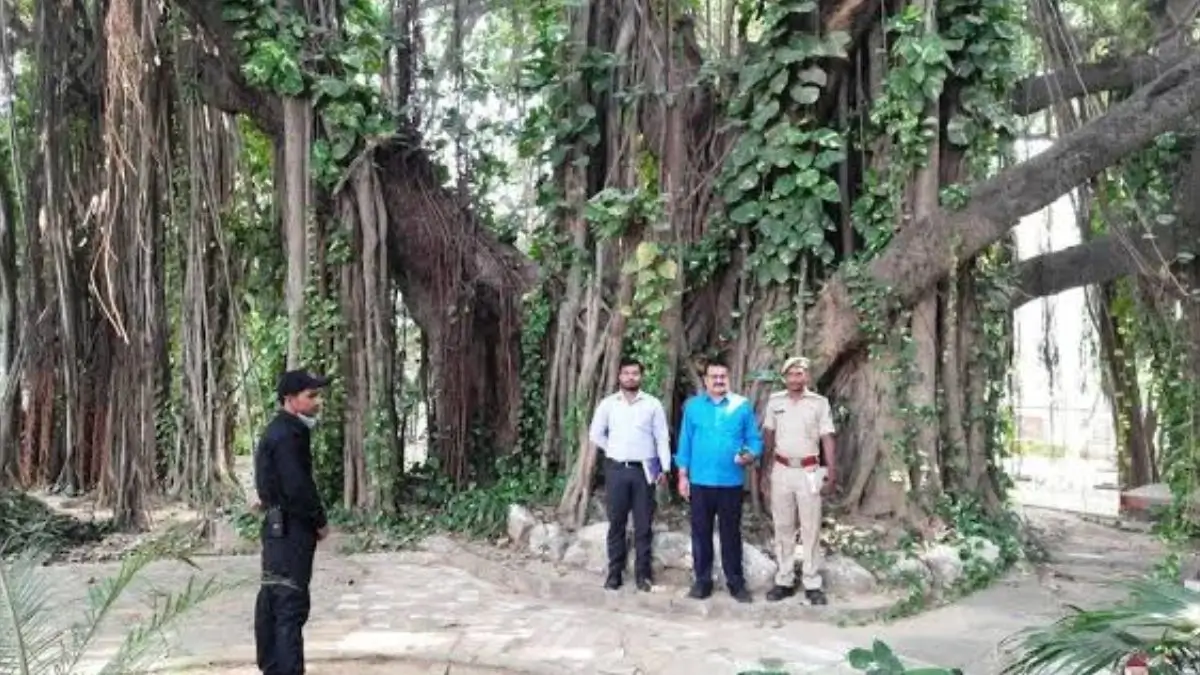
In Munger, Bihar A banyan tree has been scientifically confirmed as the oldest accurately dated banyan tree (Ficus benghalensis) after researchers determined that its age to be around 700 years by using the advanced radiocarbon dating techniques. This major discovery was announced by the Department of Science and Technology (DST) and it marks the first time scientifically validated protocol has been successfully used to determine the age of a banyan tree.
What Is the Discovery About?
Researchers have established that the famous Banyan tree of Munger is approximately 700 years old and making it as oldest accurately dated banyan tree identified through scientific analysis rather than just historical records or any folklore.
For the many centuries, the age of the large banyan trees has largely been estimated by using oral traditions, historical references or local beliefs.
However, such methods oftens lack the scientific accuracy.
The latest research provides the first major scientific evidence confirming the true age of this iconic tree.
Why Was Dating Banyan Trees So Difficult?
To determine the age of tropical broadleaf trees such as banyans has always been a major scientific challenge.
Compare to many temperate trees, banyans generally do not produce the distinct annual growth rings, making conventional dendrochronology (tree-ring dating) ineffective.
As a result of this, researchers needed to develop the alternative technique capable of accurately determining the age of tropical trees.
The Munger Banyan project has now demonstrated that the radiocarbon dating can successfully overcome this limitation.
How Scientists Determined the Tree’s Age
This study was led by Dr. Trina Bose of the Birbal Sahni Institute of Palaeosciences (BSIP), Lucknow, it is an autonomous institute under the Department of Science and Technology (DST).
Working alongside with the Dr. Mayank Shekhar and Dr. Akhilesh K. Yadava, the research team has developed the innovative scientific methodology for age determination.
This process involved the several advanced scientific steps,
- Collecting wood samples from the tree’s secondary trunk and an ancient primary branch.
- Extracting the alpha-cellulose it is the most stable structural component of the plant cell walls.
- Selecting samples near the pith, which represents the earliest stage of the wood formation.
- Also performing Accelerator Mass Spectrometry (AMS) radiocarbon dating.
- Calibrating the results by using the latest IntCal20 calibration curve and OxCal software.
This comprehensive approach enabled the researchers to produce a highly reliable estimate of the tree’s age.
Discovery Rewrites Local History
The scientific findings has challenges long-standing historical belief associated with the Munger Banyan.
Earlier accounts suggested that the tree had been planted in front of the historic Burra Bunglow, it is believed to have been constructed during the late Mughal-Early British period, which is approximately 300-350 years ago.
However, the new scientific evidence also establishes that the banyan predates the building by several centuries.
Researchers now concludes that,
- This tree likely formed part of a natural forest which once covered the region.
- It existed the long time before the construction of Burra Bunglow.
- It had witnessed significant historical developments rather than being planted alongside them.
This discovery reshapes the historical timeline of the area and it provides a more accurate understanding of the region’s environmental history.








 NASA’s PUFFINS Mission: Indian-Origin ...
 ISRO Successfully Completes Crew Moduleâ...
 Elon Musk Shows Tesla Roadster Performin...










