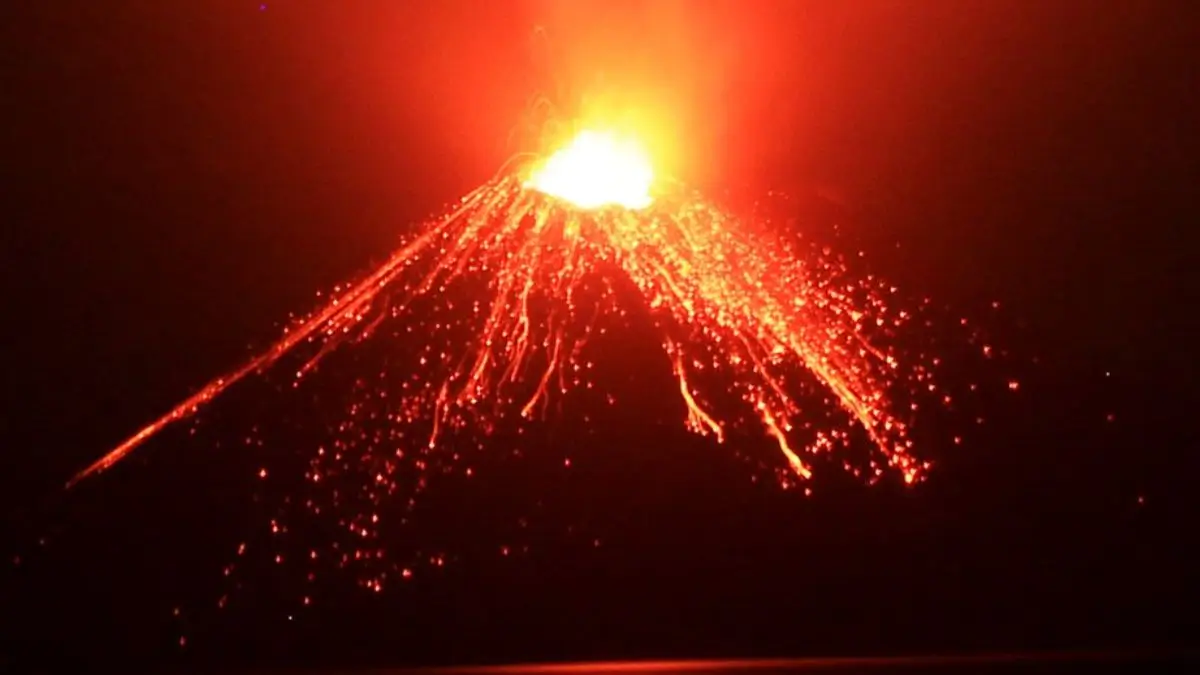
Eruptions at Mount Anak Krakatau caused the massive ash plume which enter it the atmosphere on September 6th, 2026, and caused the disruption to air transport in the several areas of Java and Sumatra. This eruptions caused some of the temporary interruptions at Jakarta’s Soekarno-Hatta International Airport, as the airline canceled some of its flights due to the volcanic ash moving in the aviation airspace.
This eruption has once again brought into focus the continued activity of Anak Krakatau, which is a volcano located in the Sunda Strait separating Java and Sumatra islands. The Anak Krakatau is a relatively young volcano that appeared from the ocean in 1927 following the eruption of Krakatau in 1883.
Eruption Mount Anak Krakatau 2026: What Has Occurred?
The Mount Anak Krakatau had a major eruption on Sunday that resulted in the release of the volcanic ash to the height of about 50,000 feet. The ash covered regions that included aviation flights above the Java and Sumatra islands.
There was an impact from the eruption at the Soekarno-Hatta International Airport in Jakarta, as runway tests had found ash deposits at the airport and consequently closed it temporarily until 1:30 pm.
According to Reuters, about 301 flights including 58 international flights were affected.
In response to the volcanic ash, airlines have taken certain measures. For instance, the Singapore Airlines suspended all its services to Jakarta for the rest of the day, whereas the AirAsia canceled or changed several flights. Garuda Indonesia advised passengers to confirm their flights before coming to the airport.
Why Is Volcanic Ash Hazardous to Aviation?
Volcanic ash poses a significant threat to flight operations due to the very fine nature of particles comprising rocks and minerals.
Upon entering a thick cloud of volcanic ash, particles can,
- Destroy parts of the aircraft engine.
- Meltdown in jet engines and form solids on turbine blades.
- Hinder proper functioning of the engine or make the engine fail.
- Damages aircraft windows and other surfaces of the aircraft.
- Influence aircraft instruments and visibility.
Since ash clouds can move long distances with the help of winds, a volcanic eruption can impact aviation at a distance from the volcano.
Impact on the Local Community
The impact of the volcanic eruption was not limited only to the airport and airlines, as some schools reportedly had to cancel programs due to eye irritation from the ash.
Furthermore, fishermen had to stop fishing as the ash spread over other areas nearby.
Some precautionary actions that were advised by Indonesia’s disaster mitigation agencies included,
- Wearing masks and eye protection.
- Avoid going outside as much as possible.
- Protecting sources of drinking water.
- Driving carefully due to poor visibility.
What Is the Alert Level of Anak Krakatau?
Alert Level 3 has been the status of Anak Krakatau volcano since July 2, 2026, as per the information provided in the report.
Other volcanoes in Indonesia that share the same alert level include Mt Semeru, Mt Merapi, Lewotobi Laki-laki, and Sinabung.
The reason why there are many active volcanoes in Indonesia is due to its location along the boundaries of tectonic plates belonging to the Pacific Ring of Fire.
What Is Mount Anak Krakatau?
The volcanic mountain known as Anak Krakatau translates into “Child of Krakatau” and is located in the Sunda Strait of Indonesia between the islands of Java and Sumatra.
It is the successor to the famous Krakatau volcano, which was involved in the most devastating volcanic eruption in human history in 1883.
Anak Krakatau emerged from the ocean waters in 1927, about four decades after the infamous eruption of 1883, and continued to build up through further eruptions.
This volcano has seen many erupptions since its formation, including the type of Strombolian eruptions.
Krakatau and the 1883 Eruption
The history of Anak Krakatau is linked to the 1883 Krakatau eruption that occurred.
This eruption resulted in very large explosions, ashfall, and tsunamis that caused death to more than 36,000 people, most of whom died from tsunamis.
This case was noted as one of the examples of destruction due to the destructive nature of volcanoes.
Geography and disaster management students find Krakatau interesting due to the destructive interaction of volcanoes and coastlines.
2018 Anak Krakatau Tsunami
Anak Krakatau gained global attention once again in December 2018 after a portion of the volcano’s slope fell into the ocean due to an eruption.
This phenomenon caused displacement of water resulting in a tsunami in the coastal regions of Java and Sumatra islands. Over 400 individuals died while many others were injured or displaced.
The 2018 tsunami made it clear that volcano hazards are not limited to ash and lava only.
Why Does Indonesia Experience Eruptions from Volcanoes?
Indonesia is situated in the Pacific Ring of Fire, which is an area around the Pacific Ocean that is highly active in terms of tectonics.
The volcanic activity of the country is highly related to the subduction process of the plates of the Earth. In the area, the Indo-Australian Plate is being subducted under the Eurasian/Sunda Plate system.
When a plate subducts under another plate, there may be activities on the surface of the Earth and inside its crust and mantle that could create magma.
Comparison of Anak Krakatau with Krakatau
| Characteristic | Anak Krakatau | Krakatau |
| Definition | Child of Krakatau | Historic volcano |
| Location | Sunda Strait | Sunda Strait |
| Formation | Raised out of water in 1927 | Eruption of 1883 |
| Importance | Volcanic formation after destruction of Krakatau | History of eruption in 1883 |
| Primary threat | Ash, lava and possible volcanic landslides | Eruption of 1883 Tsunamis |








 World Health Summit 2026: Key Initiative...
 Putin Ratifies India–Russia Agreement ...
 India Hosts First BIMSTEC Home Ministers...