
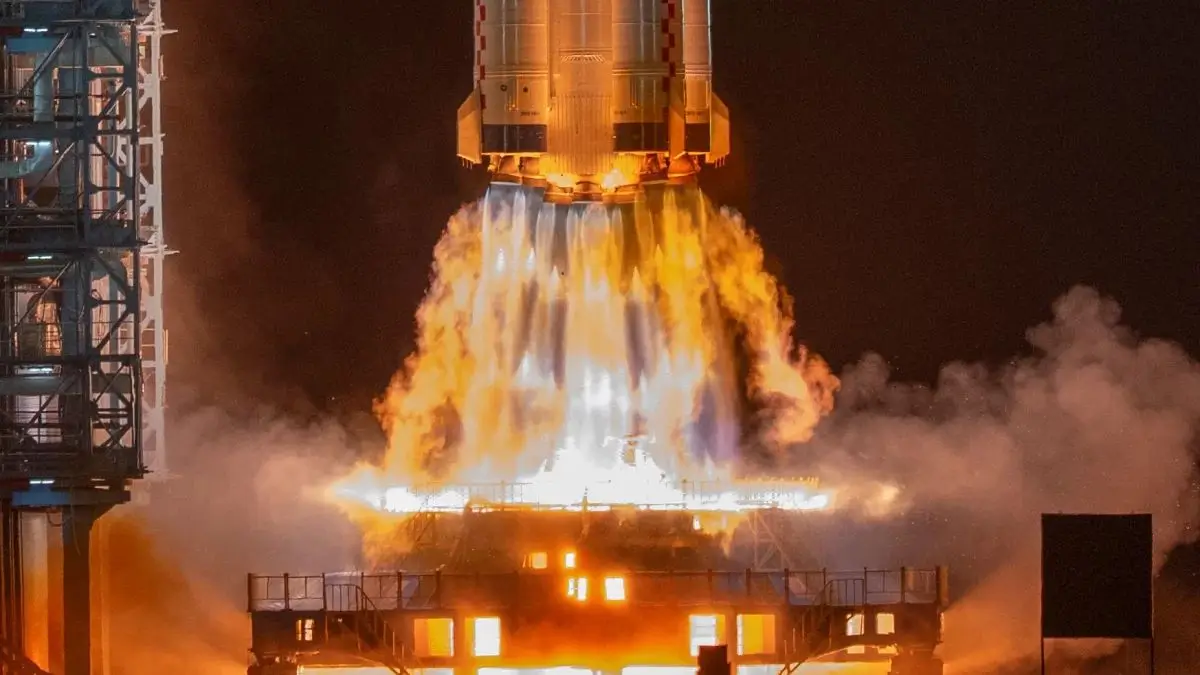
China has launched the Shenzhou 23 spacecraft and sent the three astronauts to its Tiangong space station. This is historic mission as one astronaut is expected to remain in orbit for one full year and with this it will be one of the longest human space missions in history.
Shenzhou 23 Mission Launch
The Shenzhou 23 spacecraft was launched on the May 25, 2026, from the Jiuquan Satellite Launch Center in the northwestern China.
The successful launch represents the another major achievement in the China’s steadily advancing human spaceflight program.
This mission comes at a time when Beijing is accelerating the ambitious preparations for a crewed lunar landing before 2030 and placing itself firmly in the global space race.
The spacecraft is heading towards the China’s independently built Tiangong space station, which has become the center of the country’s orbital research efforts.
Which Astronauts Are on Board?
The Shenzhou 23 mission carries the three astronauts, and they are,
- Zhu Yangzhu – Mission Commander
- Zhang Zhiyuan – Crew Member
- Lai Ka-ying (Li Jiaying) – Crew Member
The mission is historic because the Lai Ka-ying becomes the first astronaut from the Hong Kong to travel to space.
Lai’s bckground is particularly important. She was born and raised in the Hong Kong and she holds a doctoral degree in computer forensics, which showcasing the increasing diversity of China’s astronaut corps.
One-Year Space Stay: Why It Matters
One of the most significant highlights of this mission is the plan for one astronaut to remain aboard in the Tiangong for an entire year.
This extended stay aims to study the,
- Human adaptability in prolonged space conditions
- Physical and the psychological endurance
- Performance limitations during long-duration missions
- Space medicine and astronaut health monitoring
Such research are vital for the future deep-space missions and specially China’s long-term plans involving the Moon and potentially Mars exploration.
Scientific Objectives of the Mission
The astronauts will carry out the dozens of scientific experiments and application projects while aboard Tiangong.
Expected focus areas includes the,
- Space biology
- Medical science
- Materials research
- Human physiology
- Technology demonstrations
The crew will also perform the in orbit rotation with the current Shenzhou 21 astronauts, who have already spent more than the 200 days in space.tific leadership.








 ISRO Successfully Completes Crew Moduleâ...
 Elon Musk Shows Tesla Roadster Performin...
 TRISHNA Satellite Mission 2027: ISRO-Fra...










