
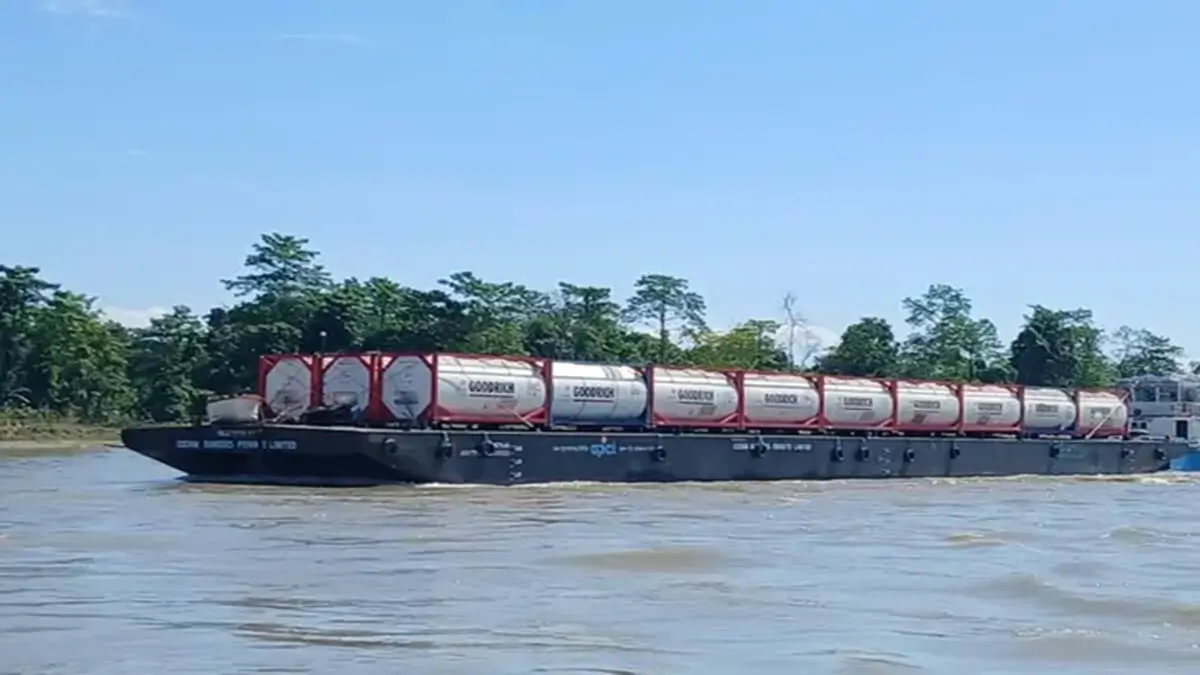
In a major boost to inland waterway connectivity in Northeast India, Dibrugarh in Assam sent its first international cargo shipment since Independence from the Bogibeel Terminal to Bangladesh.
A barge carrying 540 metric tonnes of methanol was flagged off by Union Minister for Ports, Shipping and Waterways Sarbananda Sonowal from Bogibeel in Dibrugarh. Assam Chief Minister Himanta Biswa Sarma joined the ceremony virtually.
The shipment marks the first cargo movement from Upper Assam to a foreign port since 1947, reviving Dibrugarh’s historic role as a river trade centre.
What Was Shipped?
The cargo consisted of 540 metric tonnes of methanol produced by the state-owned Assam Petro-Chemicals Limited (APCL) at Namrup, Assam.
The cargo was carried by the vessel DLB Patkai, which was pushed by the tug Kushal Konwar.
The shipment is destined for Pangaon Port in Dhaka, Bangladesh.
Route of the Shipment
The vessel will travel through the Brahmaputra River, which forms part of National Waterway-2 (NW-2).
It will cover:
- Around 768 km on National Waterway-2 up to the India-Bangladesh border
- Thereafter, it will travel through the Indo-Bangladesh Protocol Route (IBPR)
- Total journey: approximately 1,300 km from Bogibeel to the Dhaka/Narayanganj region
The movement became possible after customs and immigration facilities were established at Bogibeel and Dhubri.
Why Is This Important?
The voyage is being seen as an important test of whether the Brahmaputra can become a commercially viable freight corridor connecting Northeast India with international markets.
Regular methanol shipments to Bangladesh are also planned.
The initiative is expected to:
- Reduce dependence on road transport
- Lower fuel consumption and logistics costs
- Improve regional trade connectivity
- Strengthen India-Bangladesh waterway links
- Increase export opportunities for industries in Northeast India
Historical Importance of Dibrugarh River Port
Dibrugarh was historically one of the major river ports of eastern India.
Important milestones include:
- 1856: Government steamers began reaching Dibrugarh from Calcutta
- 1882: Dibru-Sadiya Railway started operations from Dibrugarh steamer ghat
- 1913: Steamers regularly transported tea, timber and passengers
- 1954: Regular bookings from Dibrugarh Ghat stopped
- 15 October 1956: Dibrugarh river ghat was closed
- 1972: India and Bangladesh signed a river trade protocol
- 1988: Brahmaputra stretch from Sadiya to Dhubri was declared National Waterway-2
- 2017: Regular cargo movement resumed on NW-2 with cement movement from Pandu to Dhubri
National Waterway-2
National Waterway-2 covers the Brahmaputra River from Sadiya to Dhubri in Assam.
Its length is about 891 km.
The waterway plays an important role in improving inland transport and regional trade connectivity in Northeast India.
Growth of Inland Waterway Cargo
According to the Ministry of Ports, Shipping and Waterways, cargo movement on India’s national waterways increased from around 18 million metric tonnes in 2013-14 to 218 million metric tonnes in 2025-26.
More than ₹6,800 crore is being invested in waterway infrastructure across the Northeast, including development of National Waterway-2 and facilities at Pandu.








 Shabari Naturals Wins G-Mark Global Desi...
 Ballon d’Or 2026: All You Need to Know...
 India’s First Cooperative-Sector Airli...










