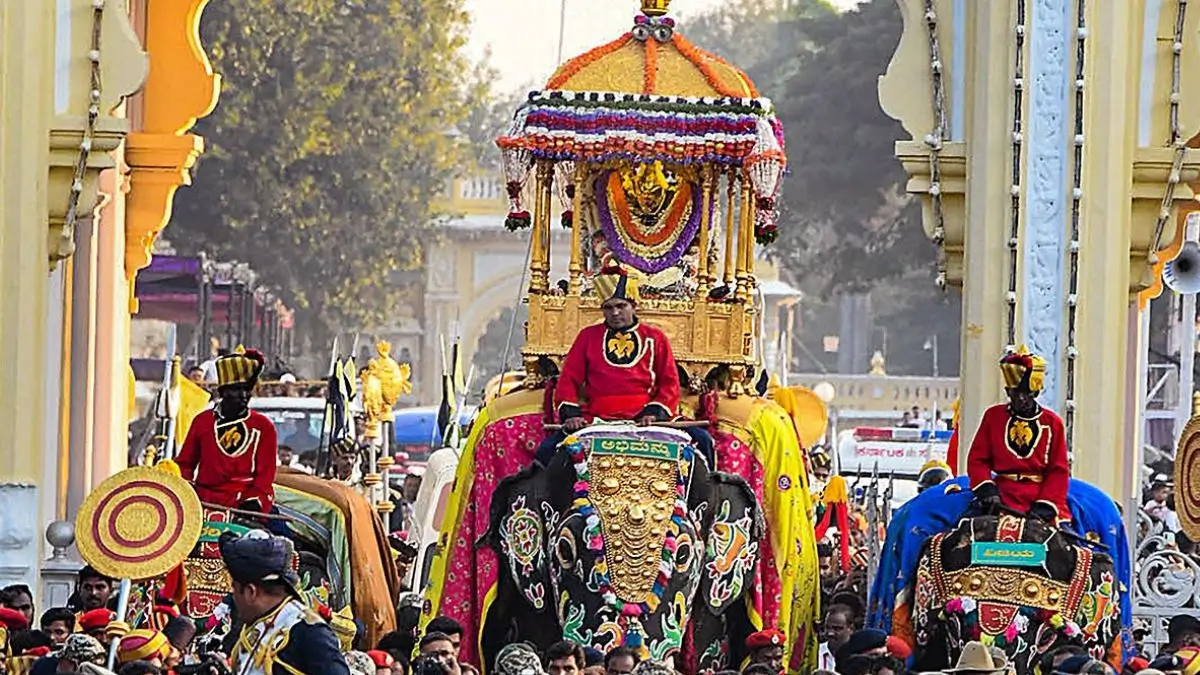
While Mysuru Dasara includes aspects of worship and regal pageantry, it also embodies the tradition of South Indian courts that reached their zenith during the period of the Vijayanagara Empire. The celebrations of Mahanavami at Hampi in the 16th century were characterized by not only religious rites but also included military parades, wrestling bouts, music, dance, and ceremonies that reinforced the power of kings. The tradition continued after the political fall of the Vijayanagara Empire in the kingdoms of its successors and took a distinct shape under the reign of the Wadiyar dynasty of Mysuru.
Mahanavami at Hampi: The Background of Royal Dasara
The origins of Mysuru Dasara date back to the festival of Mahanavami that marked the festivities of the Vijayanagara Empire that ruled most of south India from the 14th century onwards. The capital of Vijayanagara was located at what is today Hampi in Karnataka.
Mahanavami was one of the nine nights of Navaratri festival. During the rule of the Vijayanagara kings, this festival developed into an elaborate celebration that was a combination of religious rituals and martial displays along with court performances, music, dance, and wrestling. It was a time when the king received tribute from his subordinate chiefs and troops.
It was not merely a religious festival but was also meant to project the glory of the king.
Mahanavami Dibba: The Focus of Royal Celebrations
The Mahanavami Dibba, sometimes called Dasara Dibba, is one of the most important surviving buildings linked with the royal rituals of Vijayanagara. Situated in the Royal Enclosure of Hampi, this raised stone platform has reliefs depicting processions, animals, performers and others that give clues about the rituals at the royal court of Vijayanagara.
Activities at Mahanavami,
Some of the reported activities that took place on the occasion of this festival include the following,
- Royal rituals: The king appeared in front of his court, along with dignitaries from all over the empire.
- Military parades: Military prowess was exhibited through the means of soldiers, horses, and elephants.
- Performance: Music, dance, and performance was included as part of the celebration.
- Physical games: Wrestling and physical strength demonstration to entertained the audience.
- Fireworks: Rockets and fireworks were used during celebrations as seen by Europeans who visited the empire.
- Political rituals: Chiefs and subordinate kings appeared in front of the king of the empire.
This is how Mahanavami turned out to be such a political event for the Vijayanagara Empire.
Mahanavami as a Political Festival
One of the unique aspects of Mahanavami at Vijayanagara was the relationship of religious festival with political power.
The empire depended upon the relations between the king and regional military chieftains. Chieftains had territorial powers, controlled armies, and were answerable to the king. The festival was an opportunity for the chieftains to come to the capital and declare loyalty.
Parading of soldiers, tributes, and presents gave the festival a political character by showing the organization of the empire through the power pyramid in which the king was at the top.
How the Dasara Tradition Survived after Vijayanagara
While the fall of the capital did not entail the disappearance of all forms of court traditions, succeeding states developed their own customs with regard to their own political and religious events, performances of music and dances and athletic competitions.
For instance, the Nayaka kings of Tanjore established an important court culture that promoted music and performing arts. There were other rulers in different regions who had their own forms of politics and religion.
The Wadiyars of Mysore emerged as another center of royal patronage, whose tradition of Dasara festival is generally seen to be based on the Mahanavami tradition of the previous era.
Raja Wadiyar I and the Origin of Mysuru Dasara in 1610
The origin of the Mysuru Dasara tradition is said to be in the year 1610 when Raja Wadiyar I celebrated the festival in Srirangapatna, which was an important place in the kingdom of Mysuru during that time period. This origin has been acknowledged in the history of Mysuru Dasara.
The choice of the Dasara festival shows how the politics of Wadiyars and their affiliation to the royal culture of South India played a role. The festival helped promote the glory of Mysuru court through religious rituals and other performances.
It is because of the importance of Srirangapatna from a political and cultural point of view that the festival came into practice there. The festival soon turned into one of the most prestigious ceremonies of Wadiyars.
Modern Mysuru Dasara: A Continuing Cultural Tradition
In today’s times, Mysuru Dasara is celebrated as Nada Habba, the state festival of Karnataka. The programs associated with the festivities are organized by the Government of Karnataka and the District Administration of Mysuru, whereas the private rituals for the festival are continued by the members of the Wadiyar family.
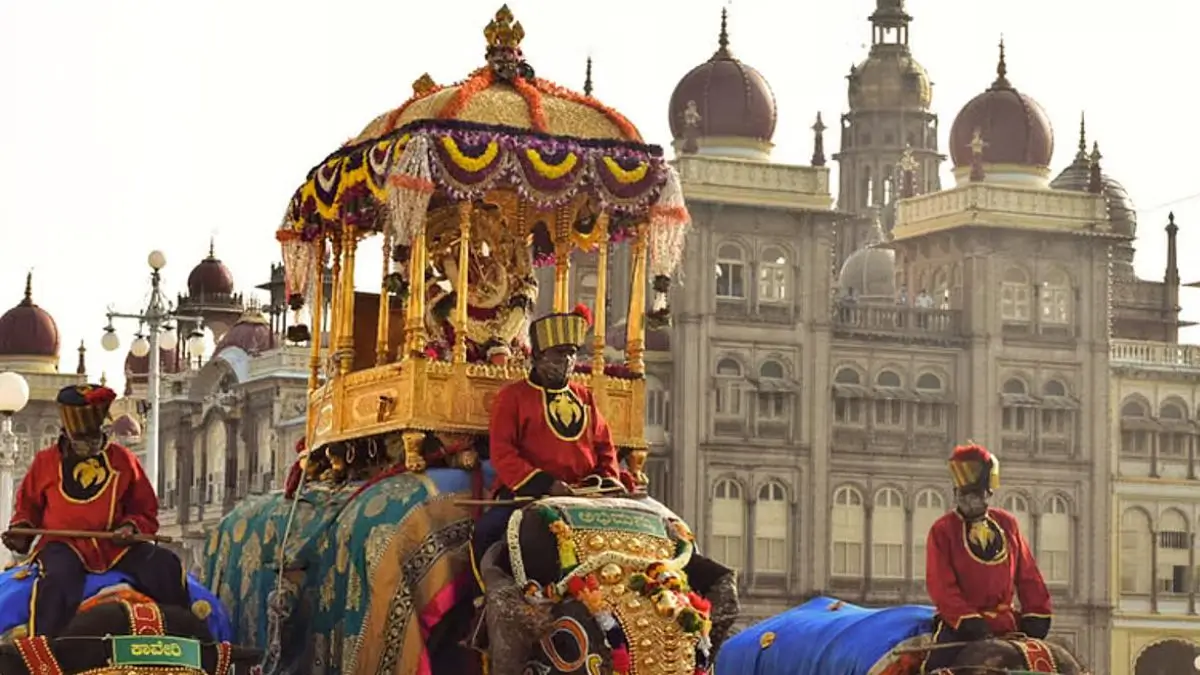
The most prominent event of this festival is the Jamboo Savari, which is conducted on Vijayadashami day. The idol of Goddess Chamundeshwari is taken in an elaborately decorated howdah of gold that rides atop an elephant in a procession starting from the Mysuru Palace to reach Bannimantap. Cultural programs, tableaux, musical events and torchlight parade are also part of the program.
The religious aspect has also retained its significance in this festivity. Mysuru Dasara is celebrated in honour of Goddess Chamundeshwari who is one of the forms of Goddess Durga and defeated Mahishasura, an essential part of Mysuru’s traditional history.






 Mysuru Dasara 2026: History, Jamboo Sava...
 Dussehra Celebrations Across India: 12 U...
 Ravana in the Ramayana: 10 Facts About t...