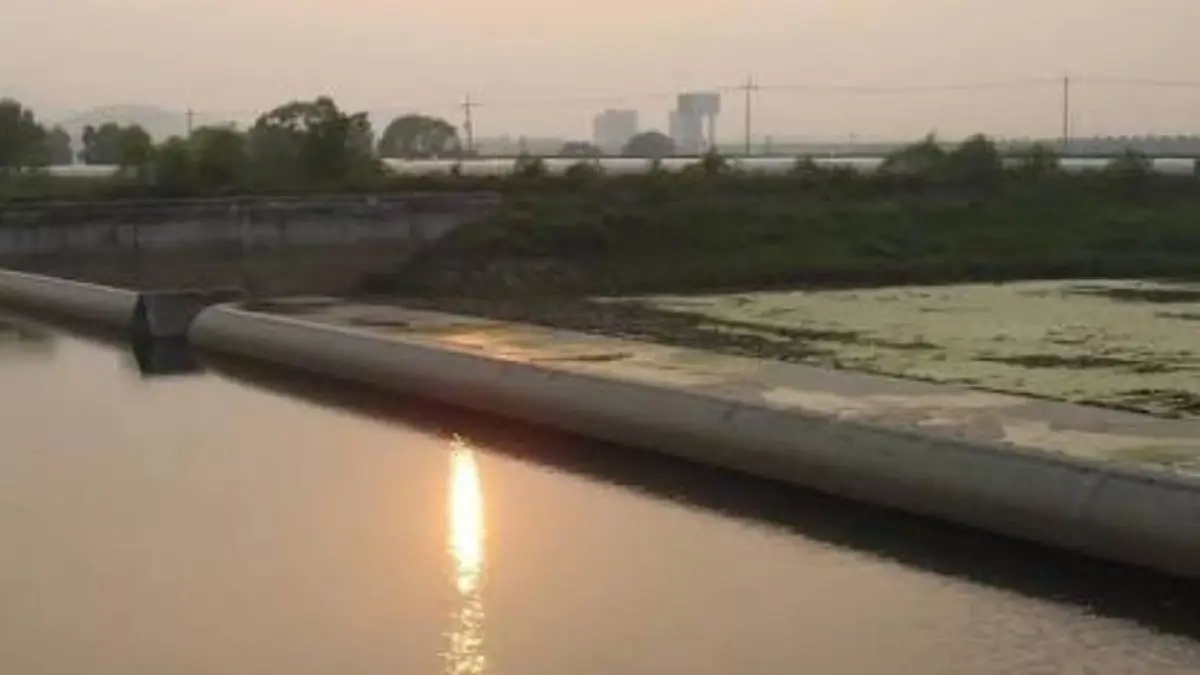
The state of Gujarat is making its first stride towards contemporary water resource management with the development of its first two air-filled rubber dams constructed with advanced technology from South Korea. The dams will be set up at the Heran River in Chhota Udepur district and the Ambika River in Tapi district to improve irrigation facilities, enhance groundwater recharge, store water effectively, and control flooding issues. The innovative dams will be provided with automatic SCADA systems and represent a significant milestone in sustainable water infrastructure and are expected to help many farmers in the state.
What Are Inflatable Rubber Dams?
An inflatable rubber dam is a new kind of a hydraulic structure constructed from tough rubber and placed across a river or a canal.
It is different from the traditional concrete dam in that it can be inflated by air or water in order to store more water and deflated during the floods to let excess water flow down the river without causing any harm.
Gujarat’s First air-filled rubber dams
The government of Gujarat, in its recent efforts for a sustainable dam project, has started working on two rubber dam projects,
- Rajvasana Rubber Dam
- Place : Rajvasana, Chhota Udepur district
- River : Heran River
- Cost of the overall project : ₹ 82.97 crore
- Current stage : Nearly 75% complete as on 6th July 2026
- Date of commissioning : By September 2027
The projected cost of the Rajvasana rubber dam is ₹82.97 crore and once finished, the Rajvasana rubber dam is expected to provide irrigation to more than 3,420 hectares of land.
Pathakwadi Rubber Dam
- Place : Pathakwadi, Tapi district
- River : Ambika River
- Cost of the overall project : ₹79.13 crore
- Current stage :Nearly 90% complete
The project is estimated to provide irrigation to nearly 650 hectares of riced growing land with assured watering facilities.
These two rubber dam projects will require an investment of more than ₹162 crore.
Technical Specifications of the Rubber Dams
These projects are supported by many technologically advanced features making them different from conventional water storage structures.
Rubber Bladders Having High Tensile Strength
For the construction of the dams, engineered rubber bladders have been acquired from South Korea, known for its advanced technology in the manufacture of industrial rubber products.
The specifications of the rubber bladders are,
- Thickness of rubber bladder ranges from 18 mm to 32 mm
- The rubber can bear temperature up to 50 C
- The movable rubber bladders have a life of approximately about 30 years
- They have high resistance to weathering as well as to hydraulic pressure.
All these features give them long-lasting durability in addition to low maintenance cost.
SCADA Technology Used for Automation
Both projects have been introduced with SCADA (Supervisory Control and Data Acquisition) system to provide full automation.
SCADA allows automated continuous monitoring of river conditions as well as control of bladders’ inflation and deflation electronically.








 Asiatic Lions Return to Barda Wildlife S...
 Himachal Pradesh Inaugurates Its First S...
 Lakshadweep Becomes India’s First 100%...