
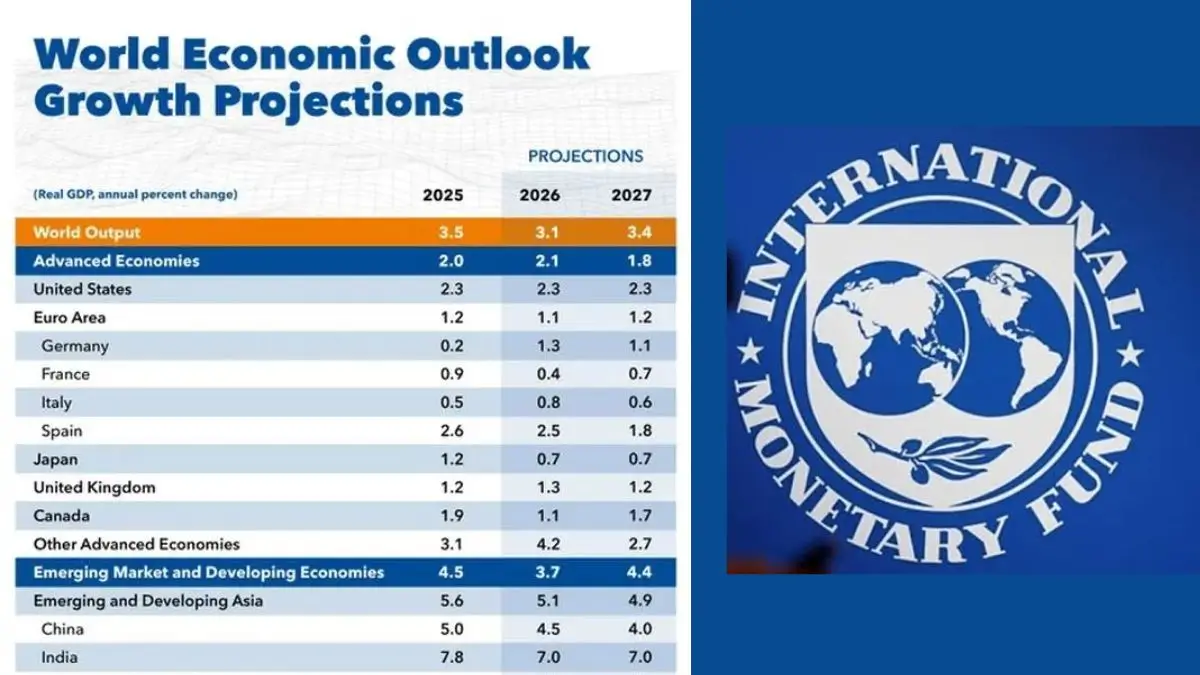
The International Monetary Fund (IMF) has upgraded its projections for India’s growth in FY 2026-27 (FY27) to 7% by raising it by 60 basis points. In its most recent World Economic Outlook, the institution cites robust domestic demand, vigorous service sector activity, and positive economic momentum as some of the factors behind the optimistic projections, notwithstanding high oil prices and geopolitical tensions. These projections put India among the fastest growing major economies, although the outlook for the world economy is rather gloomy on account of inflation and geopolitical tensions.
IMF, RBI and World Bank: FY27 Growth Projections for India
India’s revised growth projections are due to strong economic performance in India.
The IMF increased its growth projection from 6.4% to 7%, whereas the RBI and World Bank estimated growth of 7.1% for FY27, as per the mentioned reports. It should be noted that these are mere estimates of the growth rate.
| Institution | India’s FY27 GDP Growth Projection |
| International Monetary Fund (IMF) | 7.0% |
| Reserve Bank of India (RBI) | 7.1% |
| World Bank | 7.1% |
| Organisation for the Economic Co-operation and Development (OECD) | 7.1% |
The IMF has revised its growth projections as India exhibited resiliency in demand and service sectors. Similarly, the RBI has raised its projection to 7.1%, but the World Bank warned that India’s growth may ease during the second half of FY27.
Why is India’s Economic Growth Prospect Improved?
Three reasons which according to the International Monetary Fund have been responsible for the improved growth prospect of India include favorable demographics, a large domestic market that is growing bigger, and structural reforms.
Domestic demand fuels economic activities through household expenditure and investments. Favorable conditions in the services sector have contributed to India maintaining a good economic growth despite the rising oil prices and uncertainties due to the war between the West Asian countries.
This improved projection separates India from other emerging economies, especially those which are importers of energy and whose growth prospects are affected by geopolitics. Inflation, energy prices, and external demand cannot be overlooked.
IMF on FTAs and India’s Economy
According to the IMF, FTAs promote economic growth through reduction of tariff and non-tariff barriers and enhancing trade in goods and services, besides improving the resilience of the supply chains.
India has been diversifying its trade relationships, including FTAs with the European Union and the UK. As per the Government of India, the FTA between India and New Zealand is expected to come into effect on 20 October 2026.
However, an analysis by Bloomberg Economics revealed that the FTAs signed by India, along with those with the EU and New Zealand, could boost the country’s GDP by roughly US$140 billion by 2035. Assuming that these new FTAs are implemented starting from 2027, then GDP will increase by 1.7%, while exports will increase by 6.2%.
Outlook for Global Growth and Inflation
Although the outlook for India has improved, the IMF expects that global economic growth will be modest.
| Indicator | IMF projection |
| Growth of Global GDP, 2026 | 3.1% |
| Growth of Global GDP, 2027 | 3.4% |
| Global inflation, 2026 | 4.7% |
| Global inflation, 2027 | 4.1% |
| Average annual growth of global economy, 2028-2031 | 3.2% |
It is expected that high prices for commodities, especially for energy, will cause inflation globally in 2026. It is expected that the level of inflation will decline in 2027; however, geopolitical uncertainty remains a serious risk factor.
Also, the Fund projects average annual global growth of 3.2% during 2028-2031, which will be lower than 3.7% average growth during 2000-2019.
The IMF warns that the prospects of growth have become increasingly uneven, and economies affected by the Middle Eastern conflict, as well as energy-importing emerging economies, are under additional pressure.
The IMF has recommended policy measures aimed at rebuilding fiscal space, enhancing supply side resilience, and sustaining growth.








 India’s Retail Inflation Rises to 5.54...
 GST Council Removes Arrest Powers of Tax...
 World Bank Raises India’s GDP Growth F...