
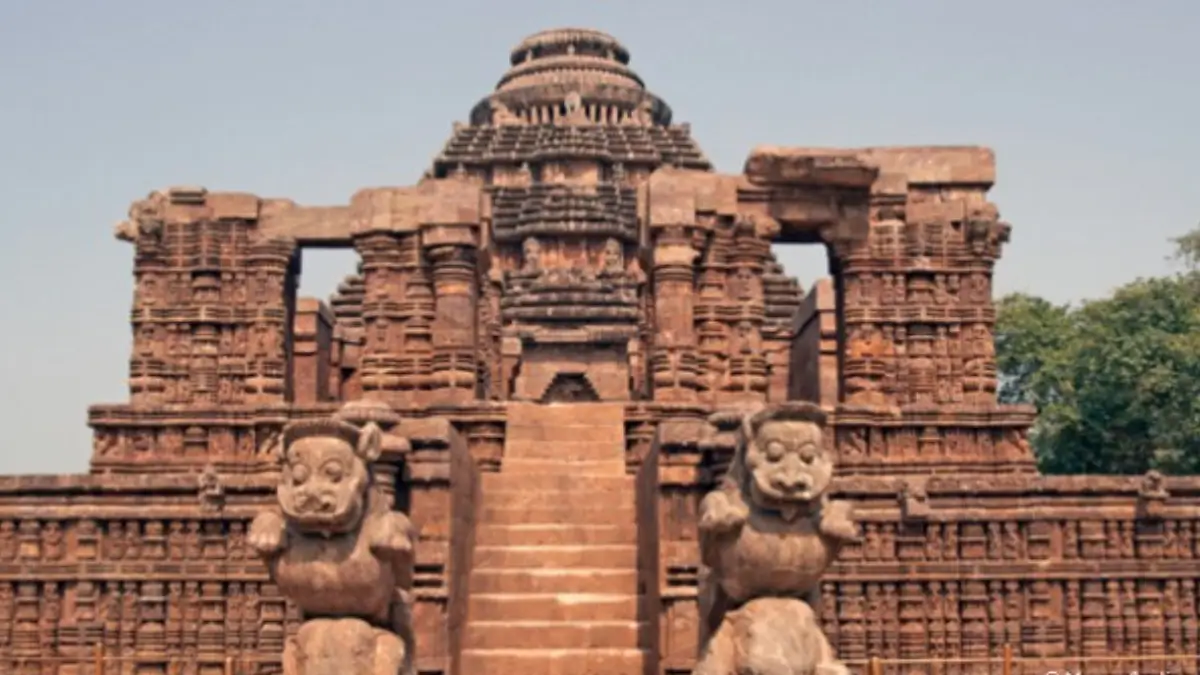
India is a land of diverse cultures and ancient heritage, known for its grand temples dedicated to various deities. Among these, one temple stands out for its breathtaking architecture and historical importance — a shrine built in honor of the Sun God. This world-famous monument reflects India’s rich art, devotion, and engineering brilliance.
Location of the Sun Temple
The famous Sun Temple is found in Konark, a small coastal town in the Puri district of Odisha, India. It is situated on the eastern coast, close to the Bay of Bengal, and lies about 35 km from Puri and 65 km from Bhubaneswar, the capital city of Odisha.
This region is part of the Golden Triangle of Odisha tourism, which includes Bhubaneswar, Puri, and Konark. The temple’s seaside location beautifully symbolises the Sun God rising from the ocean, making it one of the most scenic heritage sites in India.
Historical Background of Konark Sun Temple
The Konark Sun Temple was built in the 13th century by King Narasimhadeva I of the Eastern Ganga Dynasty around 1250 CE. It was dedicated to Lord Surya, the Sun God, who represents light, energy, and life.
According to legends, the temple once contained a magnetically suspended idol of Surya, which appeared to float in the air. Apart from being a religious site, the temple was also a centre of learning, focusing on art, science, and astronomy.
The construction of the Sun Temple marks the peak of Kalinga architecture, showing how ancient India combined engineering, geometry, and spirituality to create something truly timeless.
Architectural Beauty of the Sun Temple
The Konark Temple is designed like a giant stone chariot drawn by seven horses and supported by 24 massive wheels, each about 12 feet high. These wheels represent the hours of the day, while the horses stand for the seven days of the week.
The temple was built mainly from three types of stone — laterite, chlorite, and sandstone. Every surface is decorated with beautiful carvings of gods, goddesses, dancers, animals, and mythological stories.
The detailed stonework shows the high level of craftsmanship and artistic skill of ancient Indian builders. The temple’s design also served as a sundial, accurately showing time based on the position of the sun’s shadow.
Religious and Cultural Significance
The Sun Temple at Konark holds a special place in Hindu religion and culture. It is dedicated to Lord Surya, the Sun God, who is considered the giver of life and strength.
Every year, thousands of devotees visit Konark during the Chandrabhaga Mela, celebrated in February. During this festival, people take a holy dip in the Chandrabhaga River and offer prayers to the rising sun.
The temple represents the connection between nature and spirituality, highlighting the importance of the sun as a source of energy, hope, and enlightenment in Hindu philosophy.
Recognition as a UNESCO World Heritage Site
In 1984, the Konark Sun Temple was declared a UNESCO World Heritage Site for its outstanding artistic and cultural value. Sailors once called it the “Black Pagoda” because of its dark stone and its visibility from the sea.
Today, it stands as one of the Seven Wonders of India and remains a major tourist attraction for both Indians and foreigners. The site reflects the glory of ancient Indian architecture and continues to inspire historians, architects, and travellers from around the world.


 Weekly Current Affairs One Liners (30th ...
 Who is known as the Father of Mobile Pho...
 Which is the Highest Airport in the Worl...











