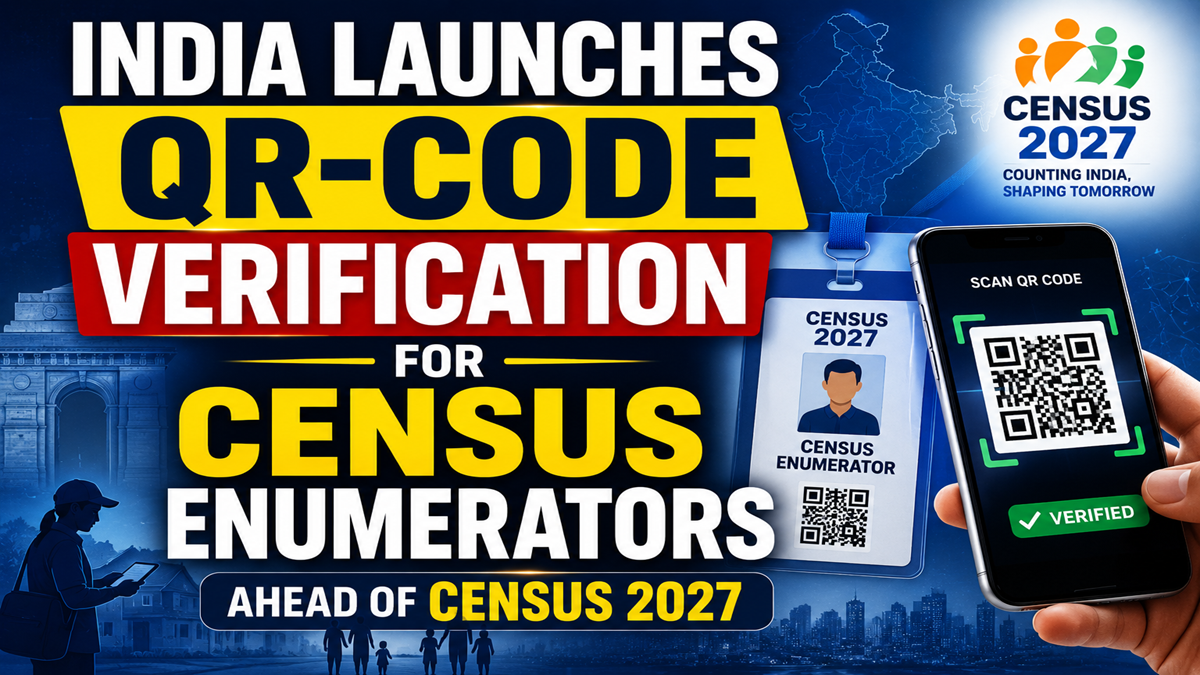
India has introduced QR-code-enabled identity cards for Census enumerators as part of the upcoming Census 2027 exercise. The new system allows residents to verify the authenticity of Census staff by scanning the QR code using a mobile device.
The move is part of the government’s larger digital Census framework aimed at improving transparency, security, and efficiency in data collection.
Why in News?
The government has started issuing QR-code identity cards to Census enumerators for the Census 2027 process.
The initiative is designed to help citizens easily verify field staff visiting homes during the Census exercise, especially in residential societies and urban areas.
The digital verification system is also being integrated with mobile applications and centralised Census portals.
Key Highlights
- QR-code identity cards issued to Census enumerators
- Citizens can verify enumerators using mobile devices
- Census 2027 first phase began on 1 April 2026
- Around 30 lakh enumerators involved nationwide
- Digital Census system includes mobile apps and central portals
- Self-enumeration facility introduced in selected areas
Census Enumeration and Digital Features
The first phase of Census 2027 started on April 1, 2026, and will continue till September 30, 2026.
The Census exercise is being carried out using a technology-driven framework that includes:
- Mobile applications
- Centralised data portals
- Real-time data transmission
- Live field monitoring systems
The government aims to reduce delays, improve accuracy, and strengthen monitoring through digital tools.
QR-Code Verification System Explained
Under the new system, every Census enumerator receives an identity card with a QR code.
How It Works
Residents can:
- Scan the QR code using a smartphone
- Verify the identity of the enumerator
- Confirm official Census assignment details
The verification system is especially useful in:
- Gated societies
- Urban residential areas
- Apartment complexes
- High-security residential zones
The initiative is intended to improve trust and prevent impersonation during field visits.
Self-Enumeration Facility for Citizens
The government has also introduced the Census of India Self-Enumeration Portal.
This portal allows citizens to:
- Submit Census details online
- Generate self-enumeration IDs
- Reduce dependence on physical visits
In some locations, including Noida and Ghaziabad, the self-enumeration window remained open from May 7 to May 21, 2026.
Authorities also provided QR-code-based access for generating unique self-enumeration IDs.
Importance of Digital Census Systems
India’s upcoming Census is expected to be one of the country’s most technology-driven Census exercises.
Key Benefits
- Faster data collection
- Reduced manual errors
- Real-time monitoring
- Better transparency
- Improved authentication mechanisms
Digital systems are also expected to help improve coordination between field teams and administrative authorities.
Important Facts About Census in India
Constitutional and Legal Provisions
- Census is a Union subject under the Constitution of India
- Conducted under the Census Act, 1948
Census Process
India’s Census is generally conducted in two phases:
- House Listing
- Population Enumeration
The exercise is carried out nationwide by trained enumerators appointed by the government.
Significance of the QR-Code Initiative
The introduction of QR-code verification reflects India’s increasing focus on digital governance and citizen-centric administration.
The move is expected to:
- Increase public confidence
- Improve security during field surveys
- Strengthen digital administration
- Make Census operations more transparent
It also aligns with the government’s broader push toward digital public infrastructure and paperless governance systems.





 India Plans Mandatory Automatic Emergenc...
 India Notifies New Telecom Rules for Tes...
 MeitY Forms Special Team to Investigate ...