
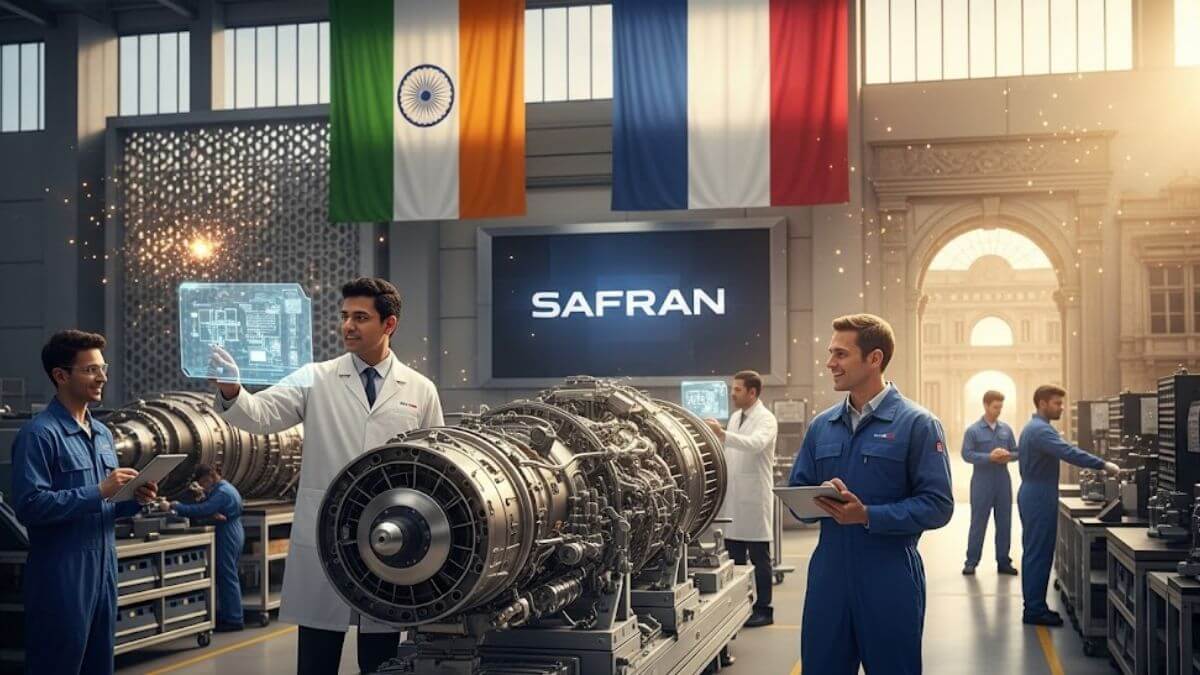
In a landmark move aimed at bolstering India’s aerospace self-reliance, Defence Minister Rajnath Singh announced a strategic partnership between India and French aerospace major Safran to co-develop and manufacture jet engines domestically. These engines will power the upcoming Advanced Medium Combat Aircraft (AMCA)—India’s indigenously designed fifth-generation stealth fighter jet.
This collaboration reflects not just technology transfer but a long-term investment in defence manufacturing and innovation, enhancing India’s capability to develop cutting-edge aerospace systems.
AMCA: India’s Fifth-Generation Fighter Jet
The AMCA project, greenlit by the Cabinet Committee on Security (CCS) in 2024, is a ₹15,000 crore mission to design and prototype a fifth-generation fighter aircraft. This aircraft is being developed by the Defence Research and Development Organisation (DRDO) and Hindustan Aeronautics Limited (HAL).
AMCA will be developed in two variants,
- Mark 1: Powered by existing engines.
- Mark 2: Expected to use the new co-developed engine with higher thrust capacity (110 kN).
Details of the India–France Jet Engine Collaboration
- French partner: Safran, a globally recognized aerospace engine manufacturer.
- Indian partners: DRDO and HAL, under the Ministry of Defence.
- Project focus: Development and manufacturing of a powerful new engine domestically with end-to-end technology sharing and local production.
- The proposed engine will have a thrust rating of 110 kiloNewtons (kN), surpassing the capabilities of current operational engines globally.
- The development of a new-generation engine is expected to take around a decade, with the roadmap already prepared by Safran and DRDO.
Strategic Significance of the Partnership
This partnership brings several long-term benefits:=,
- Technological Sovereignty: India gains critical engine-making know-how, traditionally a major gap in its defence ecosystem.
- Strengthens “Make in India”: Aligns with the government’s push for indigenous defence production and reduced reliance on imports.
- Boosts Export Potential: A domestically powered 5th-gen fighter aircraft can open global markets for India’s defence exports.
- Enhances Strategic Ties with France: Adds another high-tech layer to the deepening India–France defence relationship.
Background: Why Engine Tech Matters
Jet engines are among the most complex and high-precision technologies in aerospace. While India has made strides in designing aircraft and satellites, jet engine manufacturing has remained a major technological gap.
Past attempts like Kaveri engine faced technical and funding hurdles, making international collaboration essential. The current deal with Safran is expected to revive indigenous efforts with enhanced expertise and structured timelines.


 Indian Navy INS Aridaman: Features, Role...
 INS Taragiri Commissioned - What Makes T...
 India's Defense Exports Hit Record ₹38,4...











