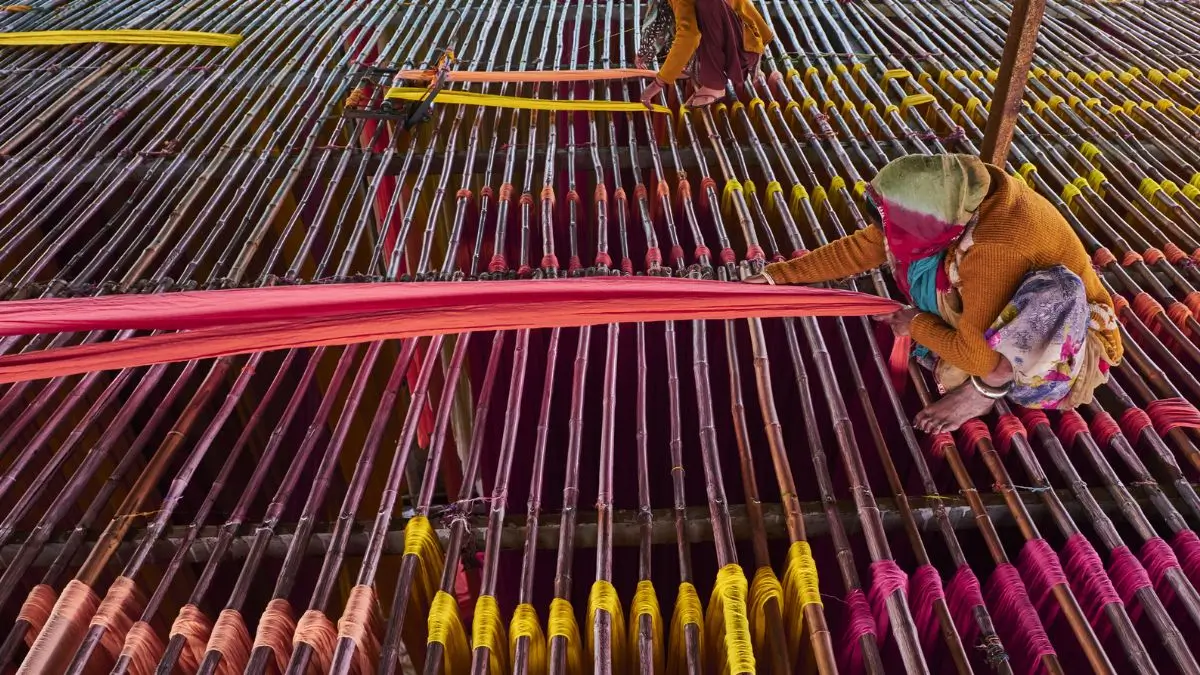
India’s textile sector have performed well as the exports grown by the 2.1% in FY 2025-26. For the FY 2025-26 the numbers stood at ₹3,16,334.9 crore which is higher than the last year cycle number which was at ₹3,09,859 crore. This steady rise showcase the strong global demand and country’s competitiveness across the various textile products.
Ready-Made Garments Leads Export Growth
Among the all segments the Ready-Made Garments (RMG) remained the largest contributor to textile exports growth.
The exports have increased from the ₹1,35,427.6 crore to ₹1,39,349.6 crore.
Also the growth rate stood at 2.9%.
RMG continues to dominate because of the strong international demand, efficient manufacturing and country’s established position in the global apparel markets.
Segment-Wise Performance of Textile Exports
The textile sector showed the mixed but stable performance across different categories.
- Cotton yarn, fabrics and handloom products have grew marginally by 0.4% and reached at ₹1,02,399.7 crore
- Man-made textiles have registered the stronger growth of 3.6% and it rising to ₹42,687.8 crore.
- Also the handicrafts had emerged as the fastest-growing segment with 6.1% growth and reaching ₹15,855.1 crore.
This diversification of the products highlights the balanced growth of sector across the both traditional and modern textile categories.
Global Market Expansion
India’s textile exports expanded across more than the 120 world destinations which indicates the strong geographical diversification.
Notable growth in key markets includes the country like,
- UAE: 22.3%
- UK: 7.8%
- Germany: 9.9%
- Spain: 15.5%
- Japan: 20.6%
- Egypt: 38.3%
- Nigeria: 21.4%
- Senegal: 54.4%
- Sudan: 205.6%
This wide expansion have reduced the dependency on a few markets and strengthens India’s global trade position.
Government Schemes Which Supporting Textile Exports
The Ministry of Textiles continues to support the exporters through key policy measures such as,
- Rebate of State and Central Taxes and Levies (RoSCTL)
- Remission of Duties and Taxes on Exported Products (RoDTEP)
Both these schemes have been extended beyond the March 31, 2026 and have ensured the continued financial support and the global competitiveness for exporters.
Role Of Free Trade Agreements
India’s active FTA strategy during 2025-26 year is expected to significantly benefit the textile sector.
Major agreements includes the,
- India–EFTA Trade and Economic Partnership Agreement (TEPA) – Which will be effective from October 2025
- India–UK Comprehensive Economic and Trade Agreement (CETA)
- India–Oman Comprehensive Economic Partnership Agreement (CEPA)
- India–New Zealand FTA (announced)
- India–EU FTA (concluded in January 2026)
These agreements aim to improve market access, also to reduce tariffs on exports and strengthen the global supply chains.








 GST Council Removes Arrest Powers of Tax...
 World Bank Raises India’s GDP Growth F...
 Centre to Borrow ₹7.86 Trillion Throug...