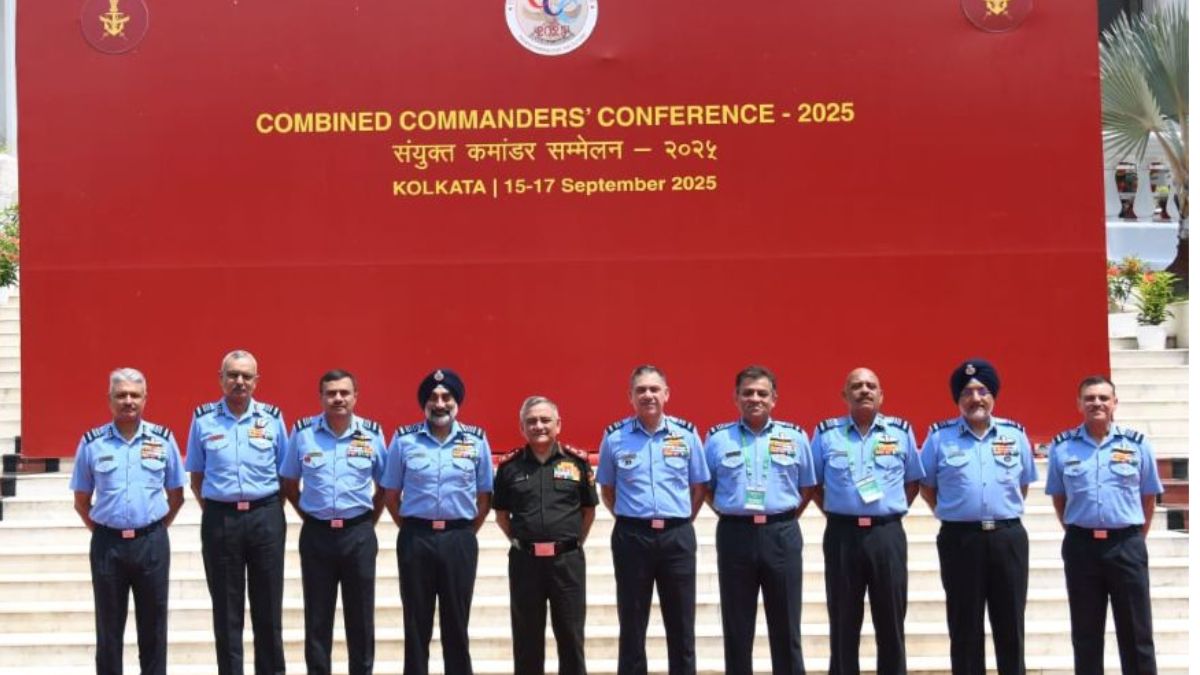
In a major stride toward modernizing and integrating the Indian Armed Forces, a series of critical decisions were announced at the conclusion of the Combined Commanders’ Conference (CCC) 2025. Among the most notable were, The merging of the education branches of the Indian Army, Navy, and Air Force to form a single Tri-Services Education Corps. The formation of three new Joint Military Stations. These reforms are part of a broader vision to make the Indian military more unified, efficient, and future-ready, in line with the directives of the Prime Minister and Defence Minister.
What Is the Tri-Services Education Corps?
The new Tri-Services Education Corps will integrate the separate education branches of all three military services. These branches are responsible for,
- Enhancing educational standards of personnel.
- Posting staff across training centres, garrisons, military schools, sainik schools, selection centres, and other establishments.
- Supporting literacy, academic training, and officer education.
By merging these, the Indian Armed Forces aim to,
- Avoid redundancy across services.
- Share educational resources and best practices.
- Promote a joint mindset from the early training stages.
- Improve efficiency in curriculum design, language training, and academic development.
This also aligns with the push for joint military doctrine and joint warfighting capabilities.
Establishment of Joint Military Stations
Alongside educational reforms, it was announced that three Joint Military Stations will be created. These stations are expected to,
- House personnel and equipment from all three services.
- Enable integrated training, logistics, and operations.
- Improve coordination and joint combat readiness.
- Provide infrastructure for families, support units, and civil-military cooperation.
Joint military bases represent a key structural shift in how India organizes its defence forces and aims to reduce inter-service silos in both peacetime operations and combat scenarios.
Strategic Importance: Why This Reform Matters
These decisions follow recommendations from top military leadership and guidance from the Chief of Defence Staff (CDS), who reviewed implementation timelines based on national defence directives.
Key Benefits
- Greater synergy betwneen Army, Navy, and Air Force.
- Optimized resource allocation and manpower usage.
- Enhanced focus on inter-operability, especially in joint operations.
- Step toward theatre command structure India is gradually moving toward.
These reforms are crucial in the context of emerging hybrid warfare, rapid tech evolution (AI, drones, cyber warfare), and the need for inter-service coordination in crisis scenarios.
Static Facts
- Event Combined Commanders’ Conference 2025
- Key Announcement 1: Formation of Tri-Services Education Corps
- Key Announcement 2: Establishment of three Joint Military Stations
- Announced by: Chiefs of Army, Navy, Air Force; reviewed by CDS
- Objective: Jointness, integration, future readiness of armed forces


 BRO's Project Chetak Turns 47: How It St...
 Indian Navy INS Aridaman: Features, Role...
 INS Taragiri Commissioned - What Makes T...