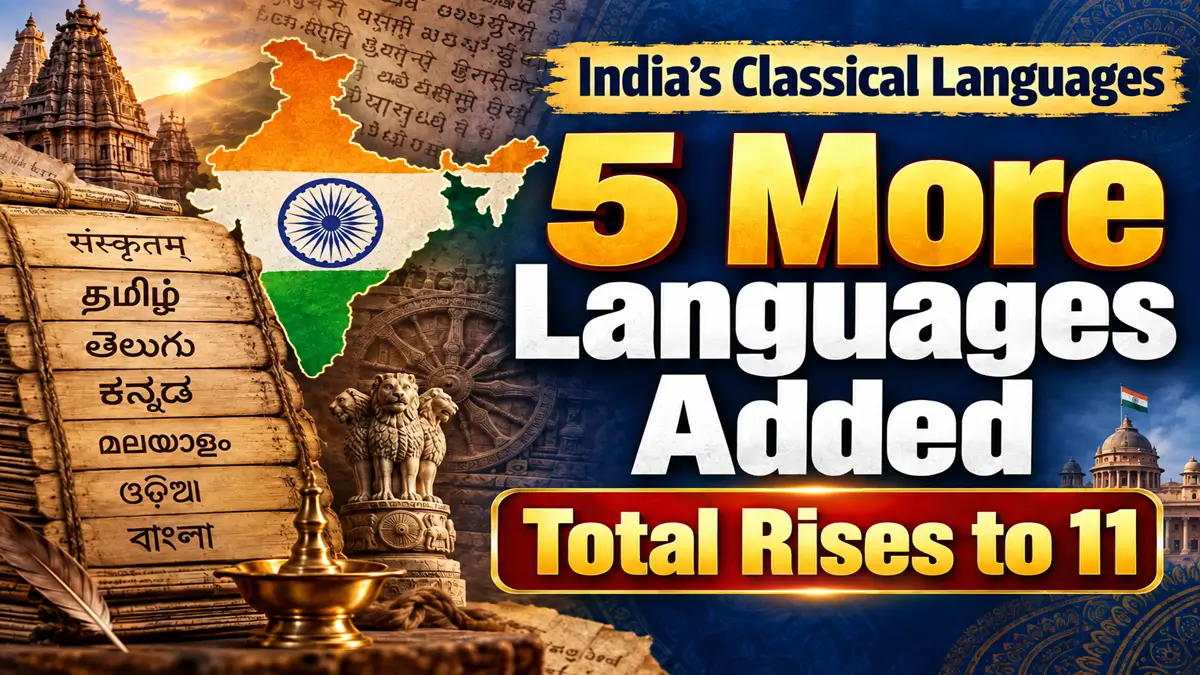
India has expanded its list of Classical Languages by granting the status to Marathi, Pali, Prakrit, Assamese and Bengali. With this addition, the total number of Classical Languages in India has increased from 6 to 11.
The decision highlights India’s rich linguistic heritage and recognises the historical, literary and cultural importance of these languages.
What is a Classical Language?
A Classical Language is a language that has:
- A long and documented history
- Ancient literary traditions
- Significant cultural and historical importance
- A body of classical literature and inscriptions
- A tradition that is distinct from its modern form
The recognition is granted by the Government of India based on linguistic, literary and historical criteria.
Total Classical Languages in India
India now has 11 Classical Languages:
- Tamil
- Sanskrit
- Telugu
- Kannada
- Malayalam
- Odia
- Marathi
- Pali
- Prakrit
- Assamese
- Bengali
Classical Languages and Recognition Year
| Language | Classical Status Granted |
|---|---|
| Tamil | 2004 |
| Sanskrit | 2005 |
| Telugu | 2008 |
| Kannada | 2008 |
| Malayalam | 2013 |
| Odia | 2014 |
| Marathi | 2024 |
| Pali | 2024 |
| Prakrit | 2024 |
| Assamese | 2024 |
| Bengali | 2024 |
Which is India’s Oldest Language?
The question “Which is India’s oldest language?” depends on the criterion being used.
Tamil is widely regarded as one of the oldest continuously spoken living languages in the world and was also the first Indian language to receive Classical Language status in 2004.
Sanskrit, meanwhile, has one of India’s oldest literary traditions, especially through the Vedic texts.
Therefore, for competitive exams, it is safer to remember:
Tamil was the first language to be granted Classical Language status in India.
Tamil
Tamil belongs to the Dravidian language family.
It has a very old literary tradition, including Sangam literature, and early Tamil-Brahmi inscriptions provide evidence of its ancient use.
Tamil received Classical Language status in 2004.
Sanskrit
Sanskrit belongs to the Indo-Aryan language family.
Its ancient form, Vedic Sanskrit, is associated with the Vedas and represents one of the oldest literary traditions in India.
Sanskrit was granted Classical Language status in 2005.
Kannada and Telugu
Both Kannada and Telugu belong to the Dravidian language family.
They were granted Classical Language status in 2008.
Kannada has a long inscriptional tradition, while Telugu has a rich literary and historical heritage in southern India.
Malayalam and Odia
Malayalam received Classical Language status in 2013.
Odia became a Classical Language in 2014.
Before the 2024 expansion, these six languages formed India’s complete list of Classical Languages.
Five Languages Added in 2024
The Government added the following five languages to the Classical Language list:
- Marathi
- Pali
- Prakrit
- Assamese
- Bengali
This increased the total number of recognised Classical Languages from 6 to 11.
Why is Classical Language Status Important?
Classical Language status helps promote:
- Preservation of ancient texts
- Linguistic research
- Translation and documentation
- Academic studies
- Cultural heritage conservation
- Teaching and promotion of classical literature
It also strengthens institutional support for the study and preservation of these languages.






 Agasthyamalai Biosphere Reserve Records ...
 Vastra Utsav 2026 Celebrates India's Tex...
 Kalpasar Project: Gujarat's Ambitious Mu...