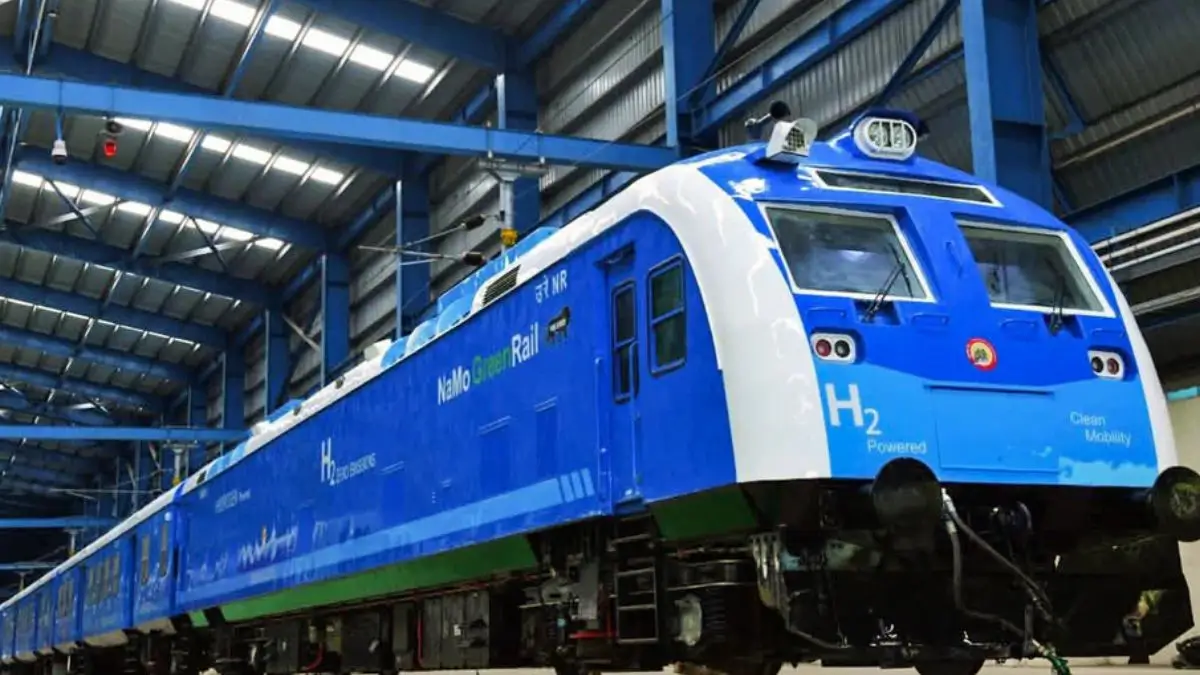
Indian railways set to launch India’s first Hydrogen Fuel Cell Train, the train was developed with domestic technology and with the assistance of the hydrogen ecosystem located in Jind, Haryana, the train that produces electricity on board with the help of hydrogen fuel cells with the only by-product being water vapour. The train can take around 2,600 passengers, all advanced multi-layer safety systems, along with nearly zero emissions, are installed on board the Hydrogen Fuel Cell Train, which can be regarded asthe India’s movement towards clean energy provision and technological advancement in order to make the railway system greener.
About First Hydrogen Fuel Cell Train in India
India’s Hydrogen Fuel Cell Train is a next-gen railway vehicle that generates electricity onboard using the hydrogen fuel cells instead of conventional diesel engines or above-ground electric systems.
In comparison with the normal trains, hydrogen stored in the tanks onboard the train reacts with oxygen to produce electricity through PEM (Proton Exchange Membrane) Fuel Cells.
This is used to operate the engines of the train, and the only output is steam, which makes it one of the cleanest technologies for the railways.
This project symbolizes a giant step towards the sustainable and low carbon transport in India.
What Makes This Train an Importanbt Symbol for Indian Railways?
Indian Railways has made significant strides in to electrifying over 99% of its broad gauge network, which has substantially cut down the use of diesel.
The Hydrogen Fuel Cell Train enhances this transition even further by,
- Stopping carbon emissions during its operation.
- Generating electricity while on the board.
- Aiding India in transition to clean energy.
- Proving the capability the technology sector of the country possesses.
- Contributing to the National Green Hydrogen Mission.
- Creating a new possibility in supporting with the Net Zero goals of the country.
It marks a new era in the history of the railway propulsion system from steam to diesel, and now to electric and hydrogen propulsion system.
How Does a Hydrogen Fuel Cell Train Function?
Instead of just utilizing fossil fuel combustion like diesel trains do, the train has a miniature power plant that is made up of the Proton Exchange Membrane (PEM) Fuel Cells.
The procedure is as follows the,
- Hydrogen from the storage tanks on the train enters the fuel cell.
- Oxygen is sourced from the air.
- Electrochemical reaction takes place.
- Electricity is generated.
- Electricity is sent to the traction motors.
- Only steam and heat are emitted as by-products.
Unlike the diesel engines, there is no fire, no emissions and no waste products.
To summarize,
- Hydrogen + Oxygen → Electricity + Steam + Heat
Technical Specifications of India’s Hydrogen Train
The Commissioning of the new Hydrogen Train has been accomplished for the mass passenger transport from one place to other.
Key Features
- Train Structure: 10 cars
- Passenger Capacity: Approximately 2,600 passengers
- Power Cars: 2 Hydrogen Power Cars
- Trailer Cars: 8
- Power Production: 1,200 kW (1,600 hp) per Power Car
- Total Power: 2,400 kW
- Operating Speed: 75 km/h
- Maximum Design Speed: 110 km/h
This technology positions the hydrogen train to be bigger than other hydrogen passenger trains currently operating throughout the globe which generally consist of only two to four cars.
Route and Operations
Initially, this train will be running in the segment from Jind to Sonipat under the Northern Railway.
Major Stations in the Route
- Jind Junction
- Jind City
- Pandu Pindara Junction
- Gohana Junction
- Bhambhewa
- Butana
- Mohana
- Sonipat
- Sonipat New
The 89 kilometers section has been identified for the assessment of the performance, safety, and efficiency of the hydraulic passenger trains under normal railway conditions.
India’s First Hydrogen Refuelling Facility in Jind
A major highlight of the project is the establishment of the largest hydrogen refuelling centre for trains in India at Jind in Haryana.
The integrated centre comprises of the,
Hydrogen Production
Hydrogen is obtained through electrolysis, the process of splitting the water into the hydrogen and oxygen with the help of electricity.
Hydrogen Storage.
The created hydrogen is stored in specially designed containers.
Compression.
Hydrogen is compressed by applying a pressure of around 500 b.
Refuelling
The hydrogen used to refuel the train comes from two dispensers operating at 350 bar at the same time so that both motor cars are refuelled.
Storage Capacity
The capacity of the centre is approximately of 3000 kg which is enough to cater to the regular needs for train operations.
Safety Approaches with the Advanced Multi-Level Systems
Hydrogen being highly combustible necessitates ensuring safety.
Indian Railways has put in the multiple independent safety mechanisms for the safety of people and its operations.
Main Safety Components
- Regular hydrogen leak detection.
- Flame detection devices.
- Smoke detecting devices.
- Heating monitoring devices.
- Hydrogen shutting off devices.
- Continuous ventilation aimed at avoiding gas accumulation.
- Fire prevention devices.
- Water spraying systems.
- Out of ordinary mode of operation.
- Real-time monitoring systems within the cabin of a train.
Altogether these sets of protective mechanisms follow the internationally recognized rule of defence in depth that provides for a comprehensive safety solution rather than relying on only one element.
Global Safety Regulations
The hydrogen ecosystem is also designed according to the world-wide accepted standards such as the,
- NFPA-2
- ISO 19880 Series
The system also meets the legal requirements provided by PESO.
The project has undergone the procedure of independent assessment of safety by a third party organization TÜV SÜD, Germany, which is widely recognized testing and certification authority worldwide before it is brought to actual work.






 IMC 2026: PM Modi Highlights India’s 5...
 Government Unveils 2026-2030 Strategy to...
 Health Ministry to Launch JOSH Teams for...