
Introduction
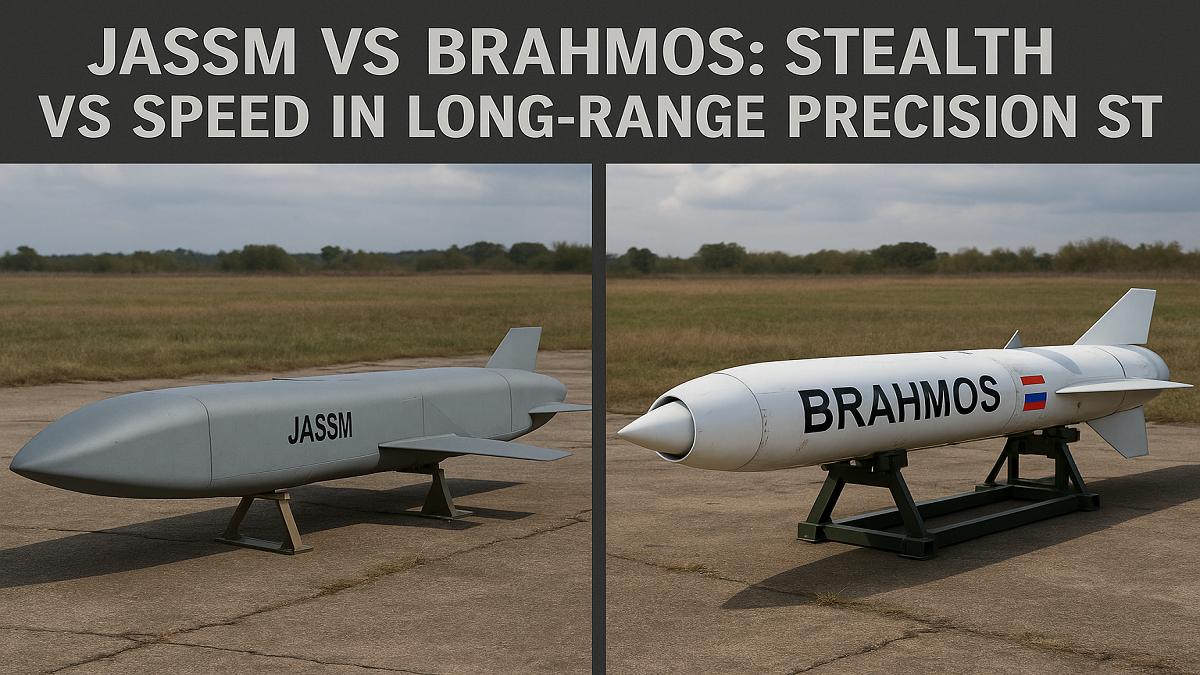
In modern warfare, air-launched long-range precision missiles play a pivotal role in enforcing deterrence, conducting strategic deep strikes, and neutralizing high-value targets. Two standout systems in this arena are the JASSM (Joint Air-to-Surface Standoff Missile) developed by the United States and the BrahMos, a product of Indo-Russian cooperation. These missiles represent different philosophies of missile design and deployment: stealth and precision in the JASSM, versus supersonic speed and brute force in the BrahMos.
BrahMos: The Supersonic Speedster
BrahMos is famous for being one of the world’s fastest cruise missiles. Developed jointly by India’s DRDO and Russia’s NPO Mashinostroyeniya, it is designed for land, sea, and air launch platforms. The air-launched BrahMos-A, integrated onto platforms like the Su-30MKI, can cover distances up to 500–800 kilometers and reach speeds of Mach 2.8 to Mach 3.5.
Key Features
- Speed and Kinetic Power: BrahMos’ high supersonic speed makes it extremely difficult to intercept and increases its kinetic energy upon impact.
- Versatile Launch Capability: Can be launched from aircraft, ships, submarines, and land-based platforms.
- Precision with Punch: It uses inertial navigation combined with guidance algorithms to accurately hit large, strategic targets.
- Hit-and-Run Capability: Its speed reduces enemy response time, making it ideal for offensive first-strike scenarios.
Operational Role
BrahMos is built for high-speed, high-impact strikes, often targeting enemy ships, bunkers, or military bases. It is particularly useful in “access denial” combat environments where quick offensive operations are preferred and early detection by the enemy must be avoided through sheer speed.
JASSM: The Stealthy Assassin
The JASSM, developed by Lockheed Martin, offers a counter-approach by emphasizing stealth, extended range, and precision. JASSM is a subsonic missile designed to avoid detection by enemy radar. The JASSM-ER (Extended Range) variant can reach targets over 900 kilometers away, allowing bombers and fighters to strike while remaining well outside enemy air defense zones.
Key Features
- Stealth Technology: Built with low-observable materials and a small radar cross-section, making it hard to detect.
- Subsonic Speed with Standoff Range: Though slower than BrahMos, its ability to maintain range and avoid detection is the key.
- Advanced Guidance Systems: Equipped with GPS and an imaging infrared seeker for accurate terminal targeting.
- Flexible Deployment: Can be used from a wide range of aircraft including the B-1B Lancer, B-2 Spirit, F-15E, and F-35.
Operational Role
JASSM is ideal for deep-strike missions against fortified enemy installations, command centers, or air defense systems. Its stealth enables it to slip past radar grids and deliver devastating strikes with minimal warning. It supports pre-planned operations where accuracy and survivability matter more than raw speed.
Comparative Overview: Stealth vs. Speed
| Feature | BrahMos | JASSM / JASSM-ER |
|---|---|---|
| Speed | Mach 2.8 to 3.5 (Supersonic) | Subsonic |
| Range | 500–800 km (air-launched variant) | 370 km (JASSM), up to 926 km (ER) |
| Warhead Capacity | Approx. 200–300 kg | Approx. 450 kg |
| Guidance | Inertial + GPS | GPS + Imaging Infrared |
| Stealth | Low | High |
| Launch Platforms | Aircraft, ships, subs, land | Fighters and bombers |
| Primary Strength | Speed and high-impact strike | Stealth and precision attack |
| Best Targets | Ships, airfields, mobile batteries | Bunkers, air defenses, HQ targets |
Design Philosophies and Strategic Deployment
The BrahMos reflects a doctrinal interest in overwhelming speed, allowing India and Russia to deliver quick blows in regional conflicts. Its supersonic velocity and versatility make it ideal for disabling critical naval or land targets in minimal time.
On the other hand, the JASSM focuses on strategic precision and survivability during long-range operations. The U.S. military’s need for global reach and covert first or second-strike ability makes stealth and flexibility indispensable.


 BRO's Project Chetak Turns 47: How It St...
 Indian Navy INS Aridaman: Features, Role...
 INS Taragiri Commissioned - What Makes T...











