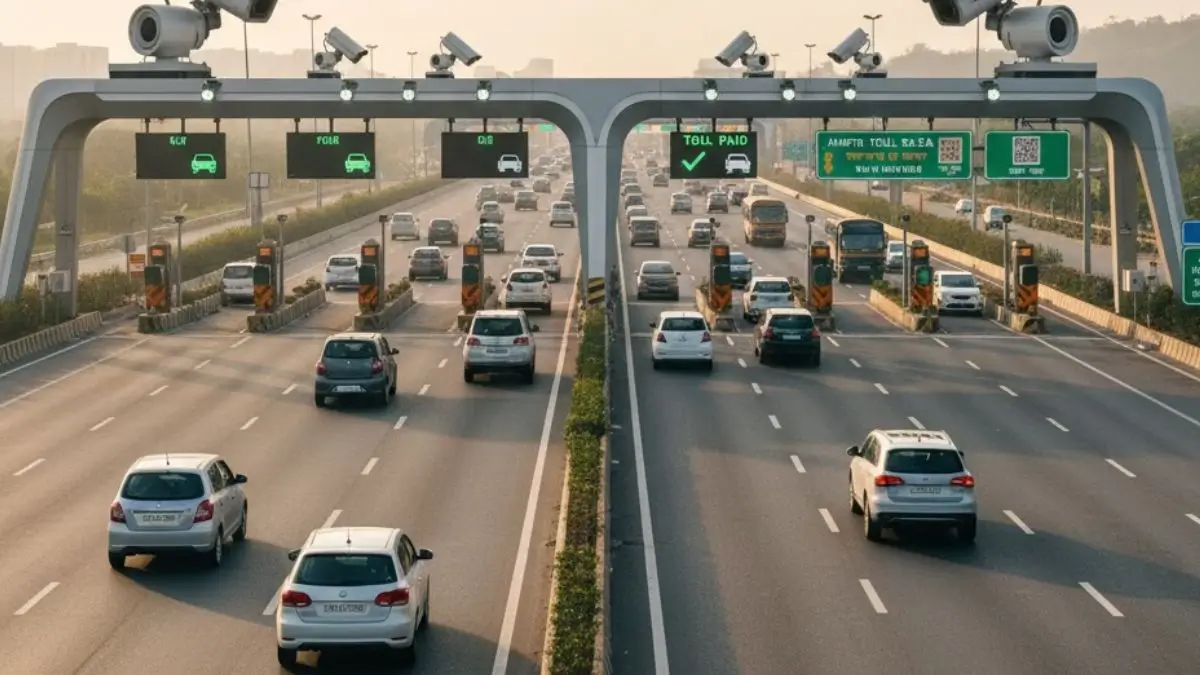
In a push toward digitised and seamless highway travel, Jio Payments Bank is set to implement Automatic Number Plate Recognition (ANPR)-based Multi-Lane Free Flow (MLFF) tolling at two major toll plazas on National Highway 48, between Gurugram and Jaipur. This pilot project aligns with the National Highways Authority of India’s (NHAI) broader goal to eliminate bottlenecks and ensure faster vehicular movement across the country’s key corridors.
Transitioning from FASTag to Barrier-Free Tolling
India’s toll collection has largely been driven by FASTag, using Radio-Frequency Identification (RFID) to automate toll payments. While effective, it still requires vehicles to slow down at toll booths. To address congestion and further streamline tolling, NHAI is piloting a new system—barrier-free, ANPR-driven tolling. The MLFF technology facilitates toll deduction without requiring vehicles to stop or even reduce speed, by automatically identifying and charging them using ANPR cameras and additional digital tracking tools.
Jio Payments Bank’s Role in the Pilot
- Jio Payments Bank (JPBL), a subsidiary of Jio Financial Services, has secured the contract to install and manage the MLFF system at the Shahjahanpur and Manoharpura toll plazas.
- This initiative marks a shift in tolling responsibility, where banks—not traditional toll operators—are now key players in managing payment and processing operations.
- JPBL has already been involved in toll collection at 11 plazas as an acquirer bank.
- With this new win, it becomes responsible for two out of the five MLFF sites selected in the pilot phase.
- The bank plans to integrate its operations with the wider Jio digital ecosystem, leveraging technologies like AI, cloud infrastructure, and real-time data processing to enhance efficiency.
How the ANPR-Based MLFF System Works
The Multi-Lane Free Flow system combines several digital technologies to identify, classify, and charge vehicles as they pass through tolling zones at normal speeds,
- ANPR Cameras: Capture license plate numbers instantly
- RFID Readers: Detect FASTag presence for validation
- Vehicle Classification Sensors: Determine vehicle type (car, truck, etc.)
- Backend Systems: Match data and deduct toll from the user’s FASTag wallet or account
If a vehicle doesn’t have a valid FASTag or isn’t linked correctly, it can still be charged based on its number plate, and e-challans may be issued for defaulters.
Benefits of the Barrier-Free Tolling System
- Faster Travel: Vehicles don’t need to queue or slow down
- Reduced Fuel Use: No idling means lower emissions and fuel consumption
- Greater Transparency: Automated systems reduce manual errors and revenue leakage
- Scalable Nationwide: NHAI plans to expand this to all 4-lane highways in the near future
- Bank-Fintech Integration: Banks like JPBL are evolving into infrastructure enablers, beyond traditional banking
Static Takeaways
- Jio Payments Bank is a subsidiary of Jio Financial Services.
- It will implement ANPR-based MLFF tolling at Shahjahanpur and Manoharpura toll plazas.
- The project is part of an NHAI pilot under the management of IHMCL.
- MLFF stands for Multi-Lane Free Flow, allowing barrier-free tolling.
- The technology uses ANPR, RFID (FASTag), and other sensors for toll deduction.


 Wipro Launches AI Hub at GIFT City: What...
 Shantanu Narayen to Step Down as Adobe C...
 Deloitte Opens ConnectSafe Cyber Securit...