
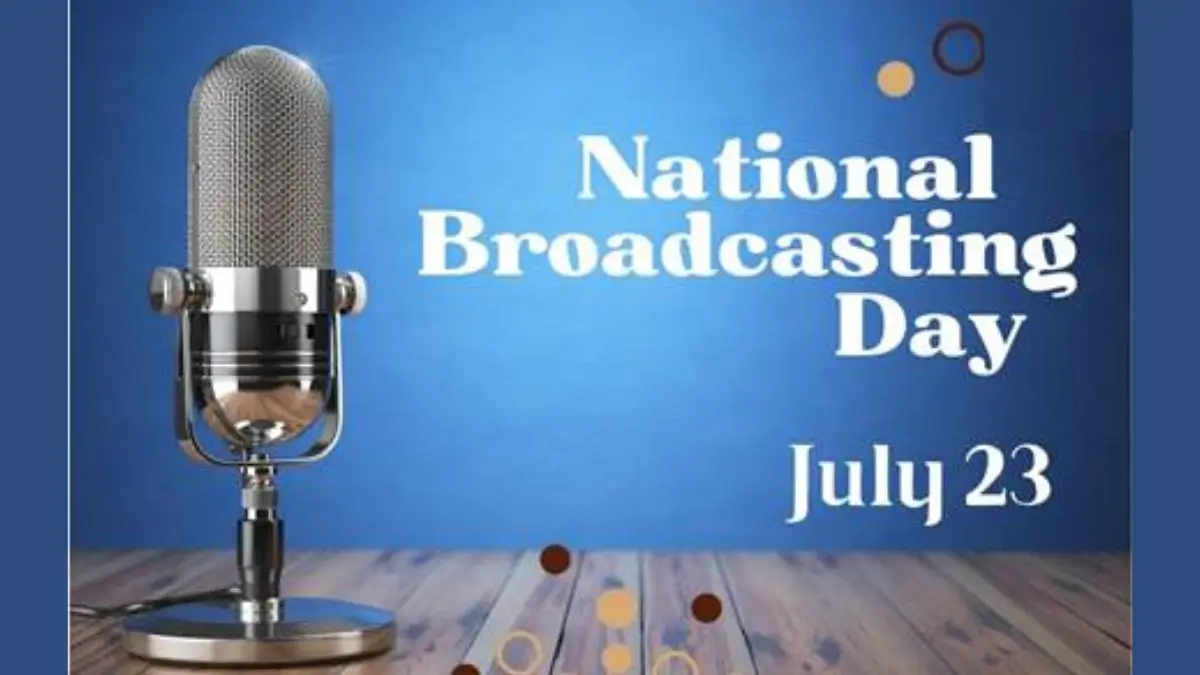
Every year, on July 23, India celebrates the National Broadcasting Day, a day to remember when the first-ever radio broadcast occurred in India on July 23, 1927, by the Indian Broadcasting Company in Bombay (Mumbai). Today, radio has turned from mere buzzing devices to FM stations, satellite broadcasting, internet radio, podcasts, and digital streaming sites. National Broadcasting Day appreciates the nation’s broadcasting tradition while celebrating the significance of audio media in the country’s life.
What is National Broadcasting Day?
National Broadcasting Day is celebrated on the anniversary of India’s first official radio broadcast, which occurred on July 23, 1927.
This day commemorates the evolution of broadcasting in India, starting from the early days of radio transmission to the present-day digital broadcasting world.
The event also acknowledges the efforts of many broadcasters, journalists, engineers, radio hosts, and different communication professionals for contributing to the development of effective communication across the nation.
The History of National Broadcasting Day
The broadcast history in India began during the rule of the British Raj and underwent a great deal of change over the last hundred years.
Some Important Event
- 1923: The first trial broadcast was conducted by the Radio Club of Bombay.
- 1924: The Calcutta Radio Club also started broadcasting.
- 23 July 1927: The Indian Broadcasting Company (IBC) made its first official radio broadcast in Bombay.
- 1930: After the IBC was liquidated, broadcasting became under the control of the Indian Government.
- April 1, 1930: The Indian State Broadcasting Service (ISBS) was created.
- June 8, 1936: The ISBS was renamed as All India Radio (AIR).
- 1957: AIR adopted the popular name Akashvani, which is still widely known.
These were the milestones that laid the foundation of one of the largest public broadcasting network in the world.
The Importance of National Broadcasting Day
For almost one hundred years, broadcasting has been one of the most reliable means of communication in India.
The importance of broadcasting includes the following,
- Providing authentic news to millions of people.
- Providing vital information to villagers who are not in touch with the government.
- Helping facilitate education through radio programmes.
- Promoting Indian languages and cultures.
- Providing communication during natural disasters.
- Supporting social awareness campaigns.
- Making democracy stronger by making citizens more informed.
Even though we live in the age of the internet, radio is still one of the most trusted communication forms due to its cheapness and easy access.
The Development of Broadcasting in India
The Age of Radio
- In the first years after independence, radio became the main form of mass media. Families used to sit together at the radio to obtain the news, listen to songs, and watch plays, sports commentaries, and educational programs.
- All India Radio (AIR) developed and expanded fast, connecting urban and rural audiences via various radio programs available in regional languages.
The Emergence of FM Radio
- The Indian broadcasting industry has changed dramatically with the launch of FM broadcasting on July 23, 1977, starting from Madras.
FM has provided,
- Clearer sound quality
- Programs mainly focused on music
- Popular radio jockeys
- City-specific content
- Entertainment for young people
Today, public and private FM stations provide a lot of entertainment to listeners across the country.
Digital Audio Revolution
Broadcasting has stepped into the new stage called,
- Internet radio
- Podcasts
- Audio streaming
- Smart speakers
- Mobile apps
- Audio content on demand
Nowadays, audience may use phone devices to get news, educational programs, interviews and entertainment whenever they wish.
All India Radio: The Backbone of Broadcasting in India
Founded in 1936, All India Radio (Akashvani) remains one of the largest public service broadcasters in the world.
Today, the AIR is,
- Operating hundreds of broadcasting centres.
- Catering to almost the entire Indian population.
- Broadcasting in 23 languages and various dialects.
- Providing news services, cultural programmes, music, sports coverage, educational content, and public service announcements.
For many years, AIR has been playing an important part during the elections, natural calamities, national celebrations, and emergencies by providing timely and accurate information.
Broadcasting In Today’s World
The evolution of technology has had a remarkable influence on broadcasting without changing its essence. Broadcasters at present have blended conventional radio with,
- Broadcasting live
- Using mobile applications
- Getting connected through the social media networks
- Broadcasting podcasts
- Using connecters which have artificially intelligent suggestions
- Using devices with smart technology
Such convergence has helped broadcasters to connect with the youth while upholding the credibility developed in decades.
Interesting Facts About Indian Broadcasting
- India’s first-ever official radio broadcast was made on July 23, 1927.
- All India Radio was founded on June 8, 1936.
- All India Radio became known as Akashvani in 1957.
- FM broadcasting started officially on July 23, 1977, in Chennai.
- All India Radio broadcasts programs in 23 languages and many dialects.
- India owns one of the biggest public broadcasting stations of the world.
- Before he became an actor, Amitabh Bachchan was said to be failed in getting hired by All India Radio.
- Harmonious sounds had restrictions in use for classical broadcasting on AIR between 1940 and 1971.








 International Day for Disaster Risk Redu...
 National Human Rights Commission to Mark...
 World Arthritis Day 2026: Date, Theme, H...










