
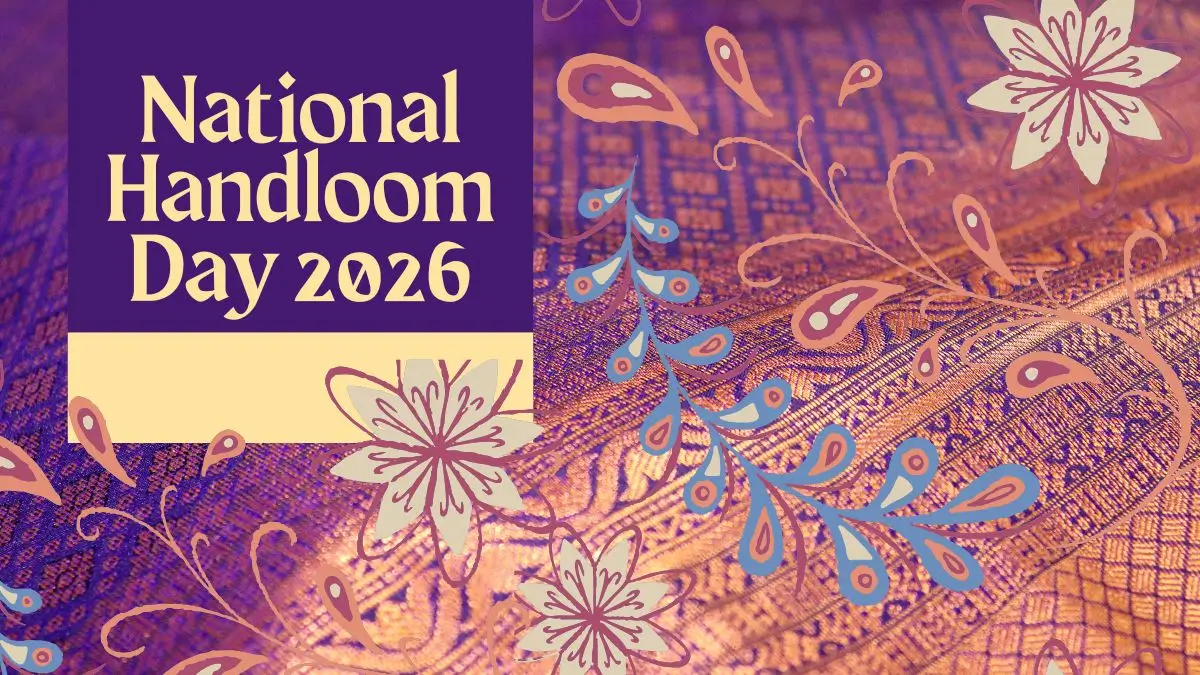
The National Handloom Day 2026 in India is observed on 7th August to pay homage to the rich handloom legacy of the nation and salute the invaluable role of weavers and artisans in the handloom sector. The yearly celebration celebrates the Swadeshi Movement that started on 7 August 1905 and promoted the usage of indigenous products.
National Handloom Day 2026
Every year, India observes National Handloom Day on 7 August.
The theme of the National Handloom Day 2026 has not been disclosed yet by the Ministry of Textiles.
As expected, the celebrations will highlight the preservation of traditional weaving heritage, empowerment of artisans, promotion of sustainable textiles and encouragement of consumers in purchasing authentic handloom products as part of “Vocal for Local” campaign.
Why Is National Handloom Day Celebrated?
The observance of National Handloom Day commemorates the anniversary of Swadeshi Movement, which started on 7 August 1905 in Calcutta Town Hall.
In particular, this movement encouraged Indians to shun foreign products and opt for locally made products, including handwoven fabrics.
Taking into account the significance of this movement and the role played by weavers, the Government of India designated 7 August as National Handloom Day. The first observance of National Handloom Day took place on 7 August 2015.
Significance of National Handloom Day
National Handloom Day focuses on the importance of the handloom sector in the economic and cultural significance of India.
It intends to,
- Honor the commitment and talent of handloom weavers.
- Save India’s rich textile culture and indigenous weaving skills.
- Encourage environmentally friendly fashion.
- Create job opportunities in rural and semi-urban areas.
- Promote the handloom workers, who are mostly women.
- Make consumers buy genuine Indian handlooms.
- Enhance awareness about India’s varied textile culture and encourage exports.
Well-known Handloom Cultures of India
India possesses some of the best hand-woven cloth in the world, representing regional excellence and distinctiveness.
Some of the well-known handloom cultures are as follows,
- Banarasi Silk (Uttar Pradesh) – For luxurious silk sarees with zari embroidery.
- Kanchipuram Silk (Tamil Nadu) – For colorful silk sarees with gold borders.
- Jamdani (West Bengal) – For delicate muslin weaving and flowers patterns.
- Sambalpuri Ikat (Odisha) – For its famous tie and dye method of weaving.
- Pochampally Ikat (Telangana) – For geometrical patterns of weaving.
- Paithani (Maharashtra) – For silk sarees woven with designs of peacock and lotus.
- Chanderi and Maheshwari (Madhya Pradesh) – For elegant weaving styles.
- Muga Silk (Assam) – For its golden color.
- Bhagalpuri Silk (Bihar) – For eco-friendly Tussar silk.
- Kota Doria (Rajasthan) and Kasavu (Kerala) – For its unique traditional patterns.
- Bandhani (Gujarat) – For its meticulous tying and dyeing of fabric using traditional methods
Initiatives by the Government to Aid the Handloom Industry
The Government of India has brought out various schemes for the development of the handloom sector and improvement in the living standards of weavers.
Some of the important initiatives are,
- National Handloom Development Programme (NHDP)
- India Handloom Brand (IHB)
- Yarn Supply Scheme (YSS)
- Comprehensive Handloom Cluster Development Scheme (CHCDS)
- Raw Material Supply Scheme (RMSS)
- Handloom Marketing Assistance (HMA)
- National Handloom Expos
- Weaver MUDRA Scheme
- Handloom Export Promotion Schemes








 World Post Day 2026: Why October 9 Is Ob...
 Indian Air Force Day 2026: 94th Annivers...
 World Space Week 2026 Celebrated with Th...










